Absence of Evidence Is Evidence: Why No HNW Firm Runs Paid Acquisition at Scale
A Strange Asymmetry in the Public Record
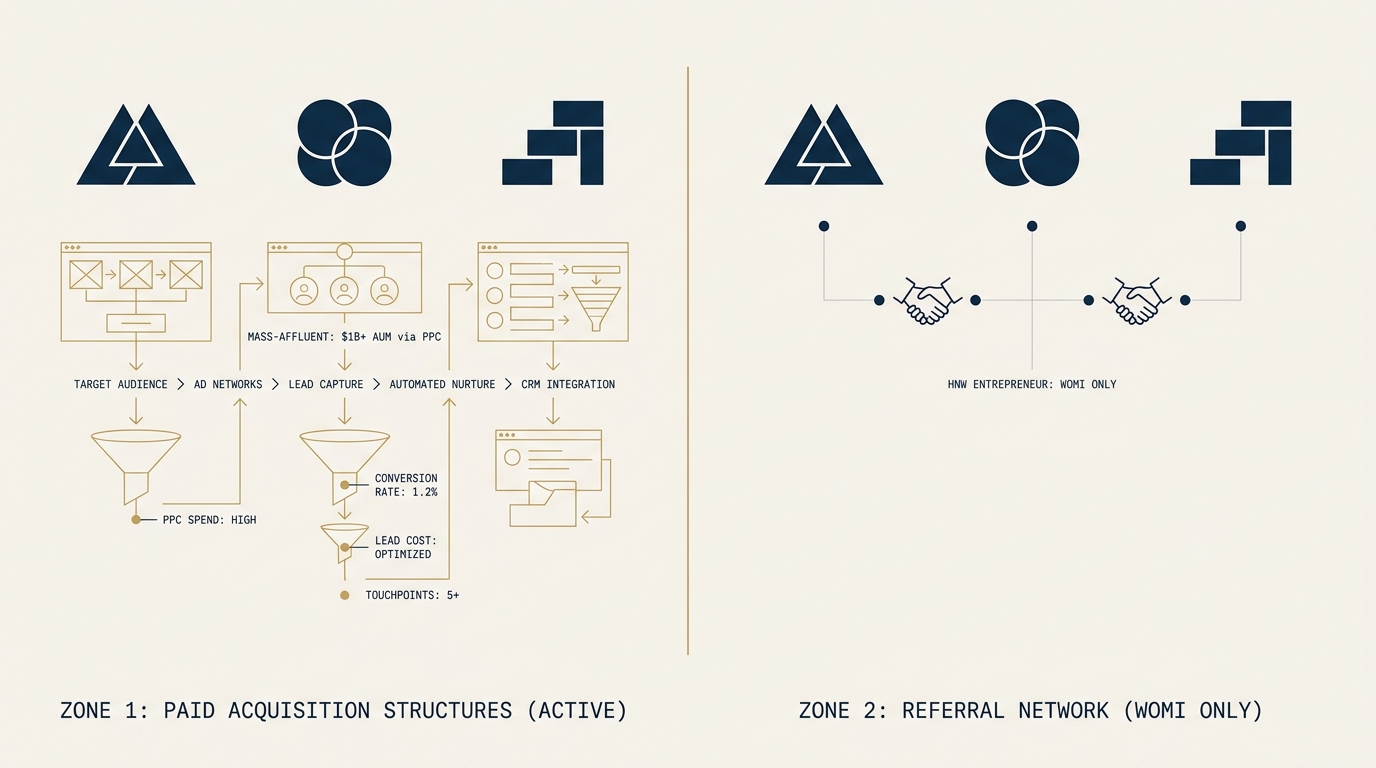
When you research the public record for paid acquisition case studies in wealth management, a strange asymmetry surfaces. The well-known success stories all serve one avatar. The avatar that most performance marketers assume their HNW (high-net-worth) advisor client is targeting has zero documented success cases.
Fisher Investments operates more than $387 billion in Assets Under Management (AUM) with over 200,000 clients globally as of early 2026. Their model is pure direct response: television, digital advertising, content offers, telemarketing follow-up. Fisher’s job postings explicitly describe building “direct response-oriented digital media campaigns” across Google, Facebook, and LinkedIn. Their stated target is pre-retirees and retirees with $500,000 to $5 million in investable assets, with a stated minimum portfolio of $1 million. The avatar is mass-affluent retiree, not entrepreneur.
Edelman Financial Engines reports over $326 billion in AUM with more than one million clients as of end-2025. They built on radio, television, books, and brand media, with a heavy mass-affluent retirement orientation. Similar economics, similar avatar.
Pure Financial Advisors, the most-cited paid-acquisition success story in advisory, generated more than $1 billion in new AUM through SmartAsset’s referral platform as of May 2024. The interesting detail is in SmartAsset’s published methodology: their model assumes a 4% close rate and an average household asset level under $1 million. The success is real. The avatar is, again, not HNW entrepreneur.
The pattern across the three best-documented success cases is clear. Mass-affluent retiree. Sub-million-dollar typical household assets. Standardized service offerings that scale across thousands of clients. PPC works in this segment. The case studies are abundant.
The Firms That Are Absent
The asymmetry is what is missing. The firms most successful at acquiring 7+ figure entrepreneur and ultra-high-net-worth (UHNW) clients (the avatar that most performance marketers assume their advisory clients are targeting) are systematically absent from the paid-acquisition case study literature.
I have checked the public record on:
- Iconiq Capital, described by Bloomberg as “famously secretive,” which acquires clients through founder-level introductions.
- Pathstone, approximately $116 billion AUM, growth through founder networks and acquisitions.
- Cresset Capital, more than $237 billion in Assets Under Advisement (AUA), growth through founder credibility and acquisitions.
- Brighton Jones, which uses AI personalization for content but does not run PPC at scale for entrepreneur acquisition.
- Tiedemann, Hall Capital, BBR Partners, Pitcairn, Ballentine Partners, GenSpring, AdvicePeriod, and Aspiriant.
None of them has a public case study of entrepreneur acquisition through PPC at scale. The closest adjacent firm to the HNW entrepreneur positioning, Wealth Factory, has opted out of paid digital entirely.
This is not a small sample. It covers most of the firms a sophisticated HNW prospect would shortlist in their advisor search. The firms with the deepest pockets, the most sophisticated marketing functions, and the strongest motivation to find a scalable paid channel have all converged on the same answer: PPC does not work at the HNW entrepreneur tier.
Why Absence of Evidence Counts as Evidence Here
The standard objection to “absence of evidence is evidence” is that the absence might reflect under-publication rather than under-performance. Firms that run successful PPC programs in this segment might simply not publicize them.
The objection does not survive scrutiny in this case. The reasons are structural:
Reason one: the firms with the strongest motivation to publicize their success have not. Boutique HNW advisory firms compete on credibility. A documented growth case study is a credibility asset. Firms that have built billion-dollar AUM businesses through PPC would, all else equal, publicize that fact because it would generate inbound interest from prospects considering similar economic profiles. The absence of these case studies is not a publication failure.
Reason two: the marketing function at these firms is large enough that successful programs would surface. Iconiq, Pathstone, and Cresset all operate sophisticated marketing functions with named Chief Marketing Officers and substantial budgets. A successful PPC program at any of them would be visible in industry trade press, in Chief Marketing Officer (CMO) panel discussions, in agency case studies, and in vendor testimonials. None of those signals exists.
Reason three: the agency ecosystem would have documented the cases. Performance marketing agencies actively publish case studies as new-business assets. The HNW entrepreneur tier is a high-prestige client base. An agency with a documented success case at this tier would publicize it aggressively. The absence of such case studies from agency portfolios is not a marketing failure; it is a non-existence of the underlying success.
The Structural Reason
The reason PPC does not work at the HNW entrepreneur tier is structural rather than tactical. Oechsli Institute research has documented, across more than a decade of replicated studies, that approximately 92% of HNW investors discover their financial advisor through word-of-mouth-influence (WOMI). The other 8% are theoretically addressable through cold-acquisition channels.
The 8% is not a small market in absolute terms. It is a small market in proportion to the WOMI channel. More importantly, the cold-acquisition prospect at the HNW entrepreneur tier is highly discerning, well-credentialed, and well-networked. They are not impulse-converting on a paid ad. They are running multi-cycle due diligence that paid acquisition funnels are structurally not designed to support.
The firms that have built successful HNW practices have all converged on the same operational answer: invest in the WOMI engine (existing client referrals, professional Center of Influence networks, family office relationships, named-feature press placements), and treat their digital footprint as referral-validation infrastructure rather than as cold-acquisition discovery. The cold-acquisition addressable market is too small and too discerning to justify the operational complexity of running PPC at scale.
The Implication for Performance Marketers
The implication for performance marketers entering the advisory vertical is uncomfortable but worth confronting directly. If you are pitching PPC services to an HNW-focused advisory firm and proposing a Fisher Investments or Edelman style direct-response approach, you are proposing a model that the firms most likely to validate it have already rejected.
This does not mean PPC is impossible at the HNW tier. It means PPC at the HNW tier is bounded by definition. It is at most a thruster, not a core engine. The firms that have tested it carefully have concluded that the addressable cold market is too small, too discerning, and too expensive to justify the investment in proportion to the WOMI engine they are already running.
A disciplined PPC engagement at this tier is therefore structured as a calibrated experiment rather than as a growth-engine commitment. The economics, the threshold framing, and the kill criteria all have to match the bounded ceiling on what cold acquisition can produce. I cover the threshold framing in detail in a companion post on channel validation targets.
The Reframe
The absence-of-evidence argument is not an argument against PPC. It is an argument against the specific framing in which PPC is sold to HNW advisory firms as a path to scale.
The honest framing is that PPC at the HNW tier is a sleeve experiment with bounded upside, an empirically low probability of clearing typical Customer Acquisition Cost (CAC) ceilings, and a documented failure pattern at the closest comparable firms. Disciplined firms run the experiment with structured gates, locked kill criteria, and an explicit acknowledgment that the channel is not where the growth model’s load sits.
If you are an HNW advisory firm being pitched on PPC, the diagnostic question is whether your prospective marketer has read the public record on the segment. If they have, they will frame the engagement as a calibrated experiment. If they have not, they will frame it as a growth strategy. The first framing is defensible. The second is selling you the Fisher Investments playbook in a category where the playbook does not apply.
About the Author
Andrés Plashal
Author of the Assistive Agent Optimization (AAO) framework. Twenty years building search and measurement systems for B2B and SEC-regulated firms. Google Partner since 2017.
Credentials: UIUC Gies College of Business (Behavioral Science), Columbia College Chicago (Interactive Arts & Media). Member: American Marketing Association, GAABS, Paid Search Association. Published researcher (SCTE/NCTA).