Introducing Bayesian & Priors: Measure What AI Recommends
The Question No One Is Measuring
For 20 years, being on the first page of Google was enough. You ranked, traffic came, leads followed. The entire marketing measurement stack was built around that loop: impressions, clicks, sessions, conversions.
Then AI changed the game.
When someone asks ChatGPT for a recommendation, there is no page one. There is one answer. One recommendation. First page does not matter if you are not the answer.
And here is the problem: no marketing platform on the market can tell you whether your business is the one AI recommends. Not your CRM. Not your attribution tool. Not your SEO platform. Not your media mix model. None of them have a channel called “AI agent recommendations,” because until now, no one had a way to measure it.
That is why I built Bayesian & Priors.
What Bayesian & Priors Does
Bayesian & Priors is a marketing science consultancy that builds the only Marketing Mix Model with a dedicated AI agent channel.
The short version: we measure whether AI recommends your business, quantify the revenue impact when it does, and show you exactly where to invest to change the outcome when it does not.
The longer version involves 10 sequential gates, Bayesian econometrics, and a framework called DSCRI-ARGDW that I have been developing for the past year. But the core idea is simple.
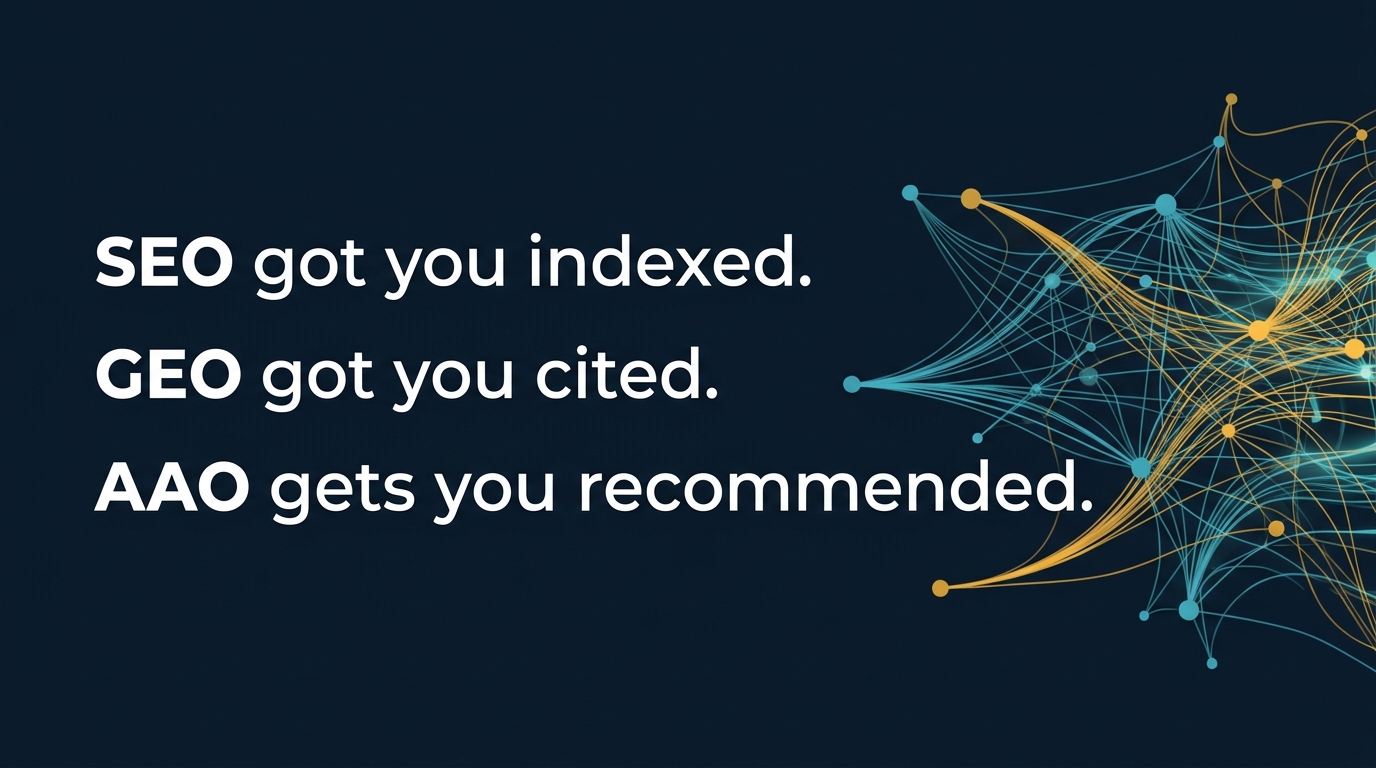
SEO got you indexed. GEO got you cited. AAO gets you recommended.
Assistive Agent Optimization is the discipline of ensuring your content survives the full decision pipeline that AI agents use when choosing what to recommend. I wrote about the 10-gate framework in detail here on this site. Bayesian & Priors is the company that turns that framework into measurement.
The Attribution Blind Spot That Is Not Accidental
Here is what nobody in the measurement industry wants to say out loud: the reason no platform can attribute revenue to AI recommendations is not a technical limitation. It is a structural one. And it looks purposeful.
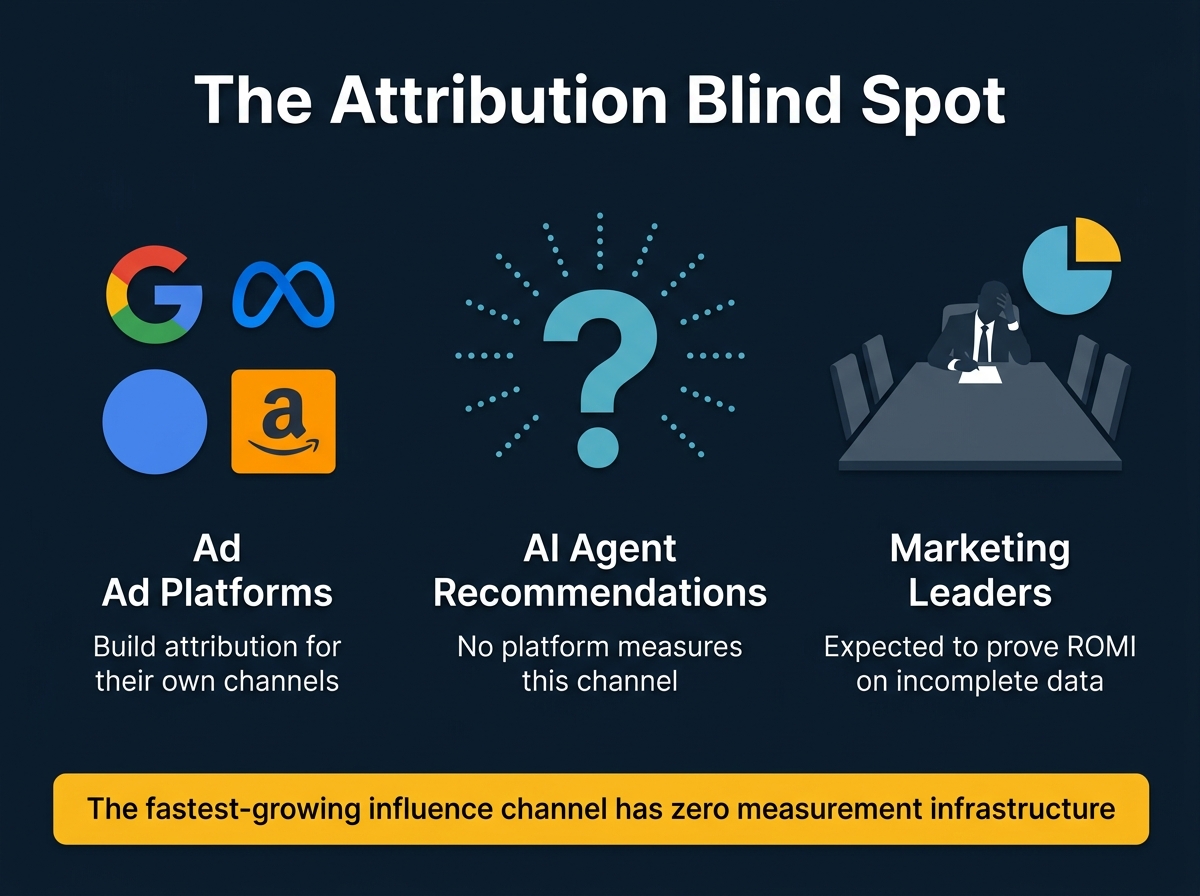
Google, Meta, Amazon: every major ad platform has spent a decade building closed-loop attribution that proves their channels drive revenue. They have every incentive to measure what happens inside their walls and zero incentive to measure what happens when an AI agent sends a buyer somewhere without a click, a cookie, or a tracking pixel.
AI agents do not generate impressions. They do not fire conversion pixels. They do not show up in your Google Analytics referral report. When ChatGPT tells a procurement director that your competitor’s platform is the best fit for their use case, that recommendation influences a six-figure decision and leaves no trace in any attribution model on the market.
This is not an oversight. The platforms that dominate marketing measurement are the same platforms that lose budget when a new channel proves its value. There is no rush to build instrumentation for a channel that competes with paid search and paid social for the same dollars.
Meanwhile, marketing leaders are walking into board meetings every quarter expected to justify every dollar with ROMI (Return on Marketing Investment). The CFO wants to see which channels are producing pipeline. The CEO wants to know where the next dollar of growth comes from. And the CMO is presenting a model that is structurally blind to the fastest-growing influence channel in the buyer’s journey.
That is the gap I built Bayesian & Priors to close.
Why This Matters More Every Quarter
I have spent 20 years in performance marketing. I have built attribution systems, managed eight-figure media budgets, and designed marketing operations for enterprise brands. And the pattern that led me to start this company is one I have seen before.
When paid search arrived, it took years before attribution models could properly weight it. When social media became a discovery channel, marketers treated it as a branding line item because they could not connect it to revenue. Every new channel goes through the same cycle. It matters, everyone knows it matters, but nobody can measure it, so it gets ignored in the budget model until someone builds the instrumentation.
AI-mediated recommendations are that channel right now. But this time, the trajectory is steeper.
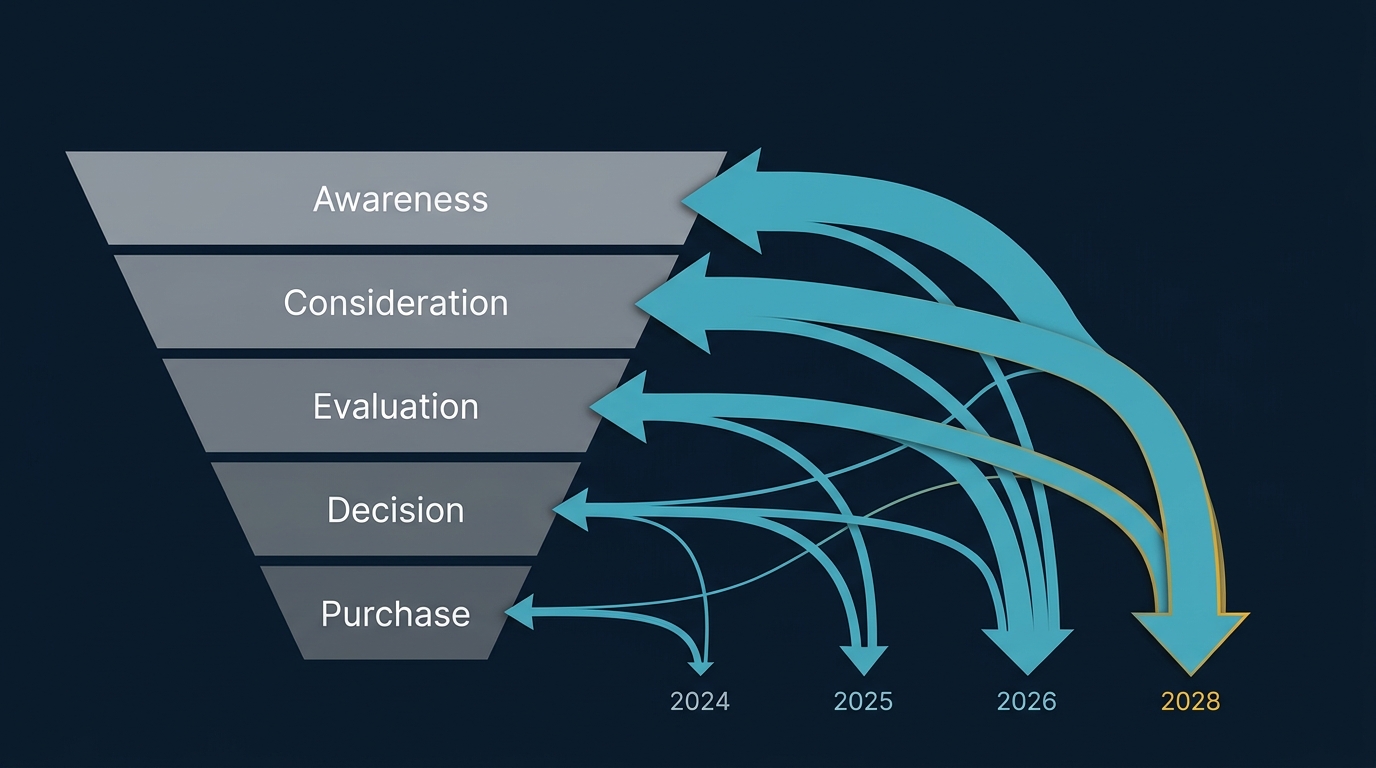
AI agents are not staying in the top of funnel. They are moving deeper into purchase decisions every month. Buyers are using ChatGPT, Perplexity, and Copilot to shortlist vendors, compare pricing, evaluate technical capabilities, and make final recommendations to buying committees. Gartner estimates that by 2028, AI agents will autonomously manage 15% of day-to-day work decisions. That percentage includes sourcing decisions, vendor evaluations, and technology procurement.
The marketing organizations that prepare for this now, by measuring AI recommendations as a channel, by optimizing content for agent consumption, by integrating gate scores into their media mix, will have two years of compounding advantage over the ones that wait for Google Analytics to add an “AI referral” row.
How It Works
The system operates on a principle borrowed from Bayesian statistics: prior beliefs, updated with observed evidence, produce better decisions than either one alone.
In practice, that means:
-
DSCRI-ARGDW gate scores become informative priors. Each of the 10 gates in the AAO pipeline produces a confidence score for your content. These scores tell us how likely AI agents are to recommend you before we even observe the outcome.
-
Observed recommendations become the likelihood. We monitor actual AI agent behavior: what gets recommended, what gets cited, what gets surfaced in AI Overviews and conversational search. This is the evidence that updates our priors.
-
The posterior (the updated answer) tells you where to invest. Once the model combines what we predicted with what we observed, the result is called the posterior: your best current understanding of how AI recommendations are affecting your revenue. The model produces a channel-level measurement of that impact alongside every other channel in your mix. For the first time, you can see paid search, organic, social, email, and AI recommendations in the same model, competing for the same budget dollar.
This is not a dashboard that shows you vanity metrics. It is a decision engine that learns. Every new observation updates the model. Every budget reallocation gets measured against outcomes. The system gets smarter as your data grows.
What This Means for Marketing Leaders
If you are a CMO or VP of Marketing presenting budget allocation to your board, here is the reality you are operating in:
Your measurement stack is built on a 15-year-old architecture. Most MMMs still treat “organic” as a single undifferentiated channel. They cannot distinguish between a blog post that ranks on Google and a blog post that gets recommended by Claude. They are blind to an entire class of customer touchpoints that is growing faster than any channel since mobile.
That blindness creates a downstream problem. Your CFO asks for ROMI by channel. Your model says paid search drives 40% of pipeline, organic drives 25%, events drive 15%. But 10-20% of your pipeline is being influenced by AI agent recommendations that do not appear anywhere in the model. That influence is either being misattributed to other channels or disappearing entirely. You are making allocation decisions on incomplete data, and the gap gets wider every quarter as AI agents take a larger role in the purchasing funnel.
Companies are underinvesting in content quality, structured data, and the technical infrastructure that makes content AI-readable, because their measurement systems do not reward it. The ROMI of those investments is invisible in every model on the market. So the budget goes to channels that can prove returns, even when those channels are plateauing.
Bayesian & Priors makes the invisible visible. When you can measure the revenue contribution of AI recommendations, you can justify the investment in earning them. And when your competitors still cannot measure it, your allocation decisions are two years ahead of theirs.
Where We Are
Bayesian & Priors is now accepting beta signups at baypri.ai. The framework is documented, the measurement methodology is built, and we are opening early access to marketing leaders who want to be first to measure a channel their competitors do not even know exists.
Beta participants get direct access to the DSCRI-ARGDW gate scoring pipeline, a dedicated AI agent channel in their marketing mix model, and a seat at the table as we refine the methodology with real-world data. Spots are limited because every engagement involves hands-on model calibration.
If you run marketing at scale and you have ever wondered whether AI is helping or hurting your pipeline, that is the exact question we built this company to answer.
Not another marketing dashboard. A decision engine that learns.
Sign up for early access at baypri.ai | Read the AAO framework | About me
About the Author
Andrés Plashal
Senior Marketing Executive and Strategic Revenue & Search Marketing Engineer. $150M+ attributed revenue across 30+ companies. Google Partner since 2017.
Credentials: UIUC Gies College of Business (Behavioral Science), Columbia College Chicago (Interactive Arts & Media). Member: American Marketing Association, GAABS, Paid Search Association. Published researcher (SCTE/NCTA).