The 2026 SEC Marketing Rule: Paid Channel Implications You May Have Missed
The Rule Reframes What “Marketing” Means
The SEC Marketing Rule (formally Rule 206(4)-1 under the Investment Advisers Act of 1940) was adopted in December 2020 and went into compliance effect in November 2022. Most RIA marketing teams updated their websites and social media policies in 2022. Few revisited the rule when paid channels (paid search, paid social, programmatic display, retargeting) became dominant traffic sources between 2023 and 2026.
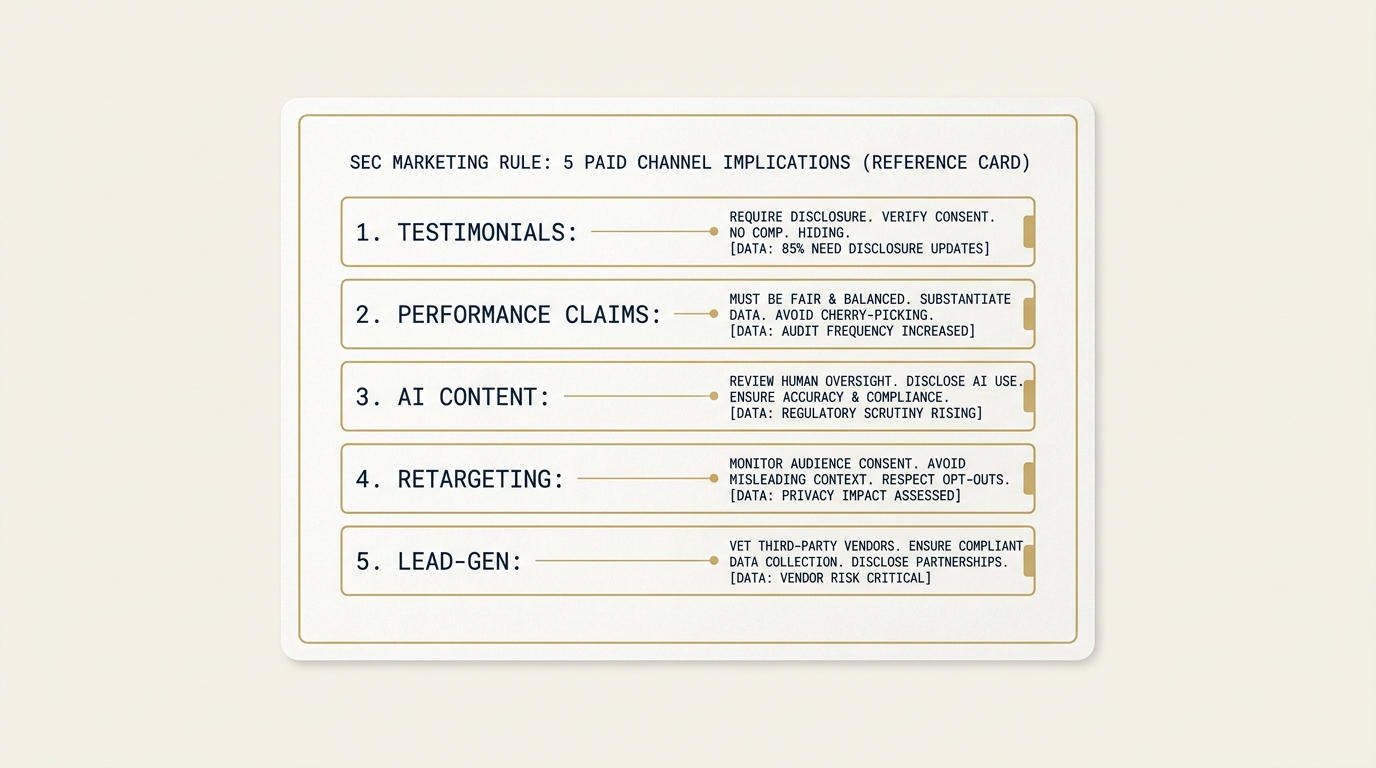
The 2022 update was necessary. The 2026 reframing is the work most teams still owe. This post covers five paid-channel implications of the rule that operations teams most consistently underweight, with fixes that can be implemented without legal-team friction. The framing is operational; refer to counsel for jurisdiction-specific application.
The companion piece in Batch 1 is the cluster post on RIA PPC compliance, which covered the paid-search-specific scope. This post zooms out to the full paid acquisition surface.
Implication One: Testimonials And Endorsements In Paid Channels
The Marketing Rule expanded the definition of “testimonial” to include any statement about an advisory firm by a current or prospective client and “endorsement” to include statements by non-clients. The 2022 update most firms made was to add disclosure language to testimonials on the website. The 2026 question: what happens when those testimonials appear in paid creative?
Operational implications:
- A paid social ad that quotes a client testimonial inherits the disclosure requirement.
- The disclosure must be “clear and prominent” within the ad creative, not buried in a destination page.
- Paid placements that omit the disclosure are typically violations, even when the underlying testimonial is properly disclosed on the website.
The fix is creative discipline: every paid placement using a testimonial includes the required disclosures in the creative itself, not only on the destination page.
Implication Two: Performance Claims In Lead-Gen Funnels
“Performance” under the rule includes claims about advisory returns and claims about the firm’s commercial outcomes. The latter category catches lead-gen pages that claim metrics like “we generated $X in new AUM” or “our process produced Y% client acquisition rate.”
Operational implications:
- Lead-gen pages with performance claims trigger the rule’s performance-presentation requirements.
- Net-of-fees, gross-of-fees, time-period, and benchmark disclosures apply.
- Casual phrasing on landing pages (“we drive results”) generally does not trigger; specific quantitative claims do.
The fix: every quantitative performance claim on a paid-traffic landing page gets a methodology disclosure stating the net-of-fees basis, time period, and benchmark inline.
Implication Three: AI-Generated Content And The Adopter Standard
The rule treats content the firm “uses” in marketing as the firm’s responsibility regardless of who created it. AI-generated content (blog posts, social copy, ad creative) is the firm’s responsibility once published.
Operational implications:
- AI-generated investment commentary that includes errors is the firm’s liability, not the tool’s.
- Disclosure requirements apply equally to AI-generated and human-written content.
- The compliance team’s review obligations apply to AI-generated content. Skipping review because the AI “checked it” is not a defense.
The fix: AI-generated content goes through the same compliance review queue as human-written content, with no exception for content a tool claims to have self-checked.
Implication Four: Retargeting Pixel Audiences As Disclosure Surfaces
A retargeting pixel that captures site visitor data may trigger privacy disclosure obligations under state law (CCPA, VCDPA, others) and may trigger Marketing Rule considerations when the resulting audience is used for performance advertising.
Operational implications:
- A retargeting audience built from advisory-content visitors and used for performance-focused ad creative may be subject to the rule’s disclosure requirements at multiple touchpoints.
- The privacy disclosure required by state law and the advisory disclosure required by the Marketing Rule are separate obligations; both apply.
- Some firms have inadvertent compliance gaps where retargeting was set up by marketing without compliance review.
The fix: audit retargeting setups for both privacy and advisory disclosure compliance, treating the state-law privacy obligation and the Marketing Rule obligation as two separate reviews.
Implication Five: Net-Of-Fees Presentation In Paid Channels
The rule’s “net of fees” requirement applies wherever performance is presented. Paid channel creative that shows hypothetical or actual returns has the same net-of-fees obligation as the website.
Operational implications:
- A paid social ad that shows portfolio performance in a chart must show net-of-fees results (or both, with appropriate disclosure).
- A paid search ad that quotes a return number triggers the requirement.
- Hypothetical performance scenarios (often used in lead-gen content) carry stricter requirements than actual performance.
The fix: net-of-fees discipline propagates to paid creative review. Performance scenarios in paid creative get reviewed against the same standards as performance shown on the website.
The Operational Audit Pattern
A workable audit pattern for an RIA marketing team that wants to align paid-channel work with the rule:
-
Inventory paid placements. List every paid channel (search, social, programmatic, podcast, OOH, sponsored content). For each, identify creative templates currently in use.
-
Identify testimonial and performance touchpoints. Within each template, mark whether the creative contains testimonials, endorsements, or quantitative performance claims.
-
Audit disclosures per touchpoint. Compare each flagged creative against the rule’s disclosure requirements. Surface gaps.
-
Build a compliance review queue. Every new paid creative goes through compliance review before launch. The queue should be small enough to be sustainable (1 to 3 day review cycle).
-
Document the audit and review pattern. A written compliance procedure that the firm follows is itself a compliance signal.
Worked Example
A wealth management firm we audited had robust website compliance (disclosures, methodology pages, testimonial framing) and unreviewed paid creative. Eight paid social ads ran with client testimonials and no in-creative disclosures. Three paid search ads quoted a “100% client retention rate” without methodology.
The audit took two days. The remediation: a 30-day pause on paid creative to rebuild the templates with proper disclosures, plus the implementation of the compliance review queue going forward. No external enforcement action; the remediation was preemptive.
The cost: 30 days of paused paid traffic. The cost of not remediating could have been substantially higher.
Frequently Asked Questions
Does this apply only to RIAs or also to broker-dealers?
This post covers the SEC Marketing Rule (RIA scope). Broker-dealers are subject to FINRA Rule 2210, a separate regime that overlaps significantly with the Marketing Rule but is not identical.
What about firms that are dual-registered (RIA and broker-dealer)?
Both regimes apply. The strictest applicable standard governs each specific creative. Dual-registered firms often need separate review tracks for advisory and brokerage marketing.
Does the rule apply to social media organic content?
Yes. The rule applies regardless of whether the placement is paid or organic. Paid placements receive more scrutiny because they are commercial speech with audience targeting.
How often should we audit paid creative for rule compliance?
Quarterly for stable campaigns; per-launch for new campaign templates. The audit cadence should match the rate of creative iteration.
Is there a safe harbor for AI-generated content?
No. The firm’s responsibility is the same regardless of authorship. AI tools that include compliance review features can reduce the operational burden but do not shift the liability.
This is operational guidance for marketing teams, not legal advice. Consult firm counsel for jurisdiction-specific application of the SEC Marketing Rule and any state law overlay. Regulatory citations in this post (Rule 206(4)-1, adoption and compliance dates) should be verified independently before you rely on them.
About the Author
Andrés Plashal
Author of the Assistive Agent Optimization (AAO) framework. Twenty years building search and measurement systems for B2B and SEC-regulated firms. Google Partner since 2017.
Credentials: UIUC Gies College of Business (Behavioral Science), Columbia College Chicago (Interactive Arts & Media). Member: American Marketing Association, GAABS, Paid Search Association. Published researcher (SCTE/NCTA).