State by State RIA Advertising Rules: A Working Checklist
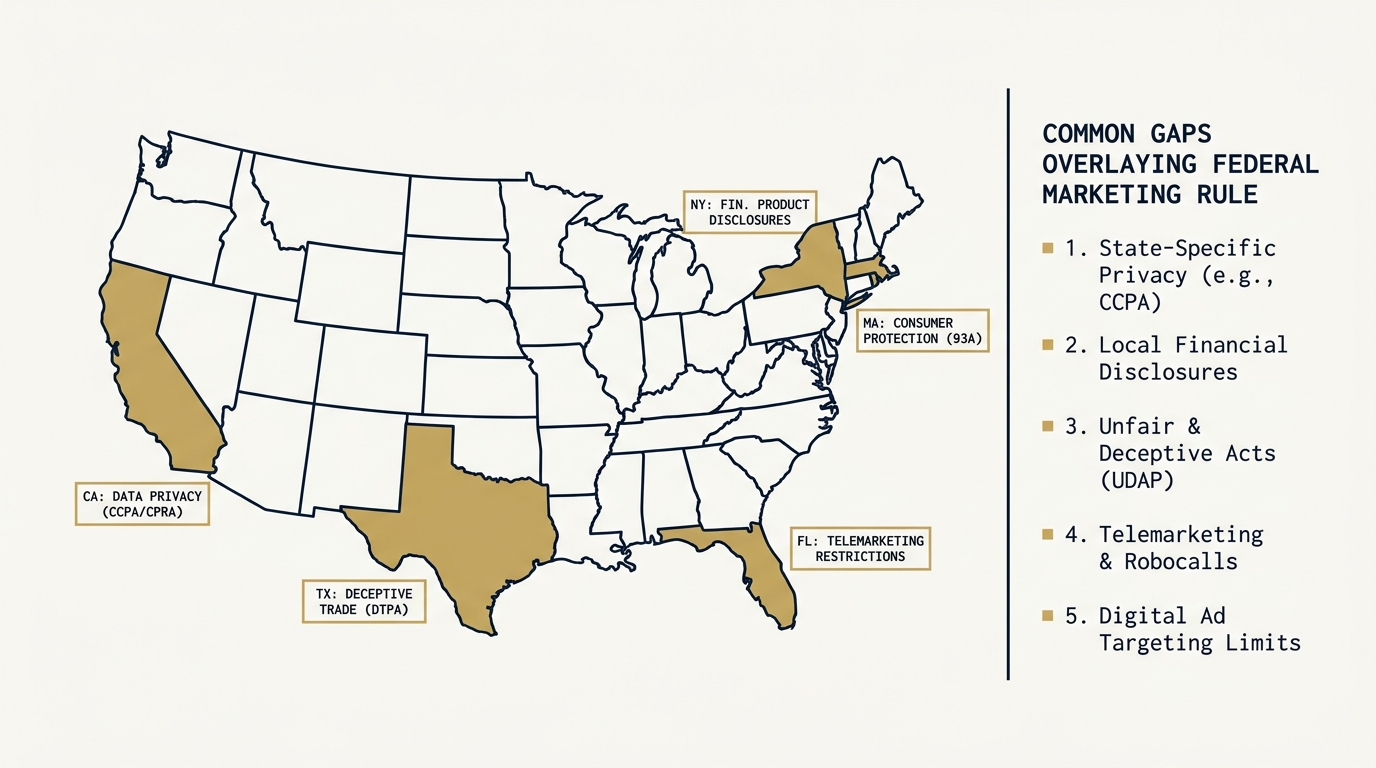
State Law Overlays The Federal Rule
The SEC Marketing Rule applies to RIAs registered with the SEC. State-registered RIAs and SEC-registered RIAs operating in specific states face additional state-level advertising rules. The federal rule sets a floor; state rules can be stricter on specific dimensions.
The result: a multi-state RIA needs to navigate the federal rule plus the strictest applicable state rule per dimension. Most firms underweight the state overlay because the federal rule is the more visible regime. The state-level variations produce the most common audit findings.
This post covers five state-level variations that most consistently catch multi-state RIAs in 2026. The framing is operational; refer to counsel for jurisdiction-specific application.
Variation One: California Privacy Plus Advertising Overlap
California’s Consumer Privacy Act (CCPA) and Privacy Rights Act (CPRA) overlay advertising in ways that intersect with the federal Marketing Rule. Specifically:
- Retargeting pixel data is “personal information” under California law. Pixel-based audience building requires explicit notice and may require opt-out mechanisms.
- Cross-context behavioral advertising (CCBA) has separate requirements. A retargeting campaign that uses behavioral data from multiple contexts faces stricter California rules than a campaign using single-context data.
- The “Do Not Sell or Share” mechanism applies. California residents who opt out should not appear in retargeting audiences after the opt-out is received.
The federal Marketing Rule does not address pixel-based advertising directly. California’s regime does. RIAs serving California clients (or that have website visitors from California, which is most firms) must comply with both.
Variation Two: New York Disclosure Language Requirements
New York imposes specific disclosure language requirements on RIA advertising, particularly around performance claims and testimonials. The state’s regulatory posture has been more active than most.
Operational implications:
- Specific disclaimer language is required in some contexts. New York may require language that differs from the federal default disclosure.
- Net-worth requirements for advertised products. Some advertised services have minimum-net-worth audience requirements; advertising to general audiences without appropriate filtering is a gap.
- Cooling-off provisions on lead-gen sign-ups. New York has consumer-protection requirements that affect marketing-to-engagement workflows.
The fix: a New York-specific review pass on creative that targets the state, with language adjustments per state-specific requirements.
Variation Three: Texas Disclosure Format And Anti-Fraud Standards
Texas has particularly active enforcement on advertising disclosures and applies anti-fraud standards that can reach beyond the federal Marketing Rule’s specific language.
Operational implications:
- Bold and large-font disclosure requirements. Texas’s disclosure standards include format requirements that “clear and prominent” under the federal rule does not always specify.
- Comparative claim treatment is stricter. Comparative claims against competitors face stricter substantiation requirements in Texas.
- Aggressive enforcement on retail-investor advertising. Texas has been active in enforcement against advertising directed at retail investors.
The fix: a Texas-specific review of creative formatting, particularly for disclosure prominence.
Variation Four: Florida And Senior-Investor Communications
Florida has specific rules on advertising and communications directed at senior investors. The state’s senior-investor focus produces requirements that overlap with but exceed federal rules.
Operational implications:
- Senior-investor targeting requires additional disclosure. Creative targeted at senior audiences (over 65, retirement-focused, or specifically demographic-targeted) carries stricter disclosure obligations.
- Anti-fraud standards apply to suitability framing. Marketing that implies suitability without specific suitability analysis is risky.
- The Florida Securities and Investor Protection Act overlays. Florida-specific protections apply to communications received in the state.
The fix: a senior-audience review pass for creative targeting Florida-resident or senior-demographic audiences.
Variation Five: Massachusetts And Multi-State Coordination
Massachusetts has been particularly active in coordinating with other states on RIA advertising enforcement. Firms registered in Massachusetts face both Massachusetts-specific rules and coordinated multi-state enforcement.
Operational implications:
- Coordinated examinations. Massachusetts participates in NASAA-coordinated examinations that look at multi-state advertising consistency.
- Specific record retention requirements. Some Massachusetts requirements exceed federal retention periods.
- Local agent supervision requirements. Firms with in-state representatives face supervisory framework requirements.
The fix: multi-state firms should treat Massachusetts as a regulatory leader and align compliance practices to Massachusetts standards by default; other states often follow.
The Operational Audit Pattern
A workable audit for multi-state RIA advertising:
-
Inventory states of registration and clients. List states where the firm is registered, where it has clients, and where its marketing reaches visitors.
-
Identify the strictest applicable standard per state per dimension. Disclosure language, format requirements, prohibited claims, record retention.
-
Audit creative against the strictest standard. A single national creative may need state-specific variants; geo-targeting may be necessary.
-
Document the state-by-state analysis. Written documentation supports compliance posture and audit response.
-
Quarterly re-audit. State rules update; quarterly review keeps the analysis current.
Worked Example
A multi-state RIA we audited had federal-rule-compliant marketing across all surfaces. The state-level audit surfaced three gaps: California retargeting compliance (no clear “Do Not Sell” mechanism); Texas disclosure formatting (some performance claim disclosures were under the state’s prominence threshold); Florida senior-investor targeting (a campaign aimed at retirement-age audiences lacked the additional disclosure).
Remediation took six weeks. None of the gaps had produced enforcement action; the audit was preemptive. The firm’s general counsel described the findings as “the kind of gap that would have been the first thing the SEC asked about in any examination.”
The cost of remediation was modest. The cost of state enforcement action triggered by the gaps would have been substantially higher.
Frequently Asked Questions
Does this apply to firms with SEC registration only?
Yes, partially. SEC-registered firms are subject to federal rules and to state rules in states where they have a place of business or maintain clients. The state overlay applies even though state registration does not.
How do I determine “strictest applicable standard”?
Per-dimension analysis. Disclosure language requirements may be strictest in one state; record retention in another; prohibited-content rules in a third. The firm’s policy aligns to the strictest standard per dimension across applicable states.
Are there state-specific compliance review tools?
Several legal-tech and compliance vendors offer state-by-state rule databases. These are useful as references; they are not substitutes for counsel review of specific marketing situations.
How does this interact with the California privacy post?
The California retargeting gap is the most common state-level issue in 2026. The next post in this series covers the operational fix for the retargeting privacy gap specifically.
How often should the multi-state analysis be refreshed?
Annually at minimum; quarterly for firms with active expansion into new states. State-rule changes are tracked by NASAA and state regulators; firms should monitor enforcement trends in the states they operate in.
This is operational guidance for marketing teams, not legal advice. Consult firm counsel for jurisdiction-specific application of state advertising rules to the firm’s marketing program.
Next In Series
The next post covers why your retargeting setup might violate California privacy law with the three-line operational fix for the most common pattern.
About the Author
Andrés Plashal
Author of the Assistive Agent Optimization (AAO) framework. Twenty years building search and measurement systems for B2B and SEC-regulated firms. Google Partner since 2017.
Credentials: UIUC Gies College of Business (Behavioral Science), Columbia College Chicago (Interactive Arts & Media). Member: American Marketing Association, GAABS, Paid Search Association. Published researcher (SCTE/NCTA).