The Reputation Gate: Cross-source Corroboration as a Citation Signal
Domain Rating Measures The Wrong Thing
Domain Rating, or any single-number authority metric, measures the volume of inbound links weighted by source authority. It is a useful aggregate. It is not what the DSCRI ARGDW framework Reputation gate measures, and it is not what AI search engines weigh when deciding citation.
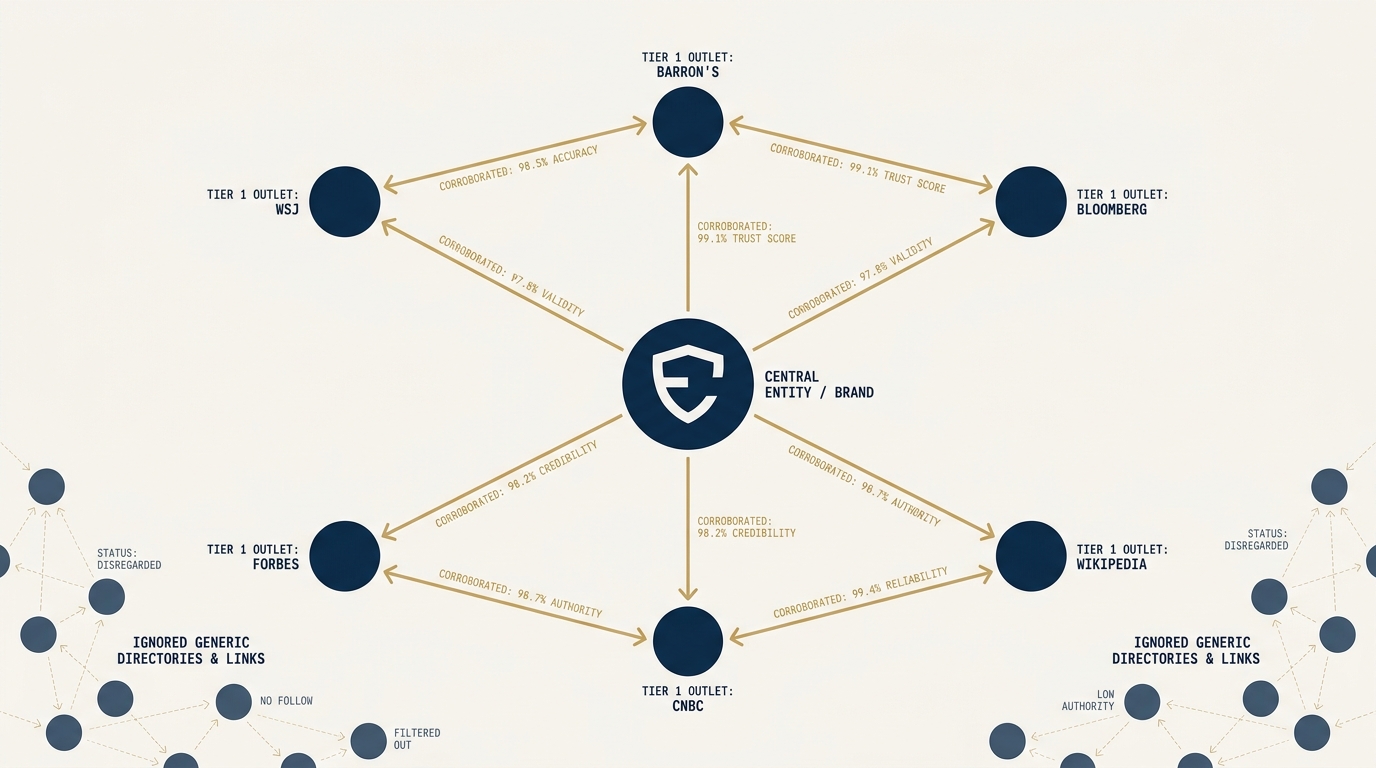
Reputation, in AI search context, is about cross-source corroboration. The question the gate answers is: do other authoritative sources confirm what this entity claims, in a way the crawler can verify? A 70 DR site with 50,000 generic SEO directory links can fail this gate. A 30 DR site with 50 high-quality citations in tier 1 financial press passes it. The difference is qualitative.
What Backlink Composition Actually Means
Composition is the qualitative breakdown of where links come from. Categorize a site’s inbound link profile and the picture sharpens fast. For a YMYL B2B finance firm, a healthy backlink composition looks like this:
- Tier 1 financial press (WSJ, Bloomberg, Barron’s, FT, CNBC, Forbes): contextual mentions, often with author bylines, often as named sources.
- Tier 2 specialist outlets (Wealthtender, Kitces, Investment News, Citywire): commentary, podcast appearances, contributed articles.
- Industry recognition (Barron’s Top 100, Forbes Best in State, regional rankings): listed inclusions.
- Wikipedia and Wikidata: factual references on category pages.
- Professional databases (Crunchbase, LinkedIn, Bloomberg terminal): claim-backed profile entries.
An unhealthy composition concentrates in directory backlinks, SEO link networks, low-DA blog comment links, and reciprocal cross-promotion. The aggregate DR may be high. The Reputation gate score is low.
AI engines run a coarse version of this composition analysis when they decide which sources to cite on a given query. The signal is not “this site has many links” but “this site has the kinds of links that authoritative sites in this category typically have.”
Named Bylines As Citation Graph Entries
A backlink from a tier 1 outlet is a Reputation signal. A backlink from a tier 1 outlet where a named author from your firm wrote the article is a stronger signal by an order of magnitude. The reason is that the byline binds the firm to the claim: when the LLM reads the article and extracts the claim, the byline tells it which entity made the claim.
This is the mechanism by which “thought leadership” actually compounds. A founder who writes monthly columns at Forbes is building a citation graph anchored to herself, with the firm as the linked entity. Over twelve months, queries about the firm’s category surface the founder’s published pieces, which contain claims attributed to the firm. The citation graph grows. The Reputation gate score increases per article.
Without bylines, the same outlet coverage is weaker. A WSJ article that mentions the firm as a source (“according to Capital Wealth Advisors”) is a signal. A WSJ article authored by the firm’s principal is a stronger signal because the byline reduces the disambiguation distance to zero.
Awards As Built-in Citation Signals
Industry awards function differently from backlinks. An award is itself a citation event: the awarding body publishes a list, names the recipient, and creates a public record of the recognition. The list page often outranks the recipient’s own pages on category queries because the awarding body is structurally a higher-authority source on category questions.
For B2B finance, the high-signal awards are predictable: Barron’s Top 100 Advisors, Forbes Best in State, Wealth Management’s Wealthies, regional and category specific recognitions. Each functions as a Reputation gate booster because the awarding body’s authority on the category is well established. Each new award is one more cross-source corroboration entry the AI engine can find.
The implication: pursuing the right awards is reputation engineering. The wrong awards (vanity awards with no editorial standard) are reputation noise.
The Linked-from Versus Cited-by Distinction
Two different signals, often conflated. A site can be “linked from” a tier 1 outlet without being “cited by” the outlet. The difference matters for Reputation gate scoring.
- Linked from: the outlet’s article contains an outbound URL to the entity’s page, but the outbound is a passing reference or directory link.
- Cited by: the outlet’s article quotes the entity as a source, includes a byline by the entity’s named principal, or references the entity’s published analysis as the basis for a claim.
AI engines weigh “cited by” several times more than “linked from” when scoring Reputation. The fix for a firm with strong “linked from” but weak “cited by” is to convert generic mentions into byline-backed contributions over a 6 to 12 month engagement with the relevant outlets.
Engineering Reputation
Reputation cannot be assembled overnight. A workable 12-month engineering plan:
- Months 1-2: audit. Categorize existing backlinks. Identify the gap between composition and tier 1 / tier 2 / award presence.
- Months 2-4: byline pipeline. Identify 3 to 6 tier 2 outlets that take contributed articles. Pitch and publish two to four pieces per quarter under named bylines.
- Months 4-8: tier 1 entry. With a tier 2 byline trail, pitch the tier 1 outlets directly. One published article per quarter is realistic at this stage.
- Months 6-12: award presence. Submit for category-recognized awards (Barron’s, Forbes, Wealth Management). Some awards require a year of operating history; budget the wait.
- Continuous: Wikipedia and Wikidata. Maintain factual presence with cited references. Wikipedia editors will not accept self-edited firm pages; the right path is to provide source material so neutral editors can update entries.
Each of these is a publishing operation. None is a backlink-building tactic. The Reputation gate, like every other AAO gate, is a publishing question.
Worked Example
A 30 DR registered investment adviser outranked a 70 DR financial planning firm on the YMYL query “fee-only fiduciary advisor in [region].” Audit explanation:
The 70 DR firm had won its score through SEO over five years. The backlink profile was 80% generic directories and SEO-optimized advisor finder sites. Tier 1 outlet presence was thin: two mentions in three years, no bylines. Award presence was none.
The 30 DR firm had been operating for seven years. The principal had written one Forbes column per quarter for two years. The firm appeared on the Wealthtender top-100 list and had been featured in two Barron’s articles as a named source. The Wikipedia entry for the principal cited the column work as published evidence. Wikidata had a QID linked from the firm’s homepage Organization schema.
The 70 DR firm passed Authority (per DR) but failed Reputation. The 30 DR firm passed Reputation comfortably. On YMYL queries, where the gate scoring weights Reputation heavily, the 30 DR firm won.
Frequently Asked Questions
How fast can a Reputation gate failure be fixed?
Six to twelve months for a meaningful shift. The byline pipeline alone takes 90 to 180 days to land first-published pieces in tier 2 outlets. Tier 1 entry usually requires the tier 2 trail as proof of contributor quality. Awards run on annual cycles. Quick fixes are not credible signals.
Can I just buy backlinks from high-authority sites?
No. Paid placement that the placing outlet flags as sponsored does not count as corroboration. Paid placement that the placing outlet does not flag is in violation of FTC guidelines and most regulated industries’ advertising rules. The legitimate path is editorial relationships, which take time.
What about podcast appearances?
Strong signal when the podcast is well-listened and the appearance is searchable on the open web. Look for podcasts that publish transcripts and have above-average production discipline. Podcast appearances without published transcripts are weak signals because the AI crawler cannot extract the content.
Does brand search volume matter for Reputation?
Indirectly. Brand search volume is a Discovery signal more than a Reputation signal. Strong brand search without strong Reputation looks suspicious to the engines and can suppress citation.
How does this gate interact with the Authority gate?
Authority is about whether your entity is recognized as authoritative in its category. Reputation is the mechanism by which Authority accumulates over time. They are sequenced: invest in Reputation engineering for six to twelve months; Authority follows.
Next Gate
The next Tuesday post covers the Infrastructure Gate: why server-side rendering, edge deployment, crawl-budget signaling, and AI bot enumeration are the technical foundations the prior four gates depend on.
About the Author
Andrés Plashal
Author of the Assistive Agent Optimization (AAO) framework. Twenty years building search and measurement systems for B2B and SEC-regulated firms. Google Partner since 2017.
Credentials: UIUC Gies College of Business (Behavioral Science), Columbia College Chicago (Interactive Arts & Media). Member: American Marketing Association, GAABS, Paid Search Association. Published researcher (SCTE/NCTA).