AI Content at Scale Is Now a YMYL Liability
The Documented Failure Pattern
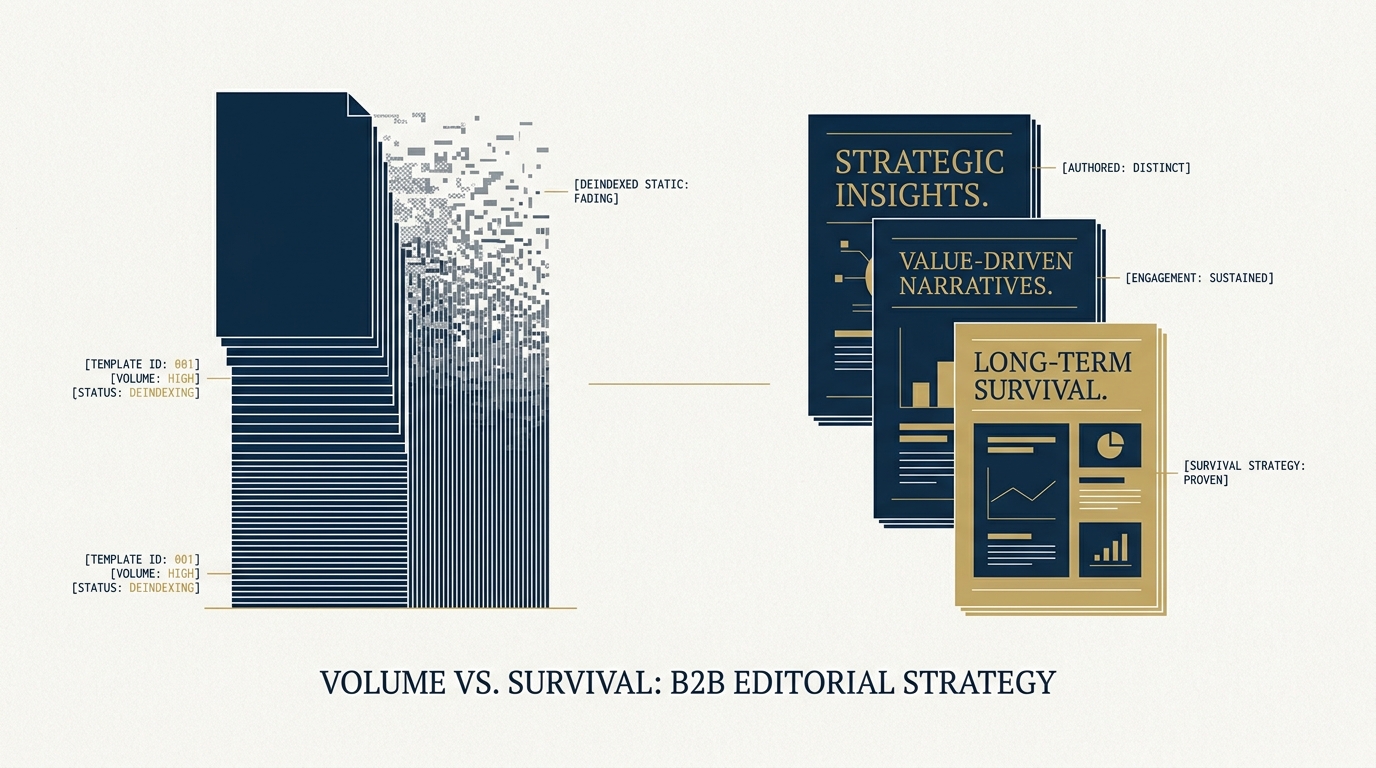
In the 24 months from late 2023 through early 2026, a consistent failure pattern emerged for sites running AI-assisted content production at scale in regulated and YMYL categories. The pattern is now documented at sizes large enough that it cannot be dismissed as small-N noise.
HubSpot’s organic traffic collapse from roughly 13.5 million monthly organic visits in November 2024 to under 2 million by January 2025 represents an 86% loss across two months. The decline coincided with Google’s December 2024 Core Update and parallel spam updates targeting “scaled content abuse” patterns. CNET Money’s 2023 AI-generated content episode required public corrections to dozens of articles after factual errors surfaced. Sports Illustrated’s AdVon Commerce relationship ended after the AI-author-portrait scandal damaged brand credibility across multiple verticals.
Originality.AI’s 2024 study of 79,000 sites found that every site in the deindexed sample contained AI-generated content. The correlation is total. Causal direction remains empirically debated, but the pattern is unambiguous at the population level: AI-content-at-scale sites are appearing in the deindexed cohort at rates that selection bias alone cannot explain.
Google’s Algorithmic Posture
The January 2025 update to Google’s Search Quality Rater Guidelines explicitly classified templated AI content as the “Lowest” quality category. The December 2024 Core Update and the March 2025 spam update both targeted the same patterns: high-velocity scaled content with thin substantive contribution, weak entity signals, and inadequate author attribution.
The vector of Google’s algorithmic improvements over the last 18 months is consistent. Every major core update has weighted against the pattern. None has loosened. Future updates are far more likely to tighten than to relax.
For YMYL categories specifically (finance, health, legal, insurance, anything where bad information can hurt someone), the algorithmic posture is stricter than in low-YMYL verticals. The reason is structural: YMYL queries carry a higher cost of error, so the threshold for inclusion in the index, and for citation inside AI surfaces, is correspondingly higher.
Why YMYL Is the Worst Category for Volume
A counterintuitive result from the comparative-firm analysis I worked through in a recent engagement: of the firms running content at high velocity in advisory and adjacent YMYL categories, the one closest to the documented failure pattern was a firm publishing 2-3 articles per week. After multiple years of output, it had achieved a Domain Rating below the case-study client’s, fewer than 100 ranking keywords, and a small handful of AI Overview citations. The volume content production did not buy an authority moat. It produced a corpus.
This is the strategic crux. In low-YMYL categories, scaled content can compound because the eligibility threshold is lower and the algorithm’s quality posture is more forgiving. In YMYL, the eligibility threshold is structurally higher and the corpus does not earn the eligibility. The “Crawled, currently not indexed” verdict (which I analyze in detail in a companion post) is the visible signature of this gap.
A site adding more content to a corpus where 40% of existing content is non-indexed is compounding the problem rather than solving it. The remediation path is not more content. It is fewer, deeper, better-attributed pieces, paired with authority work that pulls the eligibility threshold down to where the corpus can clear it.
The Cautionary Cases Are Larger Than Most Realize
It is tempting to read the HubSpot case as an outlier driven by the firm’s specific decision to scale glossary-style content across topics adjacent to its core CRM positioning. The case is not an outlier. It is the most-public instance of a pattern that has played out at smaller scale across hundreds of mid-sized publishers.
ZacJohnson’s documented decline from 8.2 million monthly organic visits to effectively zero represents a structural failure at a publication that had been operating at scale for over a decade. The decline is not attributable to a single Google update; it reflects the cumulative weight of multiple updates that targeted the exact production pattern the site relied on.
The empirical observation across the documented cases: AI-content-at-scale sites do not produce gradual decline curves. They produce step functions. A core update lands, the site loses 60-90% of its organic visibility across 2-8 weeks, and the recovery curve is shallow or absent. This is the cost structure of the bet.
The Categorical Observation
Across the deep research I have run on this question, the result that has the most explanatory power is a categorical observation rather than a single data point. There are zero documented success cases of AI-content-at-scale building authority in YMYL or finance verticals. The closest adjacent vertical, healthcare programmatic SEO (also YMYL), is documented as a categorical failure pattern. The structural argument from Google’s algorithmic treatment of YMYL is straightforward: the harder Google works to suppress thin scaled content in regulated verticals, the lower the ceiling on what AI volume can produce, regardless of how the AI content is produced.
A team running AI-assisted content at scale in a YMYL category in 2026 is therefore running a bet that the algorithmic posture will reverse before their corpus is deindexed. The historical pattern says the bet is worse than even.
The Reframe
The right read on AI content tools in YMYL is not “do not use them.” AI tools are correctly used for research, outlining, fact-checking, and editorial leverage on individual pieces written by named human authors with real domain expertise. The wrong read is to treat the tools as a velocity multiplier on a content production pipeline that operates without the editorial and authority layers Google has now explicitly classified as required.
The discipline is to invest in fewer pieces, deeper substantive contribution per piece, named-byline authorship, and the parallel authority signals (PR, editorial placement, awards) that make the published corpus eligible for inclusion at the YMYL threshold. The HubSpot, CNET, Sports Illustrated, and ZacJohnson cases all communicate the same lesson: velocity without authority is a liability, and the algorithmic vector that produced the failures is not reversing.
Related Reading
- Schema Is Necessary, Not Sufficient explains why technical SEO infrastructure (which HubSpot had in abundance) cannot substitute for the authority signals that AI engines and Google’s index now weight more heavily in YMYL categories.
- Crawled, Currently Not Indexed covers the Search Console diagnostic that surfaces the deindexing pattern at the page level, frequently before the next algorithmic update lands.
About the Author
Andrés Plashal
Author of the Assistive Agent Optimization (AAO) framework. Twenty years building search and measurement systems for B2B and SEC-regulated firms. Google Partner since 2017.
Credentials: UIUC Gies College of Business (Behavioral Science), Columbia College Chicago (Interactive Arts & Media). Member: American Marketing Association, GAABS, Paid Search Association. Published researcher (SCTE/NCTA).