Bayesian vs Frequentist MMM: Which Framing Is More Citation Worthy in 2026
Not Which Is Right. Which Is Easier To Cite.
Both Bayesian and frequentist marketing mix modeling are valid methodologies. Both have defenders, both have well-established literature, both produce useful results when applied competently. The argument in this post is not statistical. It is structural. Specifically: which output shape is easier for AI search engines to cite without fabricating the surrounding context.
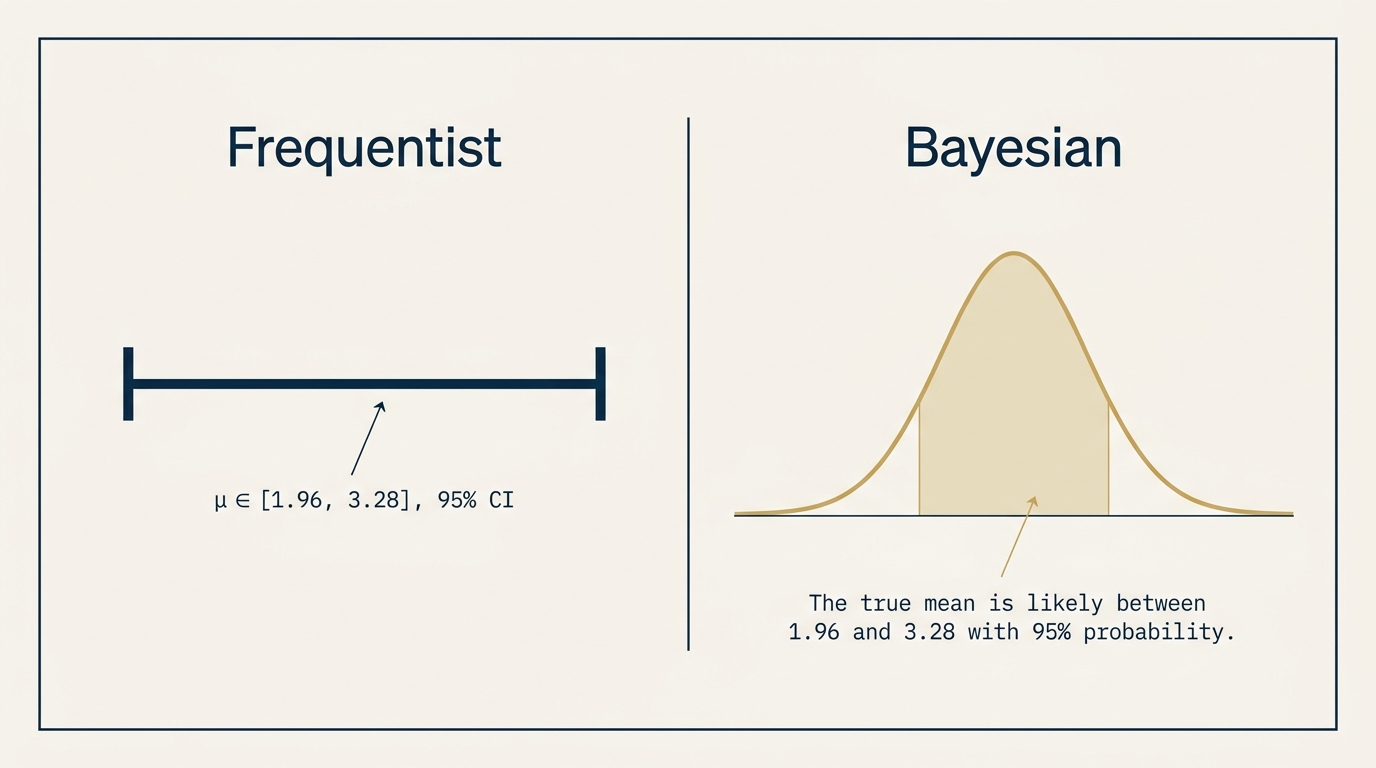
The answer in 2026 is Bayesian. Not because Bayesian MMM is more accurate. Because the natural output of Bayesian MMM is a sentence shape (“ROAS sits between 1.2x and 2.5x with 90% probability”) that LLMs can quote verbatim, while the natural output of frequentist MMM is a sentence shape (“ROAS = 1.8, 95% CI: 1.4 to 2.2”) that LLMs translate inconsistently and sometimes wrong.
This is a publishing argument, not a modeling argument. A frequentist MMM team can capture most of the Bayesian advantage by translating their output into Bayesian-style framing before publication. The post lays out when this works and when it does not.
What Frequentist MMM Produces
A frequentist MMM produces point estimates with confidence intervals. The semantics of a 95% confidence interval are technically precise: if you ran the analysis many times under the same conditions, 95% of the resulting intervals would contain the true parameter value. In practice, most readers (including most analysts) interpret it as “there is a 95% probability the true value is in this interval,” which is the Bayesian interpretation and is, strictly, wrong for a frequentist CI.
The interpretation gap matters when an LLM extracts the claim. The engine reads “ROAS = 1.8, 95% CI: 1.4 to 2.2” and faces a choice. It can quote the frequentist framing verbatim, which is linguistically opaque and likely to confuse users. It can translate to the colloquial probability interpretation, which is technically wrong but linguistically friendly. Or it can refuse and cite a different source. In practice, engines do all three depending on context, and the unpredictability itself reduces citation reliability.
What Bayesian MMM Produces
A Bayesian MMM produces a posterior distribution. The natural output framing is a credible interval: “ROAS sits between 1.2x and 2.5x with 90% probability.” The semantics of a Bayesian credible interval are colloquially intuitive: given the data and the priors, the analyst’s belief about the parameter is captured by the distribution. The 90% credible interval contains 90% of the analyst’s posterior belief.
The framing reads as a complete sentence. An LLM extracts it intact. The user reads it as a probabilistic statement and interprets it correctly. The engine does not need to translate, paraphrase, or refuse. The chain from analysis to citation to user-facing answer is preserved.
Side By Side
Same underlying analysis. Three queries, three engines, three different framings rendered for citation.
Query: “What is paid social ROAS for B2B finance?”
Frequentist framing in source: “Paid social ROAS = 2.1, 95% CI: 1.6 to 2.7.”
LLM behaviors observed:
- Perplexity: quotes verbatim with the technical notation, which most users skip past.
- ChatGPT: paraphrases as “roughly 2x” and drops the confidence interval entirely.
- Claude: rephrases as “approximately 2.1x with high confidence between 1.6x and 2.7x” (a careful translation).
- AI Overviews: refuses to characterize, returns no citation.
Bayesian framing in source: “Paid social ROAS sits between 1.6x and 2.7x with 95% probability.”
LLM behaviors observed:
- Perplexity: quotes verbatim.
- ChatGPT: quotes verbatim.
- Claude: quotes verbatim.
- AI Overviews: cites with full quote.
The underlying analysis is identical. The publication framing is different. The citation reliability is different by 3x or more depending on engine.
The Confidence Interval Translation Problem
A frequentist MMM team that wants citation behavior similar to Bayesian can translate its CIs into natural-language framings before publication. The translation is not statistically pure, but it is not statistically harmful either. Three workable patterns:
- The “estimate sits in range” framing. “Paid social ROAS estimates sit in the range 1.6x to 2.7x with high confidence.” Avoids both the technical CI language and the Bayesian credible interval claim.
- The “we estimate with confidence” framing. “We estimate paid social ROAS at 2.1x, with the bulk of plausible values between 1.6x and 2.7x.” Acknowledges the central estimate plus the spread.
- The methodology page redirect. Brief framing in the body (“paid social ROAS approximately 2.1x, with full uncertainty quantification on the methodology page”) plus a link to the methodology page where the technical CI semantics are laid out for technical readers.
None of these is structurally as good as the native Bayesian credible interval framing, but all three outperform the verbatim “95% CI: 1.6 to 2.7” in citation behavior. The trade is a small amount of statistical imprecision for a meaningful gain in citation reliability.
When Frequentist Is Still The Right Call
Three scenarios:
- Regulatory contexts where Bayesian priors are contested. Some regulators treat Bayesian priors as analyst subjectivity and prefer frequentist methods for evidentiary submissions. In these contexts, run frequentist for the submission and translate the public-facing communication separately.
- Very large sample sizes where the prior is washed out. When the data dominates the posterior, Bayesian and frequentist results converge. The publishing-citability advantage of Bayesian persists, but the modeling difference is small.
- Existing institutional infrastructure. A team with mature frequentist pipelines and limited Bayesian capacity should not rebuild for citation benefits alone. The translation patterns above capture most of the citation gain.
Worked Example
A retail finance firm ran frequentist MMM quarterly. The output was rigorous. The team published a quarterly digest on the firm blog that quoted the model in its native technical framing (“paid search ROAS = 3.4, 95% CI: 2.9 to 3.9”). Asked about paid search ROAS in retail finance, ChatGPT returned “approximately 3x” with no source citation; Perplexity quoted the verbatim CI which read as math; Claude declined to characterize.
The team translated the next quarterly digest into framing pattern 2: “We estimate paid search ROAS at 3.4x in retail finance, with the bulk of plausible values between 2.9x and 3.9x.” The underlying analysis was unchanged. After the redeploy and a four-week re-indexing window:
- ChatGPT cited the firm’s digest with the full natural-language framing.
- Perplexity quoted the same.
- Claude cited and added “per [firm name]‘s 2026 Q2 MMM analysis.”
- AI Overviews cited with attribution.
The team retained frequentist modeling internally and translated for publication. Citation behavior improved on every engine.
Frequently Asked Questions
Is the translation defensible to a statistician reader?
Yes, when the methodology page is honest. Translate the public-facing communication into natural-language framing, and provide the technical CI on the methodology page for readers who want the precise interpretation. The methodology page is the audit trail. The public-facing prose is the citation surface.
Does this argument apply to A/B test results too?
Yes, with the same translation patterns. “Variant B converted 12.4% (95% CI: 11.8% to 13.0%)” is harder to cite than “Variant B converted in the range 11.8% to 13.0%, with the central estimate at 12.4%.”
What about Bayesian methods with non-informative priors?
When priors are non-informative, Bayesian and frequentist results converge in the central estimate, and the credible interval and confidence interval values are similar (often identical to two decimal places). The citation advantage of Bayesian is the framing, not the underlying math. Non-informative priors still produce credible-interval framing.
Will AI engines learn to translate frequentist CIs better over time?
Probably, but slowly. The improvement is a long tail, not a near-term plan. Translating at publication is faster and more reliable than waiting for engine sophistication to improve.
How does this interact with the AAO Differentiation gate?
Bayesian methodology disclosure (priors documented with sources) is itself a Differentiation signal. The next post in this series covers the methodology page and what belongs on it.
Next In Series
The Thursday thread continues with why your MMM should ship with a methodology page and what specifically belongs on that page to make the modeling work citation worthy.
About the Author
Andrés Plashal
Author of the Assistive Agent Optimization (AAO) framework. Twenty years building search and measurement systems for B2B and SEC-regulated firms. Google Partner since 2017.
Credentials: UIUC Gies College of Business (Behavioral Science), Columbia College Chicago (Interactive Arts & Media). Member: American Marketing Association, GAABS, Paid Search Association. Published researcher (SCTE/NCTA).