Why Your MMM Should Ship with a Methodology Page, and What Belongs on It
The Page That Converts Private To Public
A Bayesian MMM analysis can be world class and still uncitable. The reason is structural. The work lives in a notebook, a dashboard, and a board deck, none of which are accessible to AI crawlers. The methodology page is the artifact that bridges the gap. It is the page that says, on a stable URL the crawler can reach, exactly what the model does and why. Without it, the analysis is invisible to AI search. With it, the analysis becomes a citable claim chain.
This post covers the anatomy of a methodology page that clears the DSCRI ARGDW Differentiation and Reputation gates. The structure is consistent across firms; the content varies with the model.
The Minimum Viable Methodology Page
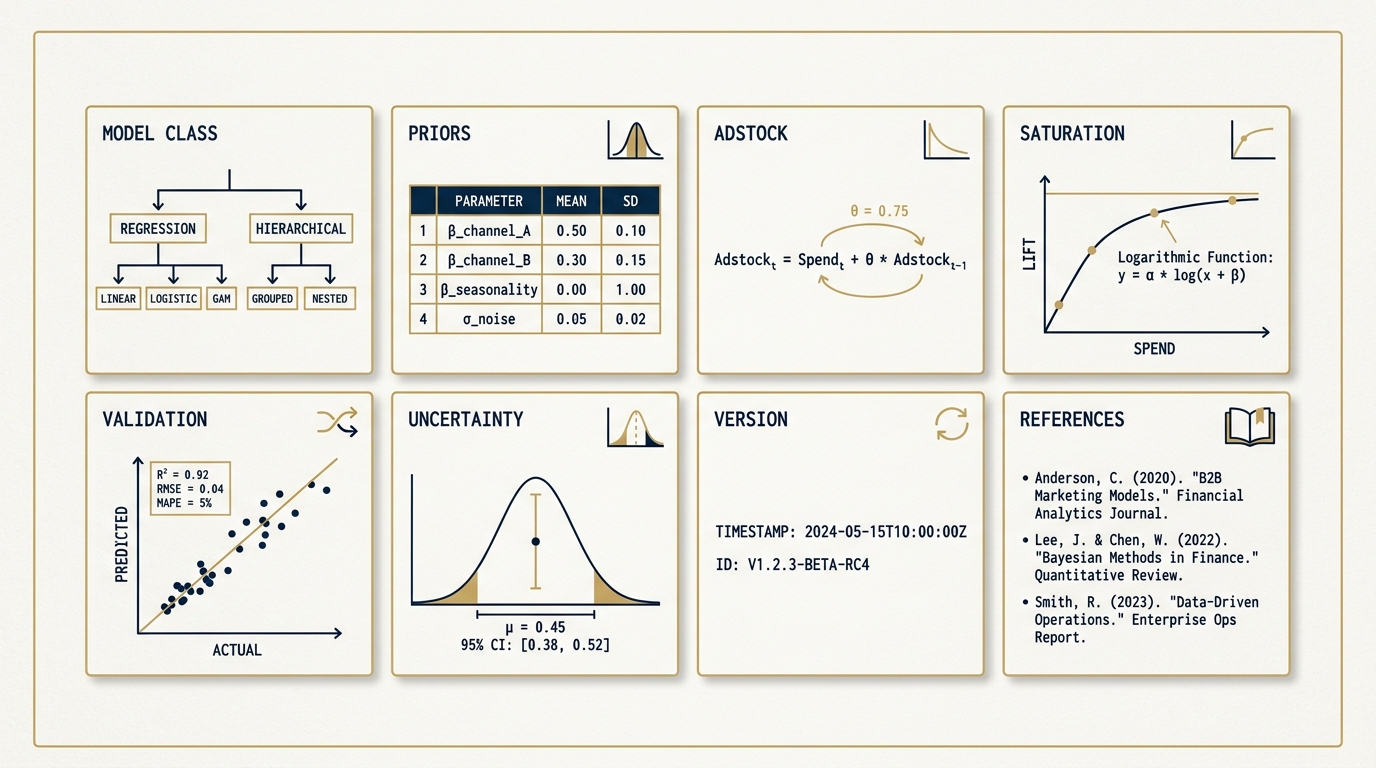
Eight sections, in order:
-
Model class declaration. “We use Bayesian Marketing Mix Modeling implemented in PyMC, with a hierarchical structure across business units.” One paragraph. Names the framework and the implementation. The crawler extracts this as an entity claim.
-
Priors and their sources. A table with five columns: channel, parameter, prior mean, prior SD, source URL. One row per channel per parameter (typically adstock decay, saturation half-saturation, base ROAS). Each source URL points to a Nielsen study, an industry benchmark, an incrementality test result, or a platform-disclosed metric. This section is the Reputation gate’s load-bearing element.
-
Adstock parameterization. Brief explanation of the adstock function used (geometric vs Weibull vs delayed adstock), the decay rate range allowed, and which channels were assigned which decay class. Should answer the technical reader’s question of “how did you handle carryover.”
-
Saturation parameterization. Brief explanation of the saturation function (Hill, logistic, or alternative), the half-saturation prior choices, and which channels are modeled as more or less saturated. Should make the analyst’s choices defensible to a peer reviewer.
-
Validation approach. How was the model validated? Holdout analysis, time-series cross-validation, incrementality back-test, or sensitivity analysis. Name the approach and link to the validation report if separately published.
-
Uncertainty quantification approach. Bayesian credible intervals at what level (80%, 90%, 95%). What the intervals mean. Whether posterior predictive checks were run. This section often confuses non-statistical readers; brief and direct works.
-
Version and change log. “Version 3.2, last updated 2026-07-15. Prior change log: 3.1 added paid social channel. 3.0 migrated from frequentist to Bayesian.” Plus a
dateModifiedin the schema. The Recency gate uses this. -
References. A bibliography of priors sources, methodology references, and related published work. Should include at least 5 external URLs to authoritative sources.
Total length: 1,200 to 2,000 words. Long enough to be substantive. Short enough to be readable in a single session.
Schema Markup Recommendations
The methodology page is a TechArticle (preferred) or ScholarlyArticle in schema.org terms. Required nodes:
TechArticlewith@id,mainEntityOfPage,author,publisher,datePublished,dateModified.- Linked
Personnode (the author) with@idandsameAsreferences (LinkedIn, Wikidata if available). - Linked
Organizationnode (the publisher) with@idandsameAsreferences (Wikidata QID). - Optional:
Datasetnodes for any underlying input data published separately, with their own@idand references to ownership. - Optional:
Citationreferences for the external sources listed in section 8.
The schema is what the Structure gate scores. Inline JSON LD; do not link to an external schema file. The crawler reads what is on the page.
Internal Linking From Results To Methodology
Every public results page (quarterly digest, blog post quoting MMM output, channel-specific case study) should link to the methodology page from the first mention of the model. The pattern: “We estimate paid social ROAS in the range 1.6x to 2.7x with 95% probability (methodology).” The bracketed link is the citation anchor. The crawler walks it and confirms the claim is backed by the methodology page.
The reverse linking matters too. The methodology page should link to representative public results, framed as “applications of this methodology.” Bidirectional linking strengthens the citation graph.
Versioning and Change Log Discipline
MMM models update. Priors change as new evidence arrives. Saturation parameters get re-estimated when channels mature. The methodology page must track these changes or it goes stale.
A workable discipline:
- Update the page on every model version increment. Even a small prior change should bump the version.
- Maintain a change log section at the bottom. Each entry: version number, date, what changed, why.
- Keep
dateModifiedin the schema accurate. AI engines weight Recency on this signal. - Snapshot major versions to dated archive URLs. When version 4.0 ships, the prior version 3.x methodology lives at
/methodology/mmm/v3/. Linking from the new version preserves the audit trail.
Worked Example
A wealth management firm published an MMM quarterly digest on its blog but had no public methodology page. The digest cited “our proprietary Bayesian MMM” without explaining what that meant. ChatGPT, asked about the firm’s measurement approach, said “the firm has not publicly disclosed methodology.”
The team published a methodology page at /methodology/mmm/, following the eight-section structure above. The page documented:
- Model class: PyMC-based Bayesian MMM with hierarchical structure across product lines.
- Priors: a table with twelve rows (four channels by three parameters), each with a source URL pointing to Nielsen, MMA, Mediascience studies and to two internal incrementality test summaries.
- Adstock: geometric, with channel-specific decay priors.
- Saturation: Hill function with half-saturation priors informed by spend history.
- Validation: rolling 13-week holdout plus quarterly incrementality back-test.
- Uncertainty: 90% credible intervals on all reported metrics.
- Version 4.1, with a change log going back to version 2.0 when the firm migrated from frequentist.
- References: 11 external URLs.
Added TechArticle schema with linked Person and Organization nodes. Linked the methodology page from every blog post that referenced MMM output. Six weeks later, ChatGPT, asked about the firm’s measurement approach, returned a three-paragraph summary that quoted the methodology page directly and named the firm and its principal. The model had not changed. The publication chain had.
Common Failure Patterns
Five failure patterns I see often:
- Methodology paragraph instead of methodology page. A single paragraph buried at the bottom of a results post. Insufficient for citation. The methodology needs its own URL.
- Vendor methodology page that is marketing copy. “Our proprietary algorithm leverages advanced AI.” Tells the crawler nothing extractable. The post on vendor methodology pages covers this pattern.
- Priors without sources. A prior table with no source URLs. The crawler treats this as analyst opinion, not as cross-source corroboration.
- No version history. Implies the model has never updated, which most engines treat as suspicious or stale.
- No internal links from results pages. The methodology page exists but no other page links to it. The crawler may find it but cannot tie it to specific claims.
Frequently Asked Questions
Should the methodology page be on the firm’s main domain or on a separate subdomain?
Main domain, top-level path like /methodology/mmm/. Subdomains carry separate Authority scores and require independent Reputation engineering. A subdirectory inherits the main domain’s authority signals.
How long should the page be?
1,200 to 2,000 words. Long enough to substantiate the eight sections. Short enough that a peer reviewer reads it in a single session. Longer methodology pages can split into a summary page plus linked deep-dive pages, each with its own URL.
Can the methodology page include charts and visualizations?
Yes, but with text alternatives that the crawler can extract. A prior plot is useful for human readers; the prior table beside it is what the crawler reads. Both serve their audience.
What if my model is proprietary and I cannot disclose priors?
Reconsider the proprietary claim. Bayesian priors are typically informed by public studies; the work is in selecting and weighting them, not in inventing them. If the priors truly cannot be disclosed, the firm has a positioning problem that publishing cannot solve. Most firms can disclose 80% of their priors without competitive risk.
How does this page support the Bayesian credible interval framing in the prior post?
The methodology page is where the credible interval framing is authoritatively explained. The blog post that quotes the credible interval can link to the methodology page for the precise statistical interpretation. The citation surface stays clean for users; the technical audit trail stays clean for reviewers.
Next In Series
The next Thursday post argues that adstock and saturation parameters are the most easily attacked elements of MMM, and documenting them with sourced priors is what makes them defensible for both peer reviewers and AI engines.
About the Author
Andrés Plashal
Author of the Assistive Agent Optimization (AAO) framework. Twenty years building search and measurement systems for B2B and SEC-regulated firms. Google Partner since 2017.
Credentials: UIUC Gies College of Business (Behavioral Science), Columbia College Chicago (Interactive Arts & Media). Member: American Marketing Association, GAABS, Paid Search Association. Published researcher (SCTE/NCTA).