The 4% Close Rate Is the Industry Baseline, Not Underperformance
The Only Primary-Source Benchmark in the Public Record
In all the years of conversations I have had with advisory firms about Pay-Per-Click (PPC) performance, one anchor data point keeps surfacing as a clarifying reference. It is the close-rate assumption baked into SmartAsset’s published methodology for its advisor referral platform.
SmartAsset has reported that Pure Financial Advisors generated more than $1 billion in new Assets Under Management (AUM) through their platform as of May 2024. The economic model SmartAsset uses to project advisor return on the platform discloses a specific close-rate assumption verbatim in their published materials: a 4% close rate, “based on data collected from partners and industry benchmarks.”
This is the only primary-source disclosed close-rate benchmark for paid wealth-management lead generation in the public record. It is not an industry rumor, not a marketing trade-press estimate, not a self-reported survey response. It is the published assumption that the most-cited successful paid-acquisition platform uses to model its own economics.
The 4% close rate is the industry baseline. The structural reason this matters at the HNW tier specifically is what I cover in the companion piece on why no comparable firm at the entrepreneur tier runs paid acquisition at scale.
Why This Reframes the Conversation
The reason this matters is that it reframes a conversation that frequently goes off the rails. An advisory firm runs a PPC test, produces a 3-5% close rate, and concludes that the channel is underperforming. The marketing freelancer running the campaign concludes that the salesperson is the problem. The salesperson concludes that the lead quality is the problem. The firm concludes that the marketer is the problem. Everyone is wrong, because no one in the conversation has anchored against the documented industry baseline.
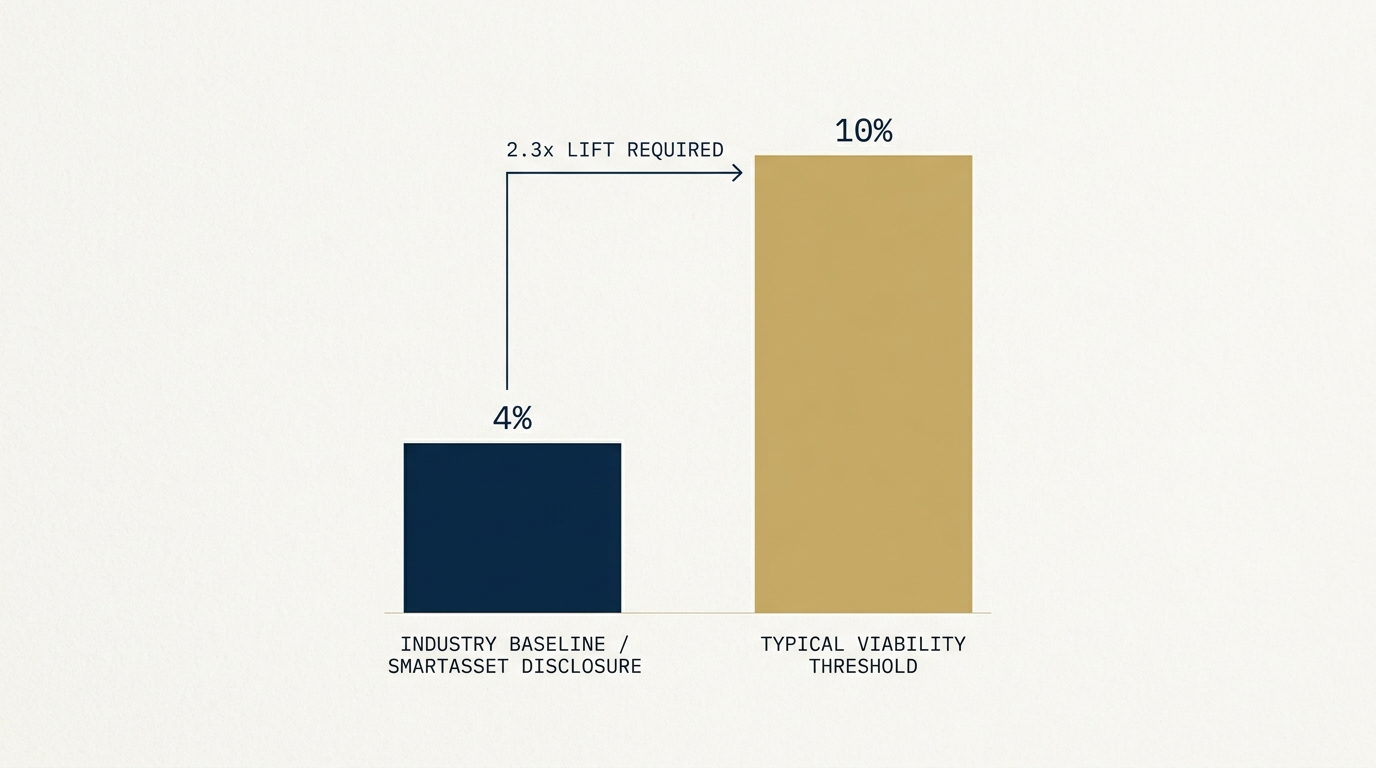
The 4% close rate is what the channel produces, at scale, at firms that have figured out how to run it. It is not a sign of failure. It is the structural ceiling on cold-acquisition conversion in this category. A firm hitting 3-5% in their first test cycle is hitting roughly where Pure Financial hit in their first billion dollars of growth.
The interesting question is therefore not “why is the channel underperforming?” It is “how much of the gap between 4% and the threshold required for our economics can we close, and what does that closing cost?”
The Math the Baseline Forces
For a firm with a Customer Acquisition Cost (CAC) ceiling of $15,000 and a typical cost per call in the $1,200-$1,500 range, the close rate required to clear the CAC threshold is roughly 10%. The math is unforgiving (and structurally identical to the framework I detailed in the companion post on threshold versus forecast framing):
- 4% close rate at $1,200 per call equals $30,000 CAC. Channel unprofitable by 100%.
- 6% close rate at $1,200 per call equals $20,000 CAC. Channel unprofitable by 33%.
- 8% close rate at $1,200 per call equals $15,000 CAC. Channel breaks even.
- 10% close rate at $1,200 per call equals $12,000 CAC. Channel profitable by 20%.
A firm validating a PPC channel at the 10% threshold is implicitly betting that funnel quality, salesperson fit, and pre-qualification rigor can produce 2.5 times the documented industry baseline.
That is the bet. It is not impossible. It is also not the median outcome.
What Sales Coaching Research Says About the Lift
B2B sales coaching research provides the empirical anchor for what kind of close-rate lift is achievable through funnel optimization and salesperson development. The numbers across multiple studies are consistent in their range:
- Ebsta and Pavilion’s 2024 research on dynamic coaching correlated with a 21.3% improvement in quota attainment and a 19% improvement in win rates.
- Hyperbound’s 2025 data put top performers at roughly 1.5 times the B2B average win rate, suggesting a 50% lift from elite skill development.
- SalesHive’s 2025 data showed baseline cold conversion of 2.35% lifting to 9.03% with daily coaching, a 4x lift, but starting from a much lower baseline than wealth management’s 4%.
- Lead Forensics’ 2024 research reports that responding within 60 seconds of a lead capture boosts conversion by approximately 400% compared to slower response times.
The pattern across these data points is that 1.5x to 2x close-rate lifts are achievable in established teams with positive baselines. A 2.3x lift, which is what most PPC viability math requires in wealth management, sits at the upper edge of the empirical literature.
It is achievable. It requires either a salesperson swap, fundamental funnel redesign, or both. It is not the default outcome of running a competent campaign.
The Honest Conversation
The honest conversation with an advisory firm considering a PPC investment is therefore structured around three explicit acknowledgments:
Acknowledgment one: the industry baseline is 4%. Pure Financial’s documented success runs on this baseline. The firm’s prior PPC tests, if they happened, almost certainly landed near or below this baseline. This is not underperformance. It is the category.
Acknowledgment two: the threshold for the firm’s economics is materially above the baseline. Typically 8-10% close rate, often higher depending on cost per call and CAC ceiling. Clearing the threshold requires 2-2.5x the baseline.
Acknowledgment three: the lift required sits at the upper edge of what B2B sales research documents as achievable. It is possible but not probable. The probable case is that funnel and salesperson improvements produce a 1.5x lift (6% close rate), and the channel underperforms the viability threshold by 25-40%.
A firm that internalizes these three acknowledgments before launching the test will not be surprised when the data lands at 6-8%. They will have a kill criterion pre-committed, a budget sized to the realistic probability of clearing the threshold, and a conversation about reallocation that does not require relitigating whether the test was set up correctly.
The Implication for Channel Sizing
The implication for channel sizing is that PPC investment in wealth management should be sized as a calibrated experiment with explicit kill criteria, not as a growth engine commitment. The expected case is that the channel produces marginal economics that do not justify scaling. The upside case (clearing the threshold) is the bet you are running, not the base case.
If you size the channel to the upside case, you commit budget that the documented probability does not support. If you size the channel to the base case, you accept that the experiment costs what it costs, and the value is the decision rather than the throughput.
The 4% baseline is the structural anchor that makes the channel sizing conversation honest. Most firms have not seen the disclosure. Most marketers have not cited it. The teams that have made the discipline explicit produce better channel decisions, lose less budget to channels that were always likely to fail, and reach the kill decision faster when the data is going to land below the threshold.
This is one of the most useful single data points in advisory paid acquisition. It is sitting in SmartAsset’s published methodology, unread, on a substantial majority of the engagements that would benefit from citing it.
About the Author
Andrés Plashal
Author of the Assistive Agent Optimization (AAO) framework. Twenty years building search and measurement systems for B2B and SEC-regulated firms. Google Partner since 2017.
Credentials: UIUC Gies College of Business (Behavioral Science), Columbia College Chicago (Interactive Arts & Media). Member: American Marketing Association, GAABS, Paid Search Association. Published researcher (SCTE/NCTA).