Pre-Committed Gate Triggers: The Discipline Against Sunk-Cost Drift
The Single Most Common Failure Mode
Across the marketing operations conversations I have audited in the past several years, the single most common failure mode in channel validation is criteria drift. The test was launched with one set of success criteria. Three months in, the data is ambiguous, and the criteria shift to accommodate the data. Six months in, the criteria have shifted again. Twelve months in, the team is debating whether the test ever had criteria at all.
The failure is not malice. It is human. When the data lands ambiguous and the team has invested operational effort, emotional capital, and a quarter of budget in the channel, the natural response is to find a framing in which the data does not require killing the work. That framing always exists if the criteria are negotiable. The criteria are always negotiable if they were not pre-committed in writing before the test began.
Pre-committed gate triggers are the structural answer to criteria drift. They are also the single highest-leverage discipline I can recommend to any marketing operations team running structured channel tests. This is the operational complement to the threshold versus forecast framing: the threshold sets the bar, the gates enforce when and how the data is evaluated against it.
What Pre-Commitment Actually Means
Pre-commitment is not a checklist of intended metrics. It is a written document, signed before the test launches, that specifies:
- The exact gates and their dates. Not “we’ll check in monthly.” Specific named gates with exact dates, written before the launch.
- The exact thresholds at each gate. Not “we’ll see how it’s doing.” Specific numerical criteria with explicit comparison standards.
- The action options at each gate. Not just “continue or stop.” Specific named actions (Go, Kill, Recycle, Conditional Go) with explicit definitions of what each means operationally.
- The locking mechanism. Written authority for who can modify the criteria mid-test, what process is required, and what default applies when ambiguity surfaces.
The locking mechanism is the load-bearing element. In a well-disciplined test, the criteria are LOCKED at launch and modifications require explicit written authority from a named approver (typically a senior operating role, not the team running the test). Mid-cycle adjustments can change operational tactics without changing the kill criteria. The criteria themselves are immutable.
The Five-Gate Architecture
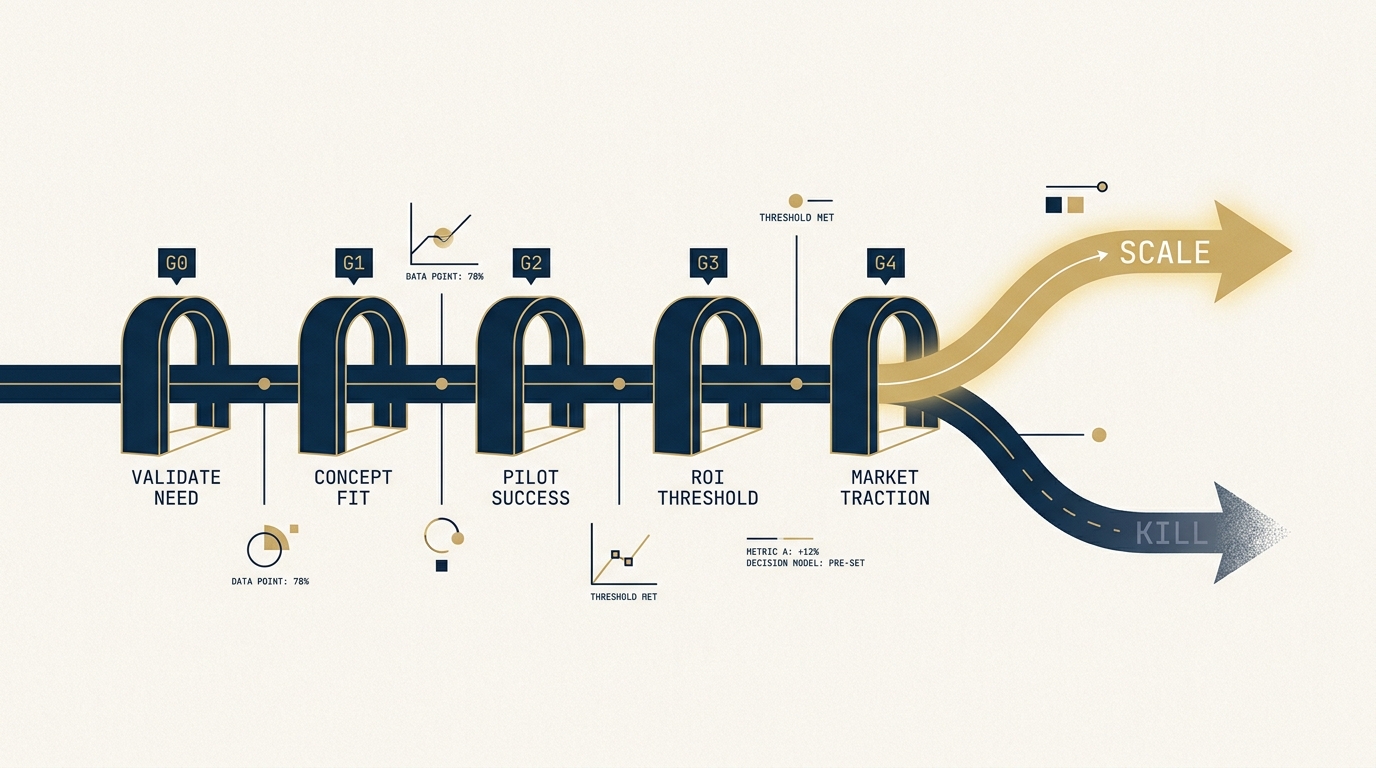
The architecture I have used most often for direct-response channel tests is a five-gate structure across a six-and-a-half-month cycle. The specific dates and thresholds vary by channel, but the structural shape is consistent:
G0: Launch Readiness. Binary. The test does not start until G0 passes. Compliance review complete. Tracking infrastructure validated. Landing pages live. Creative variants approved. Customer Relationship Management (CRM) source attribution deployed. Pre-launch infrastructure failure is the most preventable cause of inconclusive tests. Catch it before the spend begins.
G1: Learning-Phase Exit. Three to four weeks in. Each channel has exited platform learning phase. Cost Per Lead (CPL) within plus or minus 50% of plan. Minimum lead volume per channel. Action options: Go (channel proceeds), Recycle (creative refresh), Kill (channel terminated early). This is a soft gate, but it catches structurally broken tests before they consume the bulk of the budget.
G2: Cost-Per-Call Validation. Eight to eleven weeks in. Hard decision gate. Cost per call below the threshold. Show rate above the floor. Cumulative call volume above the minimum. Action options: Go (channel proceeds to concentrated budget), Kill (channel terminated, budget reallocated). Channels that fail at G2 are killed and the budget is reallocated to surviving channels in the same test cycle.
G3: Mid-Cohort Sanity Check. Sixteen weeks in. Cumulative call volume sufficient for preliminary read. Preliminary close-rate signal directionally consistent with the threshold. Action options: Go (cohort matures normally), Conditional Go (extend lead acquisition window only if capacity permits), Kill (terminate before cohort maturation). This is the last point at which the cycle can be cleanly modified before the maturation tail.
G4: Cohort Maturation Decision. Twenty-six weeks in. The binary scale-or-kill decision. Mature close rate at or above the threshold equals scale. Below the threshold equals kill. No “Hold” zone. No “Conditional Go.” Ambiguous outcomes default to kill. The three modes of the “more time” objection covers the disciplined response when stakeholders push to extend past this gate.
The “No Hold Zone” Rule
The single most important rule in the architecture is that ambiguous outcomes default to kill, not to extension. The reasoning is operational rather than statistical.
If the test was sized to settle a specific question (whether the channel can clear a 10% close-rate threshold versus a 4% baseline), the test is not sized to distinguish 7% from 10%. A close rate landing in the 6-9% statistically indistinguishable band could be reflecting a true underlying rate at threshold or below threshold. Resolving the ambiguity requires another six to nine months of data and another major budget commitment, with no guarantee of resolution at the new horizon.
The economically rational response to ambiguity is therefore to kill the channel, reallocate the budget to higher-confidence alternatives, and accept that the test did not produce a definitive verdict in either direction. The alternative is to extend, accumulate more data, and likely produce another ambiguous outcome at the new horizon. The discipline that produces decisive marketing operations is to accept that some questions do not resolve, and to make a decision rather than waiting for resolution that may never arrive.
This rule is uncomfortable for teams that have invested significantly in a channel. It is also the rule that prevents the perpetual quarterly relitigation pattern. The discomfort is the cost of the discipline.
The Locked Criteria Document
The operational artifact that makes pre-commitment work is a single document, typically one page, signed before the test launches. The document contains:
- The test name and dates. Test launch date, gate dates, decision date.
- The thresholds at each gate. Specific numerical criteria with explicit comparison standards.
- The action options at each gate. Named operational actions with explicit definitions.
- The locking authority. Named approver with authority to modify criteria mid-test, and the process required to invoke that authority.
- The default for ambiguous outcomes. Typically Kill, explicitly stated.
- The mid-cycle checkpoint schedule. Course-correction reviews that adjust tactics without modifying criteria.
The document is not long. It can be a single page. The discipline is not in the length. It is in the act of writing it down before the test begins, getting it signed, and treating it as immutable for the duration of the test.
Mid-Cycle Checkpoints Are Not Decision Gates
A distinction worth surfacing: the mid-cycle checkpoint (typically halfway through the test cycle, between G2 and G4) is a course-correction review, not a decision gate. The checkpoint can adjust operational tactics (reallocate spend across surviving channels, refresh creative, adjust audience targeting, escalate vendor output expectations). The checkpoint cannot modify the criteria at the next decision gate.
This distinction is what makes pre-commitment compatible with operational flexibility. The team retains the ability to adjust tactics in response to in-flight data. The team does not retain the ability to soften the kill criterion at the next gate. The tactical flexibility is bounded by the strategic discipline.
Why This Beats Iterative Decision-Making
The case for pre-committed gate triggers over iterative decision-making is structural. Iterative decisions are made by humans with sunk-cost biases, social commitments to colleagues running the channel, and emotional investment in the outcome. Pre-committed criteria are made by the same humans, but at a moment when they have no in-flight sunk cost, no in-flight social commitment, and no in-flight emotional investment. The decisions made at pre-commitment are systematically better calibrated than the decisions made at mid-test, on the same evidence.
The cost of pre-commitment is the discipline of writing it down. The benefit is that the test produces a terminal answer rather than a perpetual conversation. For organizations that have run channels for years without producing a terminal answer on viability, the value of the discipline is enormous.
The Implication
The discipline of pre-committed gate triggers does not change the probability that a channel works. It changes the probability that the organization will know whether it worked.
For most marketing operations functions, the second variable is more important than the first. A channel that works but cannot be confidently validated is functionally equivalent to one that does not work. A channel that does not work but is killed cleanly produces a clean budget reallocation. The architecture that produces clean validations and clean kills is worth more than the architecture that produces ambiguous outcomes either way.
If you have not run a structured channel test with pre-committed gates and locked criteria, the next test is the one to start with. The discipline is not difficult to learn. It is difficult to commit to. The teams that have made the commitment do not go back.
About the Author
Andrés Plashal
Author of the Assistive Agent Optimization (AAO) framework. Twenty years building search and measurement systems for B2B and SEC-regulated firms. Google Partner since 2017.
Credentials: UIUC Gies College of Business (Behavioral Science), Columbia College Chicago (Interactive Arts & Media). Member: American Marketing Association, GAABS, Paid Search Association. Published researcher (SCTE/NCTA).