The 'More Time' Objection: Three Modes and Their Honest Answers
The Most Expensive Answer in Channel Validation
The most expensive answer in marketing channel validation is “give it more time.” Not because giving channels more time is always wrong, but because the phrase is used to cover three structurally different requests that deserve different responses. Most teams do not distinguish among them. The undifferentiated request becomes the default response to every ambiguous test outcome, and the result is years of channel investment that never produces a binary terminal answer.
The discipline that separates effective marketing operations from perpetual quarterly relitigation is the discipline of naming which mode of “more time” is being requested, and responding accordingly.
Mode One: More Time on the Existing System
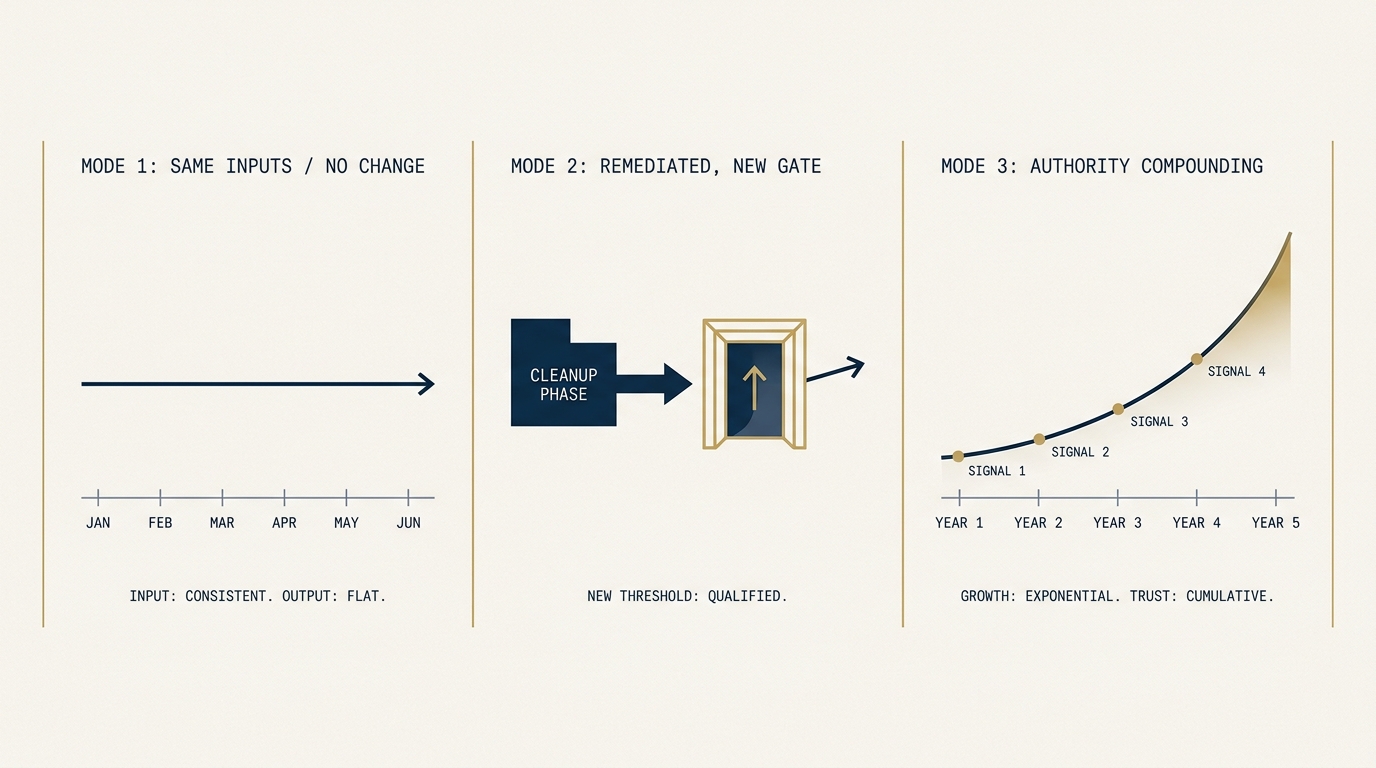
The first mode of the objection is the request to continue running the channel on the same inputs, at the same velocity, with the same operational shape, for another quarter or another year. This is the mode the threshold versus forecast framing is designed to short-circuit, because a pre-committed threshold turns “more time” requests into an explicit reopening of a closed decision.
This mode does not survive empirical scrutiny. If the channel has been operating long enough to produce data, and the data is below the threshold, more time on the same inputs at the same velocity produces the same outputs. There is no mechanism by which the existing system produces different outcomes from extended runtime. The request is mathematically equivalent to flipping a weighted coin a hundred more times and expecting the distribution to change.
The honest response to mode one is to surface the underlying logic. “What specifically about the next three months will produce a different result from the last three months?” If the answer is a concrete operational change (different creative, different audience, different landing page, different salesperson), the request is not really mode one. It is mode two. If the answer is some version of “the channel needs to compound” without a concrete change in inputs, the request is mode one, and it deserves a kill decision rather than an extension.
Mode Two: More Time After the Gaps Are Fixed
The second mode of the objection is the request to extend the channel test after a documented cleanup or remediation phase that addresses specific issues the initial test surfaced.
This mode is the strongest version of the objection and is frequently defensible. If the initial test surfaced concrete operational issues (a salesperson who was the wrong fit for cold paid traffic, landing pages that were converting below the platform median, attribution gaps that were systematically underreporting closes), and a remediation plan addressing each issue has been documented and committed, then a second test cycle at the post-remediation horizon is a defensible request.
The discipline that distinguishes a legitimate mode two request from a disguised mode one is the pre-commitment of:
- The specific issues being remediated, named and documented.
- The remediation plan, time-bounded with completion criteria.
- A new threshold gate at the post-remediation horizon.
- A kill criterion at the new gate that applies the same standards as the original test.
If those four elements are pre-committed, the mode two request becomes a structured second cycle of the same disciplined process that produced the original kill criterion. If any of the four is missing, the request collapses into mode one with extra steps.
Mode Three: More Time at the Authority-Compounding Horizon
The third mode of the objection is the request to extend the measurement horizon because the channel’s underlying mechanism compounds on a timeframe longer than a typical test cycle can resolve.
This mode applies to authority-compounding channels: organic search in YMYL (Your Money or Your Life) verticals, public relations programs, awards and recognition pursuits, named-byline placement, conference circuit work, and similar mechanisms where the return is structurally backloaded. For these channels, a six-month test does not produce decision-grade data because the underlying mechanism has not had time to compound.
The honest response to mode three is to change the test variable. Instead of measuring whether the channel produced X outcomes in Y months, the test measures whether the channel is producing the trajectory consistent with the compounding model. Is the firm earning the editorial placements that authority engines produce in year one? Is the named-byline output landing in tier 1 and tier 2 outlets? Is the conference and podcast circuit producing the appearances that should precede recognition?
If the trajectory variables are tracking, the channel is working on the timeframe it operates on, even if the direct attribution closes have not yet materialized. If the trajectory variables are not tracking, the channel is not working, and extending the horizon will not save it.
The mode three answer is therefore not “give it more time at the original measurement framework.” It is “change the measurement framework to one that matches the channel’s mechanism.” Direct attribution closes are the wrong KPI for authority-compounding channels. Trajectory milestones are the right KPI.
The Failure Mode the Three Modes Diagnose
The single most common failure mode in channel investment is conflating the three modes of the objection. A team running a direct-response channel that has produced 12 months of below-threshold data starts citing the authority-compounding argument (“authority signals take years to compound”) to justify continued investment in a channel whose mechanism does not compound on those timescales. A team running an authority-compounding channel measures the program by direct attribution and concludes it is failing after six months, when the relevant variable would have been editorial placement count rather than direct closes.
The diagnostic question for any team confronting an extension request is: which mode is this actually? If it is mode one, the answer is the kill criterion that was pre-committed. If it is mode two, the answer is the structured second cycle with the new threshold gate. If it is mode three, the answer is the trajectory measurement framework appropriate to the channel’s actual mechanism. The conversation that fails to distinguish among the three produces the perpetual quarterly relitigation that is the most expensive pattern in marketing operations.
The Synthesis
The phrase “more time” is doing real work in the three modes. In mode one it is a refusal to accept the data. In mode two it is a request for a structured second cycle. In mode three it is a request to change the measurement framework to one that matches the channel.
The discipline that produces good marketing decisions is to name which mode is being requested, in writing, before the conversation about the extension begins. If the request is mode one, kill the channel and reallocate the budget. If it is mode two, structure the second cycle with the same kill discipline as the first. If it is mode three, change the KPI to trajectory measurement and set a new evaluation horizon appropriate to the channel’s mechanism.
Most teams have run all three modes simultaneously, on the same channel, without distinguishing among them, for years. The distinction is what turns “more time” from the most expensive answer in channel validation into the most disciplined one. Both versions exist. Naming the difference is the work.
Related Reading
- The 4% Close Rate Is the Industry Baseline gives the empirical anchor that grounds mode-three trajectory measurement in advisory paid acquisition.
- Absence of Evidence Is Evidence is the long-form case for why mode-three “give it more years to compound” is itself sometimes the wrong question when no comparable firm has made the channel work.
About the Author
Andrés Plashal
Author of the Assistive Agent Optimization (AAO) framework. Twenty years building search and measurement systems for B2B and SEC-regulated firms. Google Partner since 2017.
Credentials: UIUC Gies College of Business (Behavioral Science), Columbia College Chicago (Interactive Arts & Media). Member: American Marketing Association, GAABS, Paid Search Association. Published researcher (SCTE/NCTA).