The Content Gate: Passage-level Extractability for AI Search
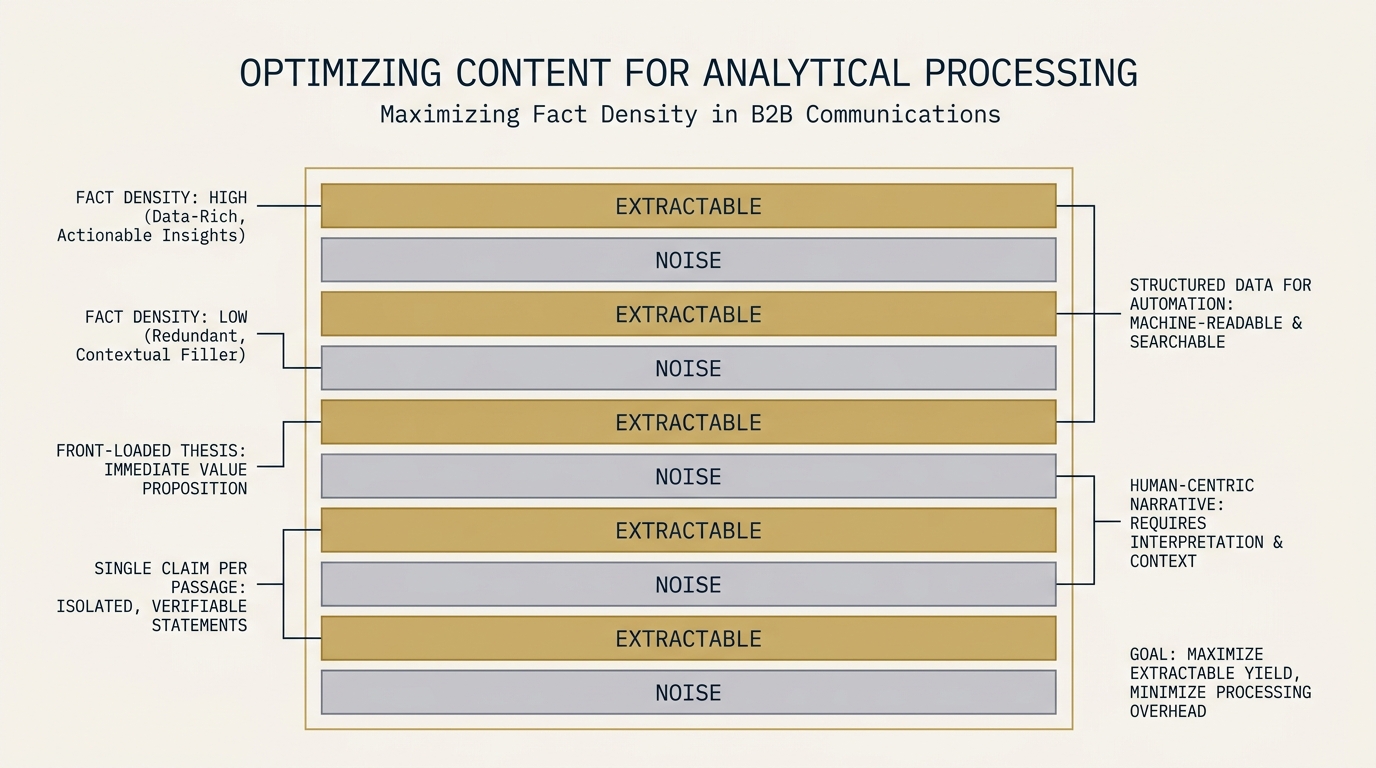
The Page Is Not The Unit
Discovery and Structure are about getting your page to the AI crawler in a parseable form. Content is about what happens next. The crawler extracts the page, but the LLM does not read the page. It reads passages. A typical extraction window is 200 to 800 tokens, which is roughly two to six paragraphs of prose. The cited claim comes from a single passage, not from the page as a whole.
This changes what “good content” means. Each passage must independently pass a quality threshold, because each passage is what the LLM evaluates when deciding whether to cite. A 2,000-word post is, from the DSCRI ARGDW framework Content gate perspective, six to ten passages stitched together. The gate scores them individually.
The 200 to 800 Token Chunk Reality
LLMs build retrieval indexes by chunking pages. The exact chunk size varies by engine (Perplexity tends shorter, Claude longer, OpenAI variable by query type) but the band is consistent: 200 to 800 tokens. A token is roughly 0.75 words in English. So a passage is between 150 and 600 words.
The crawler extracts the full page. The chunker splits it. The retriever scores each chunk for query relevance independently. The reader (the LLM in user-facing position) sees only the chunks the retriever surfaced. If your single most citable claim sits in a paragraph that contains four other claims and 200 words of context, the retriever may decide a different page has a tighter passage and skip yours.
The implication: write so that every paragraph is a complete, citable unit on its own. A passage that requires the prior paragraph for context is a passage the retriever may not surface.
The Inverted Pyramid For LLM Consumption
Front-load the thesis. Journalism has known this for a century: the lede contains the conclusion, the body adds support, the bottom is for the readers who actually care. LLM consumption follows the same pattern, with one amplification: the retriever ranks passages, and front-loaded passages outrank wandering passages because they survive the chunk boundary intact.
A common failure mode in B2B content is the warmup paragraph. The writer opens with context (the industry, the trend, the reader’s likely position) and arrives at the thesis in paragraph three. By the time the thesis lands, the chunker has already cut the lede into one chunk and the thesis into another. The thesis chunk lacks the framing; the lede chunk lacks the claim. Both score lower than they would have if combined.
The fix is structural: every section opens with its thesis sentence. Context follows. The lede paragraph of the post is the most aggressive version of this: state the conclusion in the first sentence of the first paragraph. The schema is necessary not sufficient post opens with the case study result that reframes the argument; the framing arrives second. That is the shape.
Fact Density Per Passage
The Content gate scores passages on fact density. A passage with three quantified, sourced, citable claims outscores a passage with one claim and 200 words of qualifying prose. The reason is not that LLMs prefer dense writing aesthetically; the reason is that the retriever’s ranking signal is “how many of the user’s query terms does this passage answer.” A dense passage answers more.
Three rules of thumb:
- One claim per paragraph, fully supported. Not “TV is effective for B2B finance”; instead, “TV ROAS in B2B finance ranges from 0.8x to 2.5x depending on audience targeting, per the 2025 Nielsen B2B media efficiency study.”
- Sources inline, not in footnotes. The retriever reads the passage, not the footnotes section at the bottom of the page. Cite in the prose.
- Quantify when honest. “Many firms” is uncitable. “Roughly two thirds of audited firms” is citable. “62% of audited firms” is more citable when the underlying sample is documented.
Why Wandering Ledes Kill Citation
A YMYL post on technical SEO opened with three paragraphs of trend framing before arriving at its specific argument: that schema is necessary but not sufficient for AI search citation. The post ranked competitively on broad-match queries. It was never cited on the specific argument.
Diagnostic: the chunker split the post into eight passages. Passages one through three were trend framing. Passages four and five contained the argument. The retriever, asked queries about “schema vs authority for AI search,” ranked passages four and five against the question but ranked them below tighter passages on competing pages that opened with the same argument.
The fix was a 90-minute lede rewrite. The first paragraph stated the argument in its strongest form. The trend framing moved to paragraph two as supporting context. Three weeks later, the post was cited on the specific query for the first time. No body content changed.
The Content Gate Versus The Recency Gate
Both gates run continuously. The Content gate scores extractability and fact density. The Recency gate scores how recently the passage was published or updated. They compose: a high-Content passage that is stale loses citation to a slightly weaker passage that is fresh, on time-sensitive queries.
The implication for editorial discipline: review high-value posts on a six-month cadence and update them. Refreshing dateModified in the schema is necessary but not sufficient; the body must also reflect current data. The Recency Gate post in this series covers the change-log discipline that makes updates citable.
Worked Example
A finance firm published a 1,800-word post on multi-touch attribution in 2025. The post ranked top three on the target query and earned modest organic traffic. ChatGPT, asked about MTA decay windows, did not cite the post.
Audit: the post opened with a 250-word framing section about the death of last-click attribution. The actual argument (that 30 to 90 day MTA decay windows outperform last-click for high-consideration B2B sales) lived in paragraphs five through seven. The chunker split the post such that no single passage contained both the question setup and the answer. Each chunk had half the citation-worthy content.
The fix: rewrite the lede into a single front-loaded paragraph. State the answer in sentence one. State the supporting evidence in sentences two and three. Cite the underlying study in sentence four. Move the framing into the body. Update dateModified.
Three weeks after redeploy, ChatGPT cited the post twice in a week on the target query. The argument did not change. The shape did.
Frequently Asked Questions
How long should a passage be to optimize for chunking?
Aim for 100 to 200 words per paragraph as the upper bound. The chunker will often combine two short paragraphs into one chunk and rarely splits a single paragraph mid-sentence. Writing in the 100 to 200 word range gives the chunker clean splits that align with editorial intent.
Should I add a TL;DR section at the top of every post?
If the lede paragraph already states the thesis, a TL;DR is redundant. If your lede is structurally a warmup, a TL;DR is a band-aid. The right answer is a strong lede; a TL;DR is a fallback if you cannot or will not rewrite the lede.
Does this conflict with SEO best practices around keyword placement?
No. Front-loading the thesis is consistent with classical SEO advice to include the primary keyword in the first 100 words. The Content gate amplifies that advice rather than contradicts it.
How do I know which of my passages are getting cited?
Audit citation behavior across Perplexity, ChatGPT, Claude with web access, and AI Overviews. Ask each engine variations of the queries you target. Note which passages get quoted versus paraphrased versus ignored. The pattern surfaces within an hour of focused checking.
Is FAQ schema a way to satisfy the Content gate?
Partially. FAQ schema chunks naturally because each Q-A pair is structurally a passage. It is one of the easiest shapes for the chunker to handle cleanly. The Granularity Gate post in this series covers when FAQ schema helps and when it dilutes citation.
Next Gate
The next Tuesday post in this series covers the Reputation Gate: why backlink composition (not raw Domain Rating) and cross-source corroboration are what AI engines weight on YMYL queries.
About the Author
Andrés Plashal
Author of the Assistive Agent Optimization (AAO) framework. Twenty years building search and measurement systems for B2B and SEC-regulated firms. Google Partner since 2017.
Credentials: UIUC Gies College of Business (Behavioral Science), Columbia College Chicago (Interactive Arts & Media). Member: American Marketing Association, GAABS, Paid Search Association. Published researcher (SCTE/NCTA).