The Brand-Attribute Claim Graph for AEO
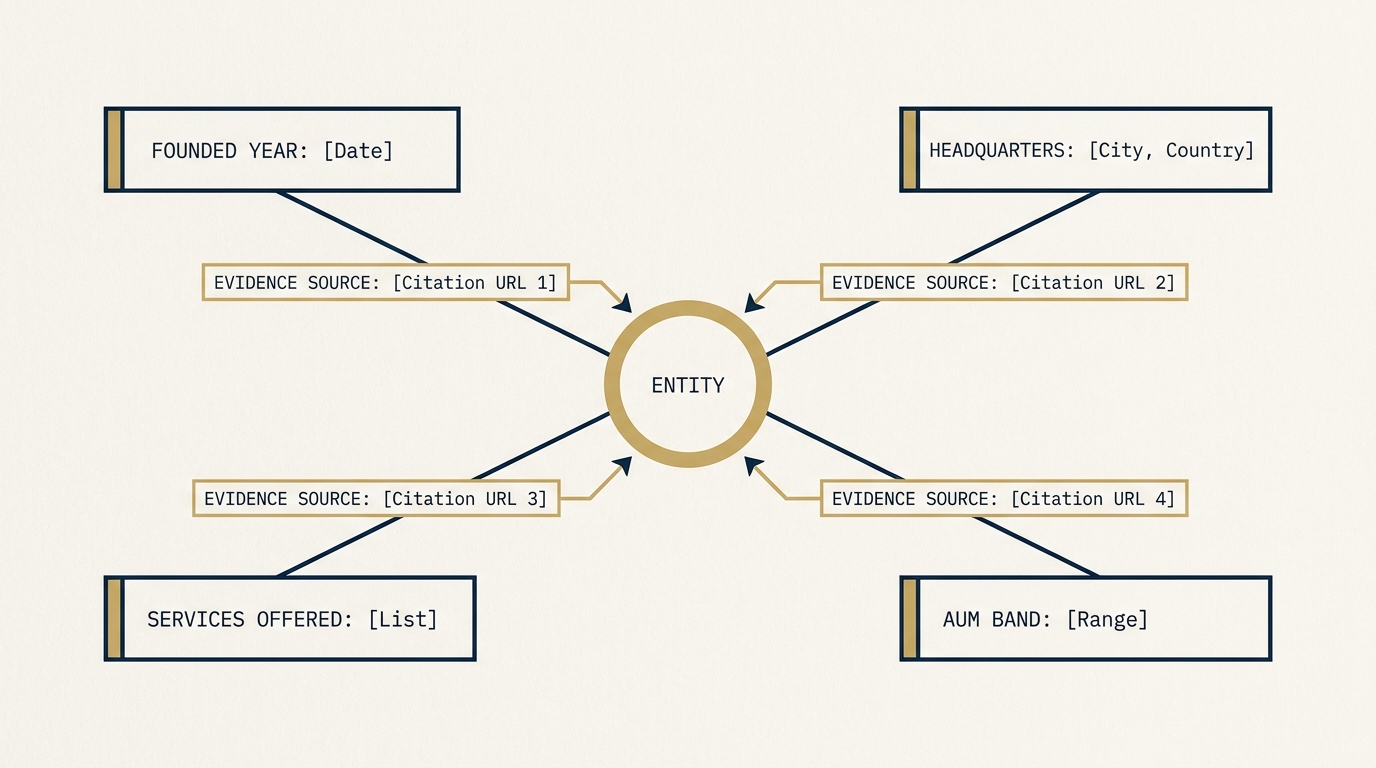
Claims About An Entity Form A Graph
Your firm makes claims about itself constantly. “Founded in 2014.” “Headquartered in Pittsburgh.” “Serves clients in eight states.” “Specializes in private equity backed firms.” Each of these is an attribute claim. Some live on the website; some live in press releases; some live only in conversation. AI engines extract whichever ones they can find and verify, and assemble them into a representation of the entity that downstream queries are answered against.
If the engines find consistent, evidence-backed claims across multiple surfaces, the entity is well-grounded. If the engines find contradictions or unsupported assertions, the entity is poorly-grounded and the citations that follow are weaker. This post covers how to structure your brand-attribute claim graph so it grounds well.
What An Attribute Claim Is
An attribute claim has three parts:
-
Subject. The entity making or being described by the claim. For most B2B finance firms, the subject is the firm itself (an Organization in schema.org terms) or the firm’s principal (a Person).
-
Predicate. The relationship the claim asserts. “Founded year,” “headquarters location,” “services offered,” “AUM band,” “founder name.” Predicates correspond to schema.org properties when possible.
-
Evidence. A source the claim can be verified against. Internal sources (the firm’s own About page) are weaker than external sources (a third-party press article). Both are useful; external sources are load-bearing for credibility.
A claim without evidence is an assertion. AI engines extract assertions but downrank them in citation. A claim with verified evidence becomes part of the entity’s defensible brand graph.
How LLMs Verify Claims
An AI engine reading a claim about your firm runs a verification pass before treating it as authoritative. The pass typically involves:
-
Cross-source check. Does the same claim appear in a second independent source? “Founded in 2014” on the firm’s website plus the same on Crunchbase plus the same in an SEC ADV passes; “Founded in 2014” only on the firm’s website is weak.
-
Consistency check. Are claims within the firm’s own surfaces consistent? If the website says 2014 and a press release says 2015, both claims get downranked.
-
Predicate-evidence match. Does the evidence actually support the predicate? “Specializes in private equity backed firms” supported by a single client testimonial is weaker than the same claim supported by a published case study set.
Claims that pass all three become reliable for citation. Claims that fail any are extracted but used cautiously.
The Three-Part Structure In Schema
The brand-attribute claim graph should be encoded in schema where the predicates map to schema.org properties. Three patterns:
-
Direct properties on Organization.
foundingDate,address,areaServed,numberOfEmployees,slogan. These are extracted directly from the Organization node in your homepage JSON LD. Use them liberally for claims that have schema.org predicates. -
sameAs references for cross-source corroboration.
sameAspointing to Wikidata, LinkedIn, Crunchbase, Bloomberg. Each reference is a cross-source check the engine can run automatically. -
About page with structured claim list. A
/about/page that includes a structured list of attribute claims, each with a source link. Mark up the page asAboutPageand the entity as themainEntity. The structured list serves both human readers and AI extractors.
The Structure Gate post covers the schema graph composition pattern. The brand-attribute work sits inside that pattern.
Publishing The Brand Claim Graph
A workable pattern for B2B finance firms:
-
Inventory the claims. List every factual statement your firm makes about itself: founding year, headquarters, founders, services, client categories, awards, partnerships, certifications. Aim for 15 to 30 entries.
-
Identify the evidence per claim. For each, find the strongest external evidence available. Press articles, regulatory filings, professional database entries, awards lists.
-
Resolve inconsistencies. Audit the claims across the website, press releases, and database profiles. Fix any contradictions. The cost of leaving a contradiction in place is higher than the cost of correcting it.
-
Encode in schema. Update Organization schema to include direct properties for as many claims as map cleanly. Add
sameAsreferences for cross-source corroboration. -
Publish a structured About page. Group the claims by category (provenance, services, recognition). Each claim has a brief explanation and a source link.
The work is editorial more than technical. Most firms can complete the inventory in two hours and the schema and About page in a focused day.
Worked Example
A specialist wealth management firm we audited had three founding-year claims floating across surfaces: 2013 on the homepage, 2014 in the most recent press release, 2012 in the founder’s Forbes bio. The discrepancy had no operational consequence and the team had not noticed.
ChatGPT, asked when the firm was founded, returned “around 2013” with low confidence. Perplexity returned “between 2012 and 2014 depending on source.” Claude declined to characterize because of the inconsistency.
Fix: the founder confirmed the actual founding date (2013), corrected the press release and Forbes bio (Forbes accepted the correction), updated the schema, added Crunchbase as a cross-reference. Three weeks later, both Perplexity and ChatGPT returned “2013” with confidence. The single attribute that had been ambiguous for years had been fixed in two hours.
The same pattern repeated for AUM band, service categories, and headquarters location across the firm’s three offices. Each fix is small; the cumulative effect on entity grounding is substantial.
Frequently Asked Questions
What if my firm cannot publish certain attributes (AUM, employee count)?
Skip them. The claim graph is the set of attributes you choose to make public. Omitting some attributes is fine; making contradictory claims about them is not. Better to have no AUM claim than to have three different AUM claims across surfaces.
How does this interact with Discovery and Reputation?
Discovery is about whether the engine finds your entity. Brand-attribute claim graph is about what the engine concludes once it has found you. Reputation is about which third parties corroborate your claims. The three compose into the entity’s overall AI search standing.
Should I publish the claim graph as a single page or distributed across the site?
Both work, with different trade-offs. A single About page is easier to maintain and easier for the engine to find. Distribution across the site (homepage, services pages, individual founder bios) covers more retrieval surface but requires more discipline to keep consistent.
How often should I audit the claim graph for consistency?
Annually for stable firms; semi-annually for firms with active growth (acquisitions, expansions, new partnerships). Set a calendar reminder. The audit takes one to two hours and prevents drift.
Do third-party platforms (Crunchbase, LinkedIn, Bloomberg) need to be updated when claims change?
Yes. Each platform should reflect current claims. The cost of an outdated Crunchbase profile is small per platform but compounds across the entity graph.
Next In Series
The next Thursday post covers FAQPage schema in 2026: why Google dropped most rich results for FAQ schema in 2023 but AI engines still reward it, and when to use FAQPage versus when to skip it.
About the Author
Andrés Plashal
Author of the Assistive Agent Optimization (AAO) framework. Twenty years building search and measurement systems for B2B and SEC-regulated firms. Google Partner since 2017.
Credentials: UIUC Gies College of Business (Behavioral Science), Columbia College Chicago (Interactive Arts & Media). Member: American Marketing Association, GAABS, Paid Search Association. Published researcher (SCTE/NCTA).