FAQPage Schema: The Structural Difference Between Google Rich Results and AI Citation
Google Dropped It. AI Did Not.
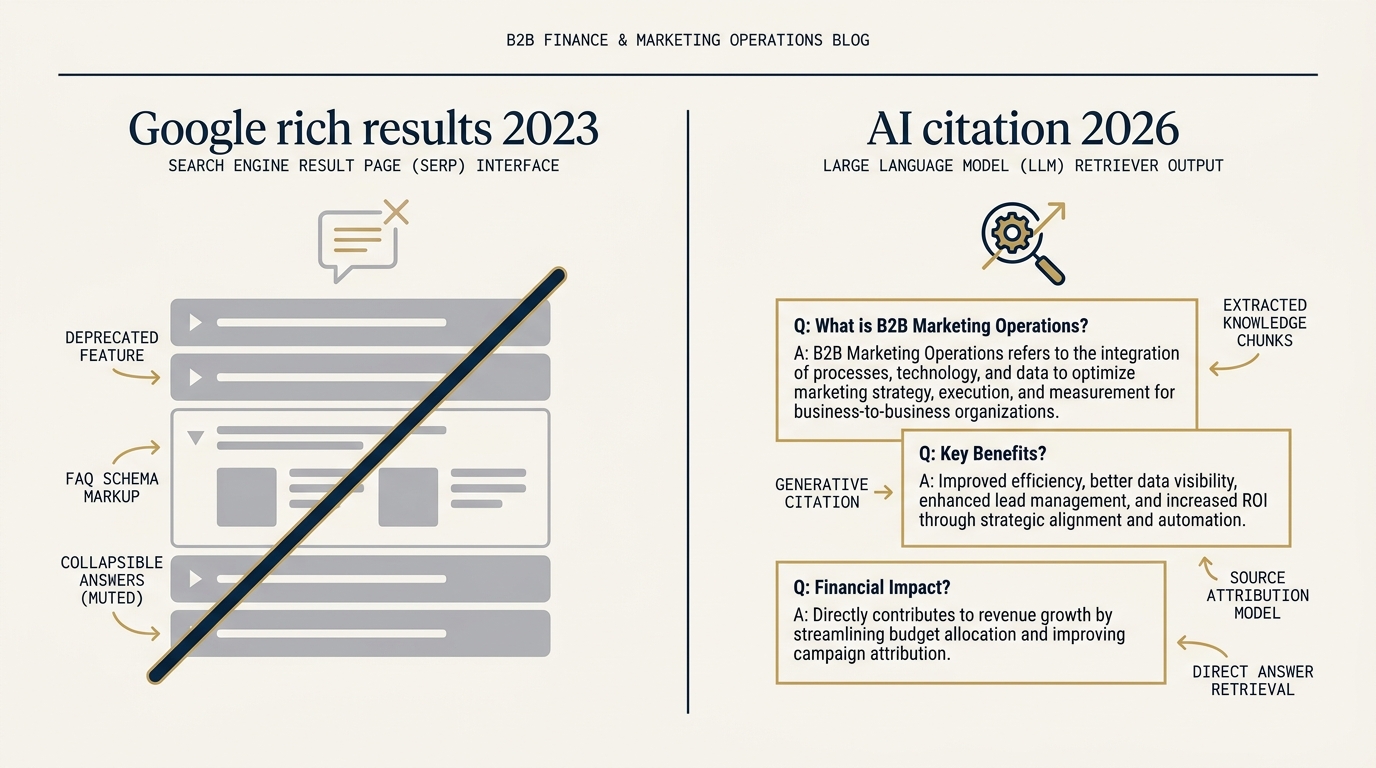
In August 2023, Google deprecated FAQ rich results for most domains. The decision affected the visible Search Engine Results Page treatment: FAQ schema no longer produced the expandable accordion in SERPs for most sites. Many SEO teams interpreted this as a signal to remove FAQPage schema entirely.
The interpretation was wrong. AI search engines, which were not yet at scale in 2023, continued to use FAQPage schema as a retrieval signal. By 2026, FAQ schema is one of the strongest tools for passage-level extractability on a page. Removing it for Google was a SERP optimization that costs AI citation visibility now.
This post covers why FAQ schema still matters for AI citation, when to use it, and the structural pattern that performs across both Google’s reduced rich results behavior and AI extraction.
What Changed In 2023 For Google
The Google change in August 2023 reserved FAQ rich results for “well-known, authoritative government and health websites.” Commercial domains lost the SERP visibility. The schema itself was not removed from Google’s structured data documentation; the rich result treatment was just narrowed.
Practical implications for commercial sites:
- FAQ accordions no longer appear in Google SERPs.
- The visible SERP real estate that FAQ schema had won went to other features (People Also Ask, AI Overviews).
- Some teams removed the schema, treating it as no longer useful.
- Sites that kept the schema retained the underlying structured data benefit without the visible reward.
Why AI Engines Still Extract FAQ Pairs
The chunking pattern documented in the Granularity Gate post explains the AI extraction behavior. AI retrievers treat each Q-A pair in FAQPage schema as a discrete extraction unit. Each pair becomes a retrieval candidate independent of the surrounding chunk boundaries.
The structural advantages of FAQ pairs from a retrieval perspective:
-
The question is a query reformulation. The retriever can match a user query against the FAQ question directly. The match is fuzzy but reliable.
-
The answer is a self-contained passage. The answer does not require surrounding context. A 50 to 200 word answer is the right size for citation quotation.
-
The schema markup tells the retriever this is a Q-A pair. Without the schema, the retriever has to infer the structure from header hierarchy. With schema, the structure is declared.
The three advantages combine. A page with five FAQ pairs has five additional retrieval candidates beyond the main body. Each can rank against a different sub-query (per the query fan-out post).
When To Use FAQPage And When To Skip It
Use FAQPage when:
- The page covers a topic that genuinely has common reader questions.
- The Q-A pairs are reader-facing (questions the audience actually asks) rather than SEO-targeted (questions invented for keyword coverage).
- The answers are 50 to 200 words each, self-contained, and front-loaded.
- The Q-A pairs add real value beyond what the body content already covers.
Skip FAQPage when:
- The page is a manifesto or argument that does not break naturally into Q-A pairs.
- The questions read as artificial keyword-coverage exercises.
- The answers are short snippets that loop back to the body (“see above”).
- The page already has strong h2 hierarchy that covers the same retrieval surface.
A useful rule: if you would not include the FAQ section for a human reader, do not include it for the schema. Forced FAQ sections read as padding and AI engines downrank pages that pad.
The Production Pattern
A workable FAQPage implementation for a B2B finance blog:
-
Five to eight Q-A pairs per long-form post. Fewer for shorter posts (1,000 words or less can skip FAQPage entirely).
-
Questions phrased as literal questions. “How long does an MMM analysis take?” not “MMM timeline.” The literal question matches user query reformulation.
-
Answers self-contained at 50 to 200 words each. Each answer should stand alone if extracted as a citation. No “as discussed above” or “see the previous section.”
-
Schema emitted alongside BlogPosting in the same
@graph. Use the@idlinking pattern from the Structure Gate post. -
Visible FAQ section in the page body. AI engines extract from the visible content plus the schema. The visible FAQ also serves human readers; the schema makes it machine-readable.
The Astro Foundation pattern emits FAQPage schema automatically when frontmatter includes a faqs array. Sites without the foundation pattern can hand-write the schema or use a templating helper.
Worked Example
A B2B SaaS firm in fintech had five long-form posts in their blog. Three had FAQPage schema; two did not. The three with FAQ schema each received steady citation traffic from Perplexity (one to three citations per week per post). The two without FAQ schema received Google traffic but no AI citations.
Audit: the two posts without FAQ schema were not obviously different in topic from the three with it. The same authors. Same depth. Different chunk structure: the three with FAQ pairs were getting cited specifically on questions that matched the FAQ questions, while the two without had no question-shaped retrieval surface.
Fix: added FAQ sections with schema to the two unscored posts. Five questions each, grounded in actual reader questions from the firm’s customer support inbox. Three weeks later, both posts started receiving Perplexity citations. The body content had not changed; the retrieval surface had expanded.
Frequently Asked Questions
Will Google penalize me for using FAQPage schema even though it does not render the rich result?
No. Google’s documentation explicitly supports the schema; the change was to the rich result rendering, not the schema validity. Pages with FAQPage schema rank normally in Google.
How does this interact with the Content Gate?
FAQPage extraction is one form of passage extraction. The Content Gate scores extractability generally; FAQPage is a specific structural pattern that makes extraction unambiguous. The two compose: a page with FAQPage schema plus high-Content passages in the body covers maximum retrieval surface.
Should I duplicate body content as FAQ pairs?
Avoid direct duplication. A Q-A pair that paraphrases an existing body section is acceptable; a Q-A pair that copies text verbatim from the body adds nothing extractable that the body did not already provide. Each FAQ pair should answer a slightly different question or framing than the body.
Is there a maximum number of FAQ pairs per page?
Diminishing returns above 6 to 8 pairs. Pages with 15 or 20 FAQ pairs start to read as keyword padding, and the AI engines downrank padding patterns.
Does this work for product pages, not just blog posts?
Yes. Product and service pages with FAQ schema (often “Common Questions about [Service]”) rank well on AI citation for service queries. The structural advantage is the same; the content category is different.
Next In Series
The next Tuesday post covers llms.txt patterns that beat the spec: the minimum the llms.txt convention requires and the real-world extensions that produce stronger AI search signals.
About the Author
Andrés Plashal
Author of the Assistive Agent Optimization (AAO) framework. Twenty years building search and measurement systems for B2B and SEC-regulated firms. Google Partner since 2017.
Credentials: UIUC Gies College of Business (Behavioral Science), Columbia College Chicago (Interactive Arts & Media). Member: American Marketing Association, GAABS, Paid Search Association. Published researcher (SCTE/NCTA).