Endorsement Disclosures: When to Disclose, When Not, and the Gray Zone
Endorsements Run Parallel To Testimonials
Where a testimonial is a statement by a current or former client, an endorsement is a statement by a non-client. The two regimes are parallel but distinct. An endorsement by a paid influencer, a compensated industry expert, or a third-party promotional partner triggers disclosure obligations that mirror but do not duplicate the testimonial framework. Multiple frameworks apply simultaneously: SEC Marketing Rule for RIA endorsements, FINRA Rule 2210 for broker-dealer endorsements, and the FTC Endorsement Guide as the federal overlay for any commercial endorsement.
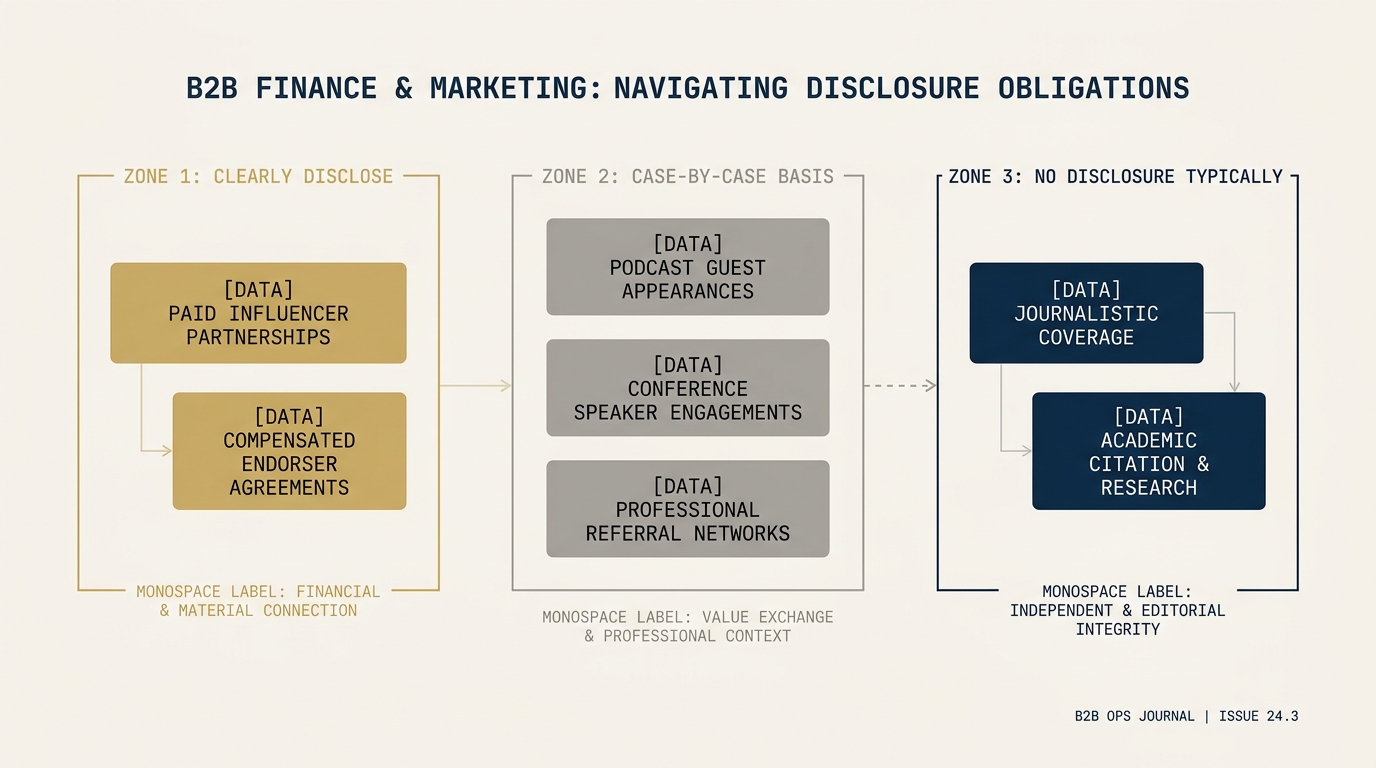
This post covers the three-zone decision framework: clear-disclosure scenarios, the gray zone that catches most firms, and the limited cases where no disclosure is typically required. The framing is operational; refer to counsel for jurisdiction-specific application.
Zone One: Clear Disclosure Required
Five scenarios where disclosure is clearly required across all applicable frameworks:
-
Paid influencer partnerships. An influencer paid to mention or recommend the firm. Disclosure must be clear and prominent in the content itself, not buried in profile bio.
-
Compensated industry experts. A non-client expert paid for endorsement content (podcast appearance fees, sponsored quotes, contracted commentary). Compensation triggers disclosure regardless of expert qualifications.
-
Affiliate or referral partnerships. A non-client who promotes the firm in exchange for a referral fee or revenue share. The compensation arrangement requires disclosure.
-
Promotional contests where the recipient endorses. A “case study contest” where a winner provides commentary in exchange for the prize. Even non-cash compensation triggers disclosure.
-
Internal employee endorsements presented as third-party. An employee posting a personal endorsement that does not identify their employee status. The non-disclosure of the employment relationship is itself the violation.
Each scenario maps to the same five-element disclosure structure documented in the testimonial advertising post: status, compensation, conflicts, representative nature, advisor information.
Zone Two: The Gray Zone
Most firms get caught in the gray zone. Three patterns that surface most often:
Podcast guests who mention the firm favorably. A podcast host invites a non-client guest who, in the conversation, mentions the firm positively. The host received no payment from the firm. The guest received no payment. The conversation is editorial. The question: does the favorable mention trigger endorsement disclosure if the firm later promotes the podcast clip in its own marketing?
Operational guidance: when the firm promotes the clip, the firm has converted editorial into endorsement. Disclosure becomes prudent even though the original conversation was editorial. The conversion happens at the moment of promotional use.
Conference speakers who reference the firm in keynotes. A speaker at an industry event references the firm as part of a broader argument. The reference is editorial; the speaker has no relationship with the firm. The firm then quotes the reference in marketing.
Operational guidance: similar to the podcast case. Editorial reference promoted by the firm becomes endorsement. Disclosure becomes prudent at the moment of promotional use, even when the original reference was editorial.
Professional referrals between firms. A non-competing firm refers business to your firm. The referring firm receives a fee or revenue share. The referral becomes endorsement if the referring firm publishes any content promoting your firm.
Operational guidance: referral arrangements should be reviewed for disclosure obligations on both sides. The referring firm’s promotional content is endorsement; your firm’s acceptance of referrals does not trigger your own endorsement obligations unless your firm publishes content based on the referral.
The gray zone is the most common audit-finding category. The fix is conservative interpretation: when in doubt, disclose.
Zone Three: No Disclosure Typically Required
A narrower set of cases where disclosure is typically not required:
-
Pure journalistic coverage. A reporter writes a piece that includes commentary on the firm. The reporter is independent, the publication is editorial, the firm received no advance review or compensation. No endorsement disclosure; the firm did not commission the piece.
-
Academic citation. A peer-reviewed paper that cites the firm’s work or methodology. The academic publication is editorial and independent. No endorsement disclosure required for the citation itself, though the firm should not promote the citation as endorsement without considering whether promotional use converts the context.
-
Government and regulatory references. A regulatory filing or government report that mentions the firm. The reference is factual and independent.
-
Awards lists and rankings published by third parties. An award given by an independent body. The firm’s existence on the list is editorial. The firm’s promotion of the award is an editorial-to-marketing conversion, but the award itself is not an endorsement requiring disclosure.
Note: in each of these cases, the firm’s promotional use of the editorial content can change the analysis. Promoting a journalist’s piece in paid creative may carry obligations even when the original piece did not.
Operational Audit Pattern
A workable audit for endorsement compliance:
-
Inventory active endorsement relationships. Influencer contracts, podcast partnerships, referral arrangements, paid expert commentary.
-
Classify each relationship. Paid, unpaid, mixed (cash plus product), referral-only. Compensation type drives disclosure form.
-
Audit existing promotional content. Any creative that includes endorsement quotes is reviewed against the five-element disclosure structure.
-
Build a pre-publication review queue for new endorsements. Endorsement content goes through compliance review before launch, with disclosure language pre-approved.
-
Document the policy. A written endorsement policy with examples and the disclosure language template.
Worked Example
A wealth management firm we audited had a podcast partnership with a finance educator. The educator received no direct payment from the firm, but the firm provided “topic suggestions” and reviewed episodes pre-publication. The relationship was informal and had not been documented.
The audit finding: the topic suggestions plus pre-publication review crossed the threshold into an arrangement that required disclosure. The firm had not been disclosing the relationship.
Remediation: a written partnership agreement that defined the relationship, plus disclosure language added to all podcast content where the firm had editorial involvement. Going forward, all sponsored or coordinated content carried clear disclosure. The remediation took four weeks; no enforcement followed.
Frequently Asked Questions
Does this apply to LinkedIn or Twitter posts by industry commentators?
Potentially yes. If the commentator is paid, compensated, or has a referral arrangement with the firm, disclosure applies. If the commentator is independent and the firm has no relationship, the post is editorial.
What about content the firm did not commission but later promotes?
Promotional use of third-party content often converts editorial to endorsement-like status. Conservative interpretation: when promoting third-party content in firm marketing, treat it as endorsement and apply disclosure.
Is there a de minimis threshold for compensation?
The SEC Marketing Rule does not have an explicit de minimis. Even small compensation (a $50 gift card, a free product, a meal) is generally compensation. Conservative interpretation treats any compensation as triggering disclosure.
Does the FTC Endorsement Guide apply to all financial firms?
The FTC Endorsement Guide is a federal overlay for commercial endorsements. It applies to firms broadly, including RIAs and broker-dealers, in addition to the SEC/FINRA frameworks. The FTC framework focuses on consumer protection; multiple regimes can apply simultaneously.
How do I handle anonymous endorsements?
Anonymization does not exempt the endorsement. Disclosure requirements apply to the content of the endorsement and the compensation relationship. Anonymization affects what disclosures are practical; the compensation and conflict disclosures still apply.
This is operational guidance for marketing teams, not legal advice. Consult firm counsel for jurisdiction-specific application of endorsement rules and the FTC Endorsement Guide overlay.
Next In Series
The next post covers lead generation pages: the case study disclaimer pattern that holds up under audit. Case studies sit at the intersection of testimonial and endorsement compliance; the pattern that satisfies both regimes is portable.
About the Author
Andrés Plashal
Author of the Assistive Agent Optimization (AAO) framework. Twenty years building search and measurement systems for B2B and SEC-regulated firms. Google Partner since 2017.
Credentials: UIUC Gies College of Business (Behavioral Science), Columbia College Chicago (Interactive Arts & Media). Member: American Marketing Association, GAABS, Paid Search Association. Published researcher (SCTE/NCTA).