Testimonial Advertising: Structuring Legal Proof for Finance Content
Testimonials Carry Specific Obligations
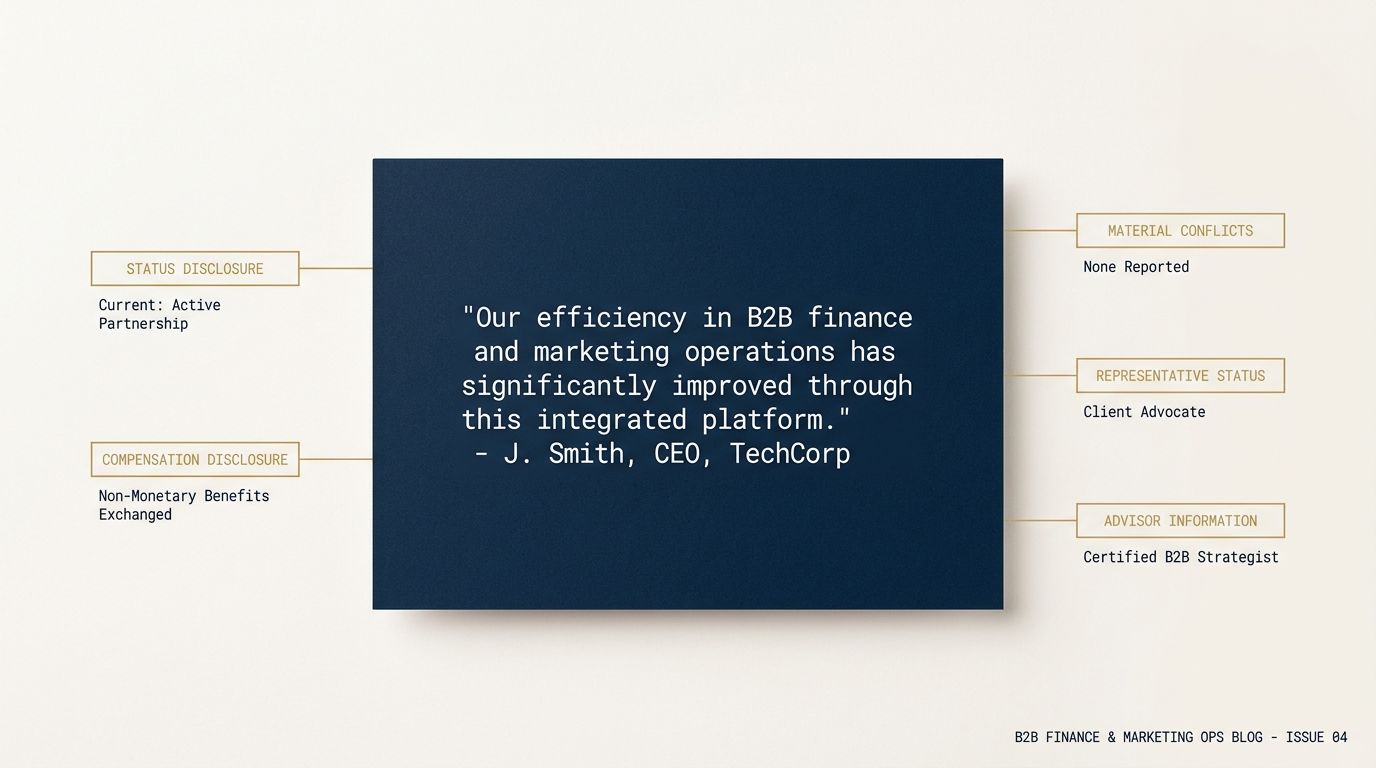
The 2020 SEC Marketing Rule reframed testimonials and endorsements for RIAs. FINRA Rule 2210 has long applied testimonial standards for broker-dealers. Both regimes converge on a structural pattern: a testimonial in finance marketing carries five disclosure obligations, and the structure that satisfies both regimes is portable across the firm’s content surfaces.
Most testimonial compliance failures fall into one of three categories: missing disclosures, disclosures in the wrong location, or disclosures that exist but are not “clear and prominent.” This post covers the five-element structure that addresses all three.
The framing is operational; refer to counsel for jurisdiction-specific application.
The Five Disclosure Elements
A compliant testimonial in finance content has five elements arranged in proximity to the testimonial itself:
-
Status disclosure. Whether the testimonial is from a current client, former client, or non-client. The rule treats these differently. A non-client testimonial is an “endorsement” under the SEC rule, with different requirements.
-
Compensation disclosure. Whether the testimonial-giver received any cash or non-cash compensation. If yes, the amount or nature of compensation must be disclosed in proximity. The threshold for required disclosure is low (any compensation, including referrals).
-
Material conflicts disclosure. Any conflict of interest between the testimonial-giver and the firm. Family relationships, business relationships, or other arrangements that might bias the testimonial.
-
Representative status disclosure. The testimonial reflects one person’s experience and is not necessarily representative of other clients. Phrasing requirements are specific; “your results may vary” is not always sufficient.
-
Advisor information disclosure. The firm’s regulatory status (RIA, broker-dealer, or both) and a link to its current registration information. This is sometimes met by the site’s footer; for paid creative, it often must be in-creative.
The five elements together form the structural pattern. Skipping any one creates a compliance gap.
Where Disclosures Must Appear
The phrase “clear and prominent” in the rule’s text has specific operational meaning. Three operational patterns:
-
Same creative as the testimonial. A paid social ad containing a testimonial includes the disclosures in the ad creative itself. Linking to a destination page where the disclosures appear is typically insufficient for paid placements.
-
Same page as the testimonial. A testimonial published on a website page has disclosures on the same page, in proximity to the testimonial (usually immediately before or after, or in a sidebar callout).
-
Same length-of-attention as the testimonial. A video testimonial includes disclosure for at least as long as the testimonial is visible. A short-form video that hides disclosure in a 1-second flash typically fails the “clear and prominent” standard.
The fix is creative design discipline. The disclosure pattern is determined at template-design time, not at compliance-review time.
The Two-Sentence Pattern
A useful starting pattern for the five elements compressed into a two-sentence disclosure block:
Testimonial from a current client of the firm, provided without compensation. Material conflicts: none. Results are individual and not necessarily representative; the firm is a Registered Investment Adviser (see ADV at adviserinfo.sec.gov/firm/123456).
The block runs approximately 50 words. It contains the five required elements explicitly. It is concise enough to fit within standard creative templates and explicit enough to survive compliance review.
Variations:
- Compensated testimonial: “…provided in exchange for [cash compensation of $X / a referral fee of $Y / a non-cash benefit of…].”
- Former client: “Testimonial from a former client of the firm…”
- Endorsement (non-client): “Endorsement from a non-client of the firm. The endorser is not advised by the firm…”
Each variation maintains the structure. The five elements remain identifiable.
Common Failures
Five patterns that produce compliance gaps:
- Disclosure in the page footer instead of near the testimonial. Site footer disclosures are not “in proximity” to the testimonial.
- No compensation disclosure when compensation existed. Even small referral fees trigger the disclosure requirement.
- Generic disclaimer language. “Your results may vary” without the additional required elements is insufficient.
- AI-generated testimonials. A testimonial fabricated or substantially altered by AI is, depending on jurisdiction, a misrepresentation. The compliance question is closed: do not publish fabricated testimonials.
- Testimonials in paid creative without in-creative disclosure. The most common gap. Disclosure must be in the ad, not on the destination page.
Worked Example
A wealth management firm we audited had testimonials on its website with full disclosure compliance in the footer. The firm ran a paid social campaign that excerpted three testimonials in ad creative. The paid creative had no disclosures (the ads relied on the destination page’s footer).
The remediation: paid creative templates updated to include the two-sentence disclosure pattern in-creative. Campaign re-launched. Result: marginal CTR impact (the disclosure consumed some ad real estate); meaningful compliance posture improvement. The firm’s preemptive remediation cost was three days of design and creative production.
The audit identified the gap before any enforcement action. The cost of remediation was small relative to the enforcement risk.
Frequently Asked Questions
Does the rule apply to video testimonials?
Yes. Video testimonials have the same disclosure obligations as written testimonials. The disclosure must be visible for the duration the testimonial is presented, or audible if the testimonial is audio-only.
What about case studies that include client outcomes?
Case studies often function as testimonials and may require the same disclosures. The case study pattern with disclaimer language is covered in the lead-gen pages post.
Are anonymized testimonials exempt?
Anonymization does not exempt the testimonial. The disclosure requirements apply to the content of the testimonial, not the identification of the testimonial-giver. The anonymization does affect what disclosures are practical (you cannot disclose “client name” if there is no name to disclose).
How does this interact with the endorsement disclosure post?
Endorsements (non-client testimonials) have similar but distinct requirements. The next post covers the specific endorsement framework and when each disclosure path applies.
What about LinkedIn endorsements or recommendations?
LinkedIn endorsements that the firm displays or promotes typically trigger the testimonial framework. Endorsements on the firm’s LinkedIn page that the firm has not actively promoted may be in a gray zone; counsel can advise.
This is operational guidance for marketing teams, not legal advice. Consult firm counsel for jurisdiction-specific application of testimonial advertising rules.
Next In Series
The next post covers endorsement disclosures: when to disclose, when not, and the gray zone. The endorsement framework runs parallel to the testimonial framework and applies to different relationships.
About the Author
Andrés Plashal
Author of the Assistive Agent Optimization (AAO) framework. Twenty years building search and measurement systems for B2B and SEC-regulated firms. Google Partner since 2017.
Credentials: UIUC Gies College of Business (Behavioral Science), Columbia College Chicago (Interactive Arts & Media). Member: American Marketing Association, GAABS, Paid Search Association. Published researcher (SCTE/NCTA).