Lead Generation Pages: The Case Study Disclaimer Pattern That Holds Up Under Audit
Case Studies Are At The Intersection
A case study is, structurally, three things at once: a testimonial (because it includes client outcomes), a performance claim (because it quantifies results), and an endorsement (when it includes client quotes). Each carries its own disclosure framework. A case study that satisfies one framework can fail another. The pattern that satisfies all three regimes simultaneously is a portable structure I see hold up under audits across both RIA and broker-dealer firms.
This post covers the seven-section pattern with the disclaimer block at the structural core. Refer to counsel for jurisdiction-specific application.
The Seven-Section Pattern
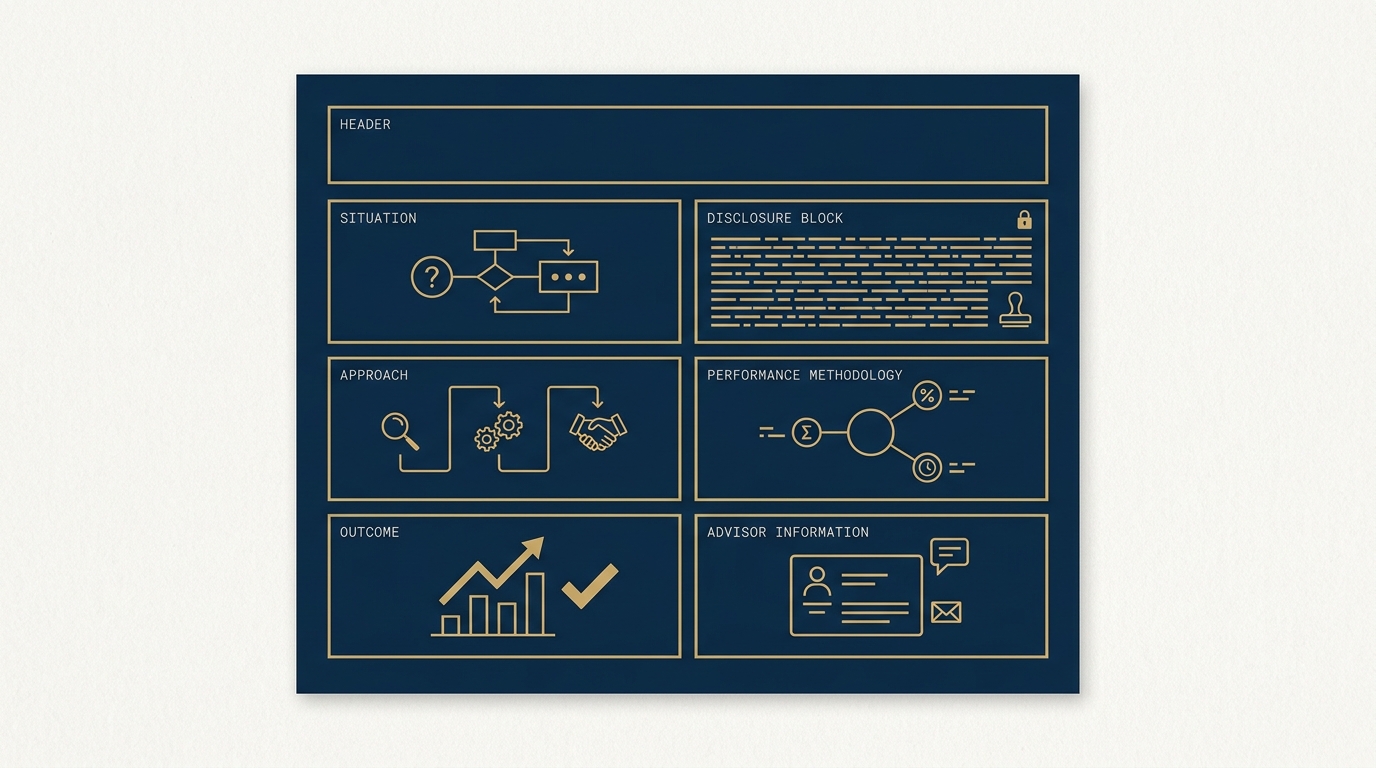
A compliant case study has seven sections in a consistent order:
-
Header. Title, publication date, last-updated date. The header establishes when the case study was prepared and last reviewed.
-
Situation. A description of the client’s starting position. Quantified where possible, anonymized where the client has not consented to identification.
-
Approach. What the firm did. Methodology disclosure here is structurally what the methodology page post covered in the MMM context: enough detail that the case study is credible and verifiable.
-
Outcome. The result. Quantified, with explicit time period and conditions.
-
Disclosure block. The compliance-load-bearing section. Status, compensation, conflicts, representative nature, advisor information. The structure mirrors the testimonial advertising post.
-
Performance methodology disclosure. Net-of-fees treatment, benchmark comparison, time period selection rationale, hypothetical-versus-actual distinction. The performance claims post covers the methodology specifics.
-
Advisor information. Firm registration status, link to current ADV (for RIAs) or BrokerCheck (for broker-dealers), and contact for inquiries.
Each section serves a specific compliance function. Skipping any section produces a gap that an auditor can identify.
The Disclosure Block Anatomy
The fifth section is the most failure-prone. A workable five-element disclosure block:
This case study describes a current/former client of the firm. The client provided their experience for use in this case study and received no compensation. Results presented are specific to this client’s situation and are not necessarily representative of other clients’ experiences. The firm is a Registered Investment Adviser; current registration information is available at adviserinfo.sec.gov/firm/[CRD]. Past performance does not guarantee future results.
Variations:
- Compensated client: “…and received [specific compensation].”
- Hypothetical scenario: ”…This case study presents a hypothetical scenario for illustration; actual client results varied.”
- Anonymized: ”…The client’s name and identifying details have been changed to preserve confidentiality; outcomes are presented as reported.”
The block is typically 60 to 100 words. It contains the five required elements explicitly. It is positioned in the case study body, not in the page footer.
Performance Methodology Section
Where the case study includes quantitative outcomes, the methodology section discloses how the numbers were calculated. Three patterns:
-
Actual returns. Disclosed net-of-fees, with benchmark comparison and time period. “The portfolio returned 8.4% net of fees over the 36-month period ending Q4 2025, compared to a Russell 2000 benchmark return of 6.1% over the same period.”
-
Aggregate metrics across clients. Disclosed with sample size, methodology, and time period. “Across 43 client engagements in 2024-2025, the median client achieved [outcome]; outcomes ranged from [low] to [high].”
-
Hypothetical scenarios. Disclosed explicitly as hypothetical, with assumptions stated and limitations identified. “This scenario assumes [conditions]; actual client outcomes may differ materially.”
Each pattern has stricter disclosure requirements than the average reader expects. Hypothetical scenarios in particular trigger detailed disclosure obligations under the SEC Marketing Rule.
Common Failures
Five patterns that produce audit findings:
-
Disclosure block in the page footer instead of within the case study. The block must be in proximity to the case study content, not in a separate page section.
-
Disclosure that combines testimonial and performance disclaimers ambiguously. Each disclosure type needs its own clear statement.
-
Hypothetical scenarios presented as actual. The most expensive failure category. Hypothetical performance presented without explicit disclosure is materially misleading and triggers enforcement risk.
-
Anonymized case studies that include identifying details. Anonymization that does not actually anonymize defeats the purpose. Operational details (geographic region, industry, AUM band) can de-anonymize even when names are removed.
-
Case studies that have aged without review. A 2023 case study that describes the firm’s process accurately at the time but inaccurately by 2026 needs updating or removal. The dateModified discipline from the Recency Gate post applies.
Anonymization Pattern
A workable anonymization pattern for client case studies:
-
Replace named clients with descriptive labels. “A mid-sized RIA in the Mid-Atlantic” rather than “Capital Wealth Advisors.”
-
Round identifying numerics. “$200M to $500M in AUM” rather than the exact figure.
-
Aggregate timing where possible. “Q2 2024” rather than specific dates.
-
Avoid identifying combinations. A unique combination (an RIA in a small city, with a specific specialty, founded in a specific year) can de-anonymize even when no single fact identifies the client.
-
Obtain written consent for any identification. If the client is identified, document the consent in writing and retain per record retention requirements.
The anonymization should pass the test: a reader who is plausibly knowledgeable about the firm’s category could not identify the specific client from the published details.
Worked Example
A wealth management firm we audited had four case studies on its website. Two were anonymized appropriately. One had been written as “anonymized” but contained sufficient identifying details that the client would be recognizable to industry insiders. One was a hypothetical scenario presented in actual terms.
The audit finding: the de-anonymization gap and the hypothetical-scenario gap together constituted material compliance risk. Remediation took six weeks. The de-anonymized case study was either rewritten with proper anonymization or replaced with a different example. The hypothetical scenario was reframed with explicit hypothetical disclosure throughout.
The remediation cost was modest. The cost of an enforcement action triggered by either case study would have been substantially higher.
Frequently Asked Questions
Can case studies be used in paid creative?
Yes, with the same disclosure pattern applied to the creative. Paid creative that excerpts case study outcomes needs the disclosure block in-creative, not on the destination page.
How long should the disclosure block be?
60 to 100 words for most cases. Longer for cases involving hypothetical scenarios or unusual compensation arrangements. The block should be specific enough that the disclosed information is unambiguous.
What about case studies on third-party platforms (LinkedIn, agency portfolios)?
The firm’s responsibility for the case study extends to third-party platforms where the firm has posted or endorsed the content. The disclosure pattern travels with the case study; the platform context does not reduce the obligation.
Should I include video case studies?
Yes, with disclosures spoken or displayed for the duration. Video case studies have the same obligation as written ones; the medium does not change the rule.
How does this interact with the performance claims post?
The performance section of a case study is governed by the same standards as standalone performance claims. The two posts compose: case studies use the seven-section pattern; the performance section within them follows the performance claims structure.
This is operational guidance for marketing teams, not legal advice. Consult firm counsel for jurisdiction-specific application of case study and testimonial rules.
Next In Series
The next post covers performance claims: a defensible structure for “we generated $X” statements and the methodology disclosures that hold up under audit when commercial outcomes are quantified.
About the Author
Andrés Plashal
Author of the Assistive Agent Optimization (AAO) framework. Twenty years building search and measurement systems for B2B and SEC-regulated firms. Google Partner since 2017.
Credentials: UIUC Gies College of Business (Behavioral Science), Columbia College Chicago (Interactive Arts & Media). Member: American Marketing Association, GAABS, Paid Search Association. Published researcher (SCTE/NCTA).