Query Fan-out: How LLMs Decompose Ambiguous Queries and What That Means for Title Tags
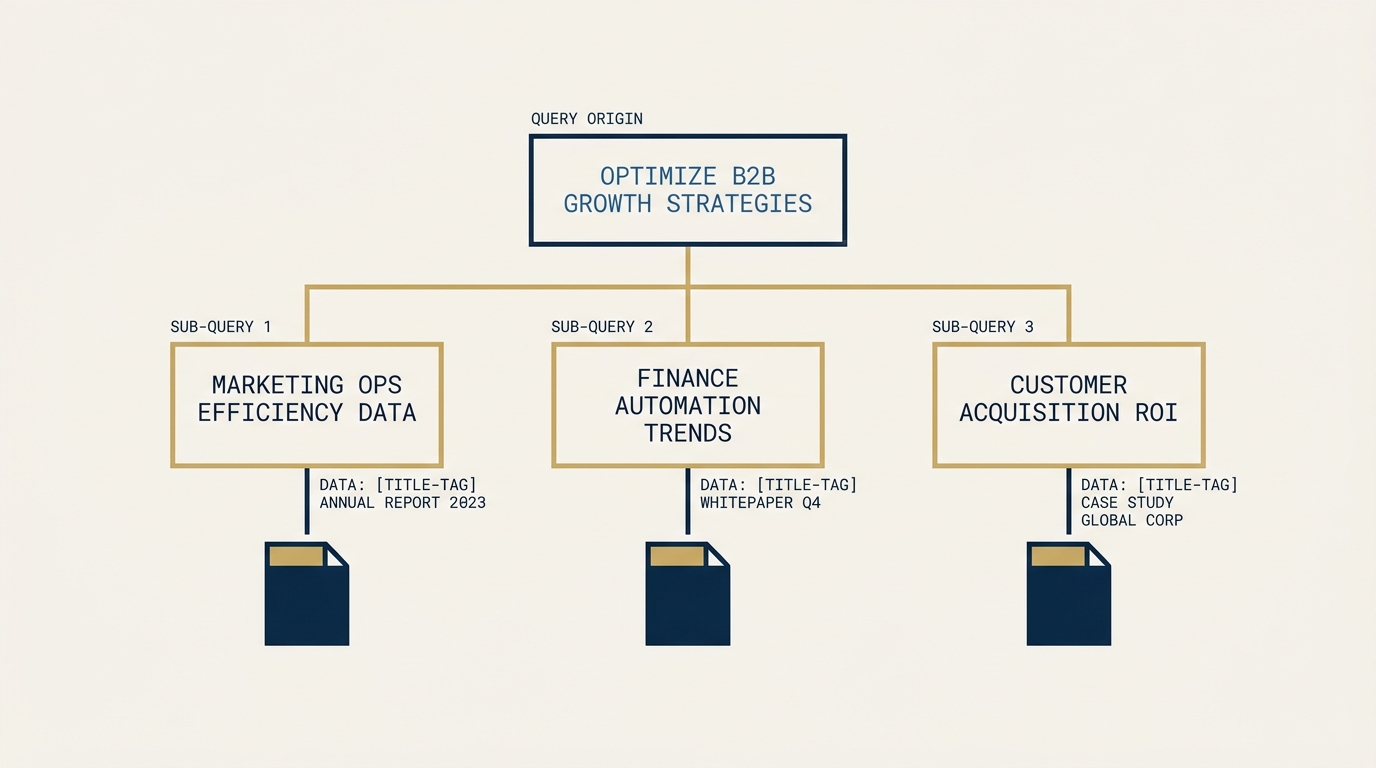
One Query Becomes A Tree
A user types “Bayesian MMM for B2B finance” into an AI search engine. The engine does not retrieve against that string. It decomposes the string into multiple sub-queries, retrieves against each, and synthesizes the responses. The user sees a single answer; the retrieval system ran three to five queries to produce it.
This decomposition is called query fan-out, and it changes how content needs to be structured for citation. Your title tag has to answer not the original query but the decomposition. Your header hierarchy has to map to the sub-queries the engine ran. A post optimized for “Bayesian MMM” ranks against one query; a post optimized for the decomposition ranks against three.
How Query Fan-out Works
The mechanism varies by engine, but the pattern is consistent. When the engine receives a query, it runs a small pre-processing model that generates two to five reformulations of the query. Reformulations cover:
- The literal query as a baseline.
- Synonyms or category expansions (“Bayesian MMM” expanded to “Bayesian marketing mix modeling,” “probabilistic MMM”).
- Sub-questions the user likely also has (“how does Bayesian MMM compare to frequentist,” “what tools implement Bayesian MMM”).
- Entity-specific variants when an entity is mentioned (“PyMC Bayesian MMM,” “Meridian Bayesian MMM”).
Each reformulation is sent to the retrieval engine. The retrieved passages from all reformulations feed into the response synthesis. The user-facing answer reflects whichever passages scored highest across the fan-out.
The Three Classes Of Decomposition
In practice, decomposition falls into three classes:
-
Reformulation. Same meaning, different wording. The engine tries variants to handle the synonym problem. Title tags that include the primary keyword plus a relevant synonym (or that have the keyword in the URL plus another in the title) rank against both.
-
Sub-component. Splits a compound query into parts. “Bayesian MMM for B2B finance” decomposes into “Bayesian MMM” and “B2B finance MMM.” A page that ranks against either component can be cited; the engine prefers pages that cover both.
-
Inferred follow-up. Adds questions the user likely has but did not ask. “Bayesian MMM” might trigger an inferred follow-up like “how to start a Bayesian MMM” or “Bayesian MMM vendor evaluation.” Pages with explicit FAQ schema covering common follow-ups rank against the inferred queries.
What This Means For Title Tags
The 60-character title tag still matters for Google. For AI search, the title tag is one of several signals the retriever considers. Three patterns that perform well across both:
-
Lead with the primary keyword. Place the primary keyword in the first 40 characters of the title. Both Google and AI retrievers weight position.
-
Include a category modifier. A title like “Bayesian MMM for B2B Finance: 2026 Guide” answers both the primary query and the sub-component decomposition. The “for B2B Finance” clause is the modifier.
-
Avoid clever framing in the title. “The Surprising Truth About Bayesian MMM” reads well to humans and tells the retriever nothing extractable. Save clever framing for the H1 if needed; keep the title literal.
Header Hierarchy As Decomposition Target
Title tags handle the primary and modifier queries. Header hierarchy (H2 and H3) handles the sub-components and inferred follow-ups. A 1,500-word post with six to eight H2 sections covers the main query plus the typical sub-components.
For example, a post titled “Bayesian MMM for B2B Finance” might include H2 sections like:
- What Bayesian MMM Adds (covers the methodology query)
- Setting Priors From Public Sources (covers the priors sub-query)
- Validation Approach (covers the validation sub-query)
- Vendor Evaluation (covers the vendor query)
- Common Failure Modes (covers the troubleshooting query)
- Decision Framework (covers the application query)
Each H2 becomes a chunk boundary (see the Granularity Gate post). Each chunk independently ranks against the sub-query its header addresses.
Worked Example
A wealth management firm published a 2,000-word post titled “How We Think About Marketing Attribution.” The post ranked for “marketing attribution” but never surfaced on more specific queries.
Audit: the title was generic. The H2 structure was discursive (“Our Philosophy,” “The Old Way,” “Where We Landed”) rather than topical. The post answered the implicit question “how does this firm think about attribution” but did not answer the explicit sub-queries that users actually ran (“MMM for wealth management,” “MTA window for advisors,” “geo holdout for HNW marketing”).
Fix: retitled to “Marketing Attribution for Wealth Management: Methods, Trade-offs, and Decisions.” Restructured the H2s to map to sub-queries: “Why Last-Click Fails,” “MMM in Wealth Management,” “MTA Window Calibration,” “Geo Holdout Tests,” “Composite KPI Design.” Body content was mostly preserved; the navigation changed.
Four weeks later, ChatGPT cited the post on three distinct queries: marketing attribution wealth management, MMM wealth management, and geo holdout for HNW. Each cited a different H2 section. The decomposition that the post now answered three ways had been answering zero ways before.
Frequently Asked Questions
Should I write multiple posts targeting each sub-query, or one post covering all?
Both work. For evergreen pillar content, one post covering all sub-queries is efficient. For specific tactical questions, individual posts allow each post to target one query precisely. The right answer depends on content depth: if you can write 200 to 400 words substantively on a sub-query, give it its own post. If less, fold it into the pillar.
Does query fan-out change my keyword research approach?
Yes. Beyond the primary keyword, identify the likely sub-queries and inferred follow-ups. Tools that surface People Also Ask data, related searches, and AI-generated FAQ suggestions cover much of the decomposition surface.
Will Google’s AI Overviews handle this the same way?
Substantially yes. AI Overviews run a similar fan-out internally, with weighting that emphasizes domain authority more than Perplexity does. The structural advice (title with primary keyword plus modifier, H2s mapping to sub-queries) applies across engines.
How does this interact with the Content Gate?
Content Gate scores passage-level extractability. Query fan-out determines which passages compete on which sub-queries. The two compose: front-loaded passages with clear thesis sentences win their assigned sub-queries; vague passages lose even if the topic matches.
Should I include the sub-queries as literal H2 text?
Not literally as questions. The H2 should be a declarative phrase that answers the sub-query topically. “MMM in Wealth Management” answers the “MMM wealth management” sub-query without phrasing as a question.
Next In Series
The next Tuesday post covers the brand-attribute claim graph for AEO: structuring your entity’s factual claims so AI engines can verify and cite them as a coherent graph rather than scattered assertions.
About the Author
Andrés Plashal
Author of the Assistive Agent Optimization (AAO) framework. Twenty years building search and measurement systems for B2B and SEC-regulated firms. Google Partner since 2017.
Credentials: UIUC Gies College of Business (Behavioral Science), Columbia College Chicago (Interactive Arts & Media). Member: American Marketing Association, GAABS, Paid Search Association. Published researcher (SCTE/NCTA).