FINRA Rule 2210 for Digital Ads: The Most-Overlooked Requirements
The Rule Predates Modern Digital
FINRA Rule 2210 was finalized in its current form before TikTok, programmatic display, and AI-generated content existed. The rule’s three communication categories (institutional, correspondence, retail) and the supervisory framework have not changed substantively in a decade. The world they govern has changed completely.
The result: broker-dealer marketing teams operating in 2026 navigate a rule that was designed for direct mail and email and that now applies to YouTube pre-roll, retargeting pixels, AI-generated commentary, and influencer partnerships. The translation is the operational work.
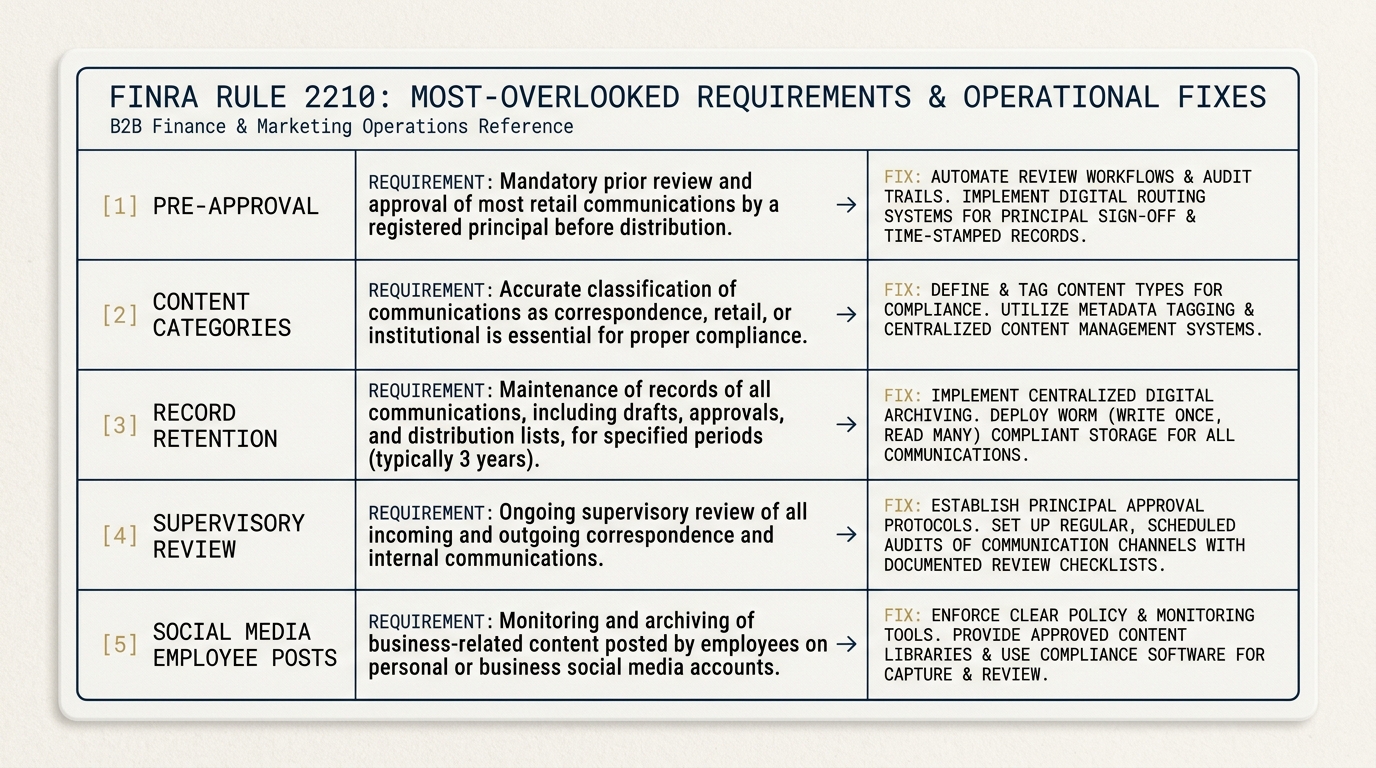
This post covers five requirements that operations teams most consistently underweight when running modern digital programs against the 2210 framework. The framing is operational; refer to counsel for jurisdiction-specific application.
Most-Overlooked Requirement One: Pre-Approval On Retail Communications
The rule requires pre-approval by a registered principal for retail communications that include performance claims, recommendations, or comparisons. The definition of retail communication includes most public-facing digital marketing.
Operational gaps that surface most often:
- Social media posts treated as exempt. A LinkedIn post by a registered representative that recommends a product or quotes performance triggers retail communication status. Pre-approval applies even though the post is short-form.
- AI-generated posts published without principal review. Generation does not change the pre-approval requirement.
- Templated lead-gen creative reused without re-approval. A creative template approved in Q1 reused in Q3 with new performance numbers needs re-approval for the new numbers.
The fix: a clear pre-approval queue with a defined review SLA (1-3 business days is reasonable for retail comms) and a written policy that covers AI-generated content explicitly.
Most-Overlooked Requirement Two: Content Category Classification
The rule treats three categories differently: institutional communications (filed with FINRA in some cases), retail communications (pre-approval required), and correspondence (post-review allowed). Misclassification produces compliance gaps.
Common misclassification patterns:
- Treating LinkedIn posts as correspondence. LinkedIn posts visible to 25 or more retail recipients are typically retail communications. The default assumption that “it’s just a personal post” misses the rule’s audience-size threshold.
- Treating organic blog posts as institutional. A blog post on the firm’s public website read by retail visitors is retail.
- Treating influencer partnerships as exempt. A paid influencer post made on behalf of the firm is the firm’s communication. Disclosure and pre-approval apply.
The fix: a classification rubric the marketing team uses before publication. The rubric should be one page and cover the common cases.
Most-Overlooked Requirement Three: Record Retention On Ephemeral Content
The rule requires records of communications for three years. Modern digital includes increasingly ephemeral surfaces (Stories, Snaps, TikTok content, deleted posts) that the rule’s record retention requirements still cover.
Operational gaps:
- Stories and Snaps not captured. A 24-hour Story containing a retail communication needs to be archived per the rule.
- Edited posts where only the final version is retained. The rule requires retention of all versions of a communication.
- AI-tool intermediary outputs not archived. A drafting tool that produces multiple variations and a final version may require retention of intermediates.
The fix: an archiving workflow that captures ephemeral content at publication and maintains version history. Multiple vendors (Smarsh, Global Relay, Hearsay) provide tooling.
Most-Overlooked Requirement Four: Supervisory Review In Distributed Teams
The rule requires supervision proportionate to the firm’s communications volume. Firms with distributed marketing teams (in-house plus agency plus contractors) often have supervision gaps where work crosses team boundaries.
Operational patterns that surface:
- Agency-created creative deployed without internal review. The agency may have a quality control process; the firm still needs supervisory review for compliance.
- Contractor-written blog posts published under firm authority. The contractor’s work is the firm’s communication.
- Cross-team workflows where review steps fall through. Marketing assumes legal reviewed; legal assumes marketing handled compliance; nothing actually was reviewed.
The fix: a documented review workflow that names the reviewer for each communication type. Email-based handoffs are insufficient; a tracked workflow tool (Workfront, Asana with compliance fields, dedicated review tools) creates the audit trail.
Most-Overlooked Requirement Five: Employee Social Media
Employees who are registered representatives have personal social media accounts that may or may not be subject to the firm’s policy. The rule’s treatment depends on whether the content is “of the firm.”
Operational gaps:
- Personal posts that mention the firm or its products. Even on personal accounts, content that promotes the firm is typically firm communication.
- Comments on third-party finance content. A registered rep commenting on a Wealth Management article with a recommendation triggers retail communication.
- Career-focused posts that touch products. A LinkedIn post about a new product launch by an employee is communication.
The fix: a written social media policy that addresses personal accounts, with employee training on what triggers firm-communication classification.
The Operational Audit Pattern
For broker-dealer marketing teams running modern digital:
- Inventory channels. List every channel where retail communications might be published (firm-owned, employee-personal, paid placements, organic earned).
- Map review workflow per channel. Who reviews, in what timeframe, with what record retention.
- Identify gaps. Channels with no defined review path are likely gaps.
- Build a written supervisory procedure. The procedure is itself a compliance signal.
- Train the team. Regular training (annually at minimum) keeps the workflow current.
Worked Example
A mid-sized broker-dealer we audited had three compliance gaps: (1) LinkedIn posts by registered reps were treated as personal and unreviewed; (2) influencer partnerships used by the marketing team did not flow through pre-approval; (3) Story-format Instagram content from the firm’s brand account was not archived.
None of the gaps had produced enforcement action. The remediation was preemptive. Took six weeks: written social media policy update with reps and training; pre-approval workflow extended to influencer partnerships; archiving tool extended to Stories.
The cost was meaningful but small relative to enforcement risk. The firm’s compliance team described the audit findings as “predictable in hindsight.”
Frequently Asked Questions
Does Rule 2210 apply to firms that are RIA-only?
No. Rule 2210 is FINRA scope (broker-dealers). RIA-only firms operate under the SEC Marketing Rule (Rule 206(4)-1), covered in the prior post in this series.
How does Rule 2210 interact with state law on digital ads?
State law overlays apply. Texas, California, and New York have particularly active enforcement on disclosure and disclaimer requirements. The strictest applicable standard usually governs.
What about influencer partnerships that touch products?
Influencer partnerships are firm communications when the influencer is paid or otherwise sponsored by the firm. Disclosure rules under FTC guidance apply alongside FINRA Rule 2210. Both regimes require disclosure; the disclosure language and placement must satisfy both.
Does the rule require pre-approval for every social media post?
For retail communications categories, yes. For correspondence-category communications (small audience size, no recommendations or performance), post-review may suffice. The classification determines the requirement.
How long does FINRA require records be retained?
Three years for most communications, with the first two years easily accessible. Some categories require longer retention. Check the rule and consult counsel for specifics.
This is operational guidance for marketing teams at broker-dealer firms, not legal advice. Consult firm counsel for jurisdiction-specific application of FINRA Rule 2210 and overlapping state-law requirements.
Next In Series
The next post covers testimonial advertising for finance content: the structural patterns that hold up under both SEC Marketing Rule and FINRA Rule 2210 scrutiny.
About the Author
Andrés Plashal
Author of the Assistive Agent Optimization (AAO) framework. Twenty years building search and measurement systems for B2B and SEC-regulated firms. Google Partner since 2017.
Credentials: UIUC Gies College of Business (Behavioral Science), Columbia College Chicago (Interactive Arts & Media). Member: American Marketing Association, GAABS, Paid Search Association. Published researcher (SCTE/NCTA).