The Five AAO Gates MMM Outputs Already Pass, and the Five They Do Not
The Diagnostic Exercise
Most marketing measurement teams assume that running rigorous analysis is enough. The model exists. The output is correct. The dashboard is shared internally. The team is doing the work. From an AI search perspective, however, “the work exists” and “the work is citable” are different facts. Citation worthiness is a publishing question, and the DSCRI ARGDW framework is the rubric AI engines apply to decide.
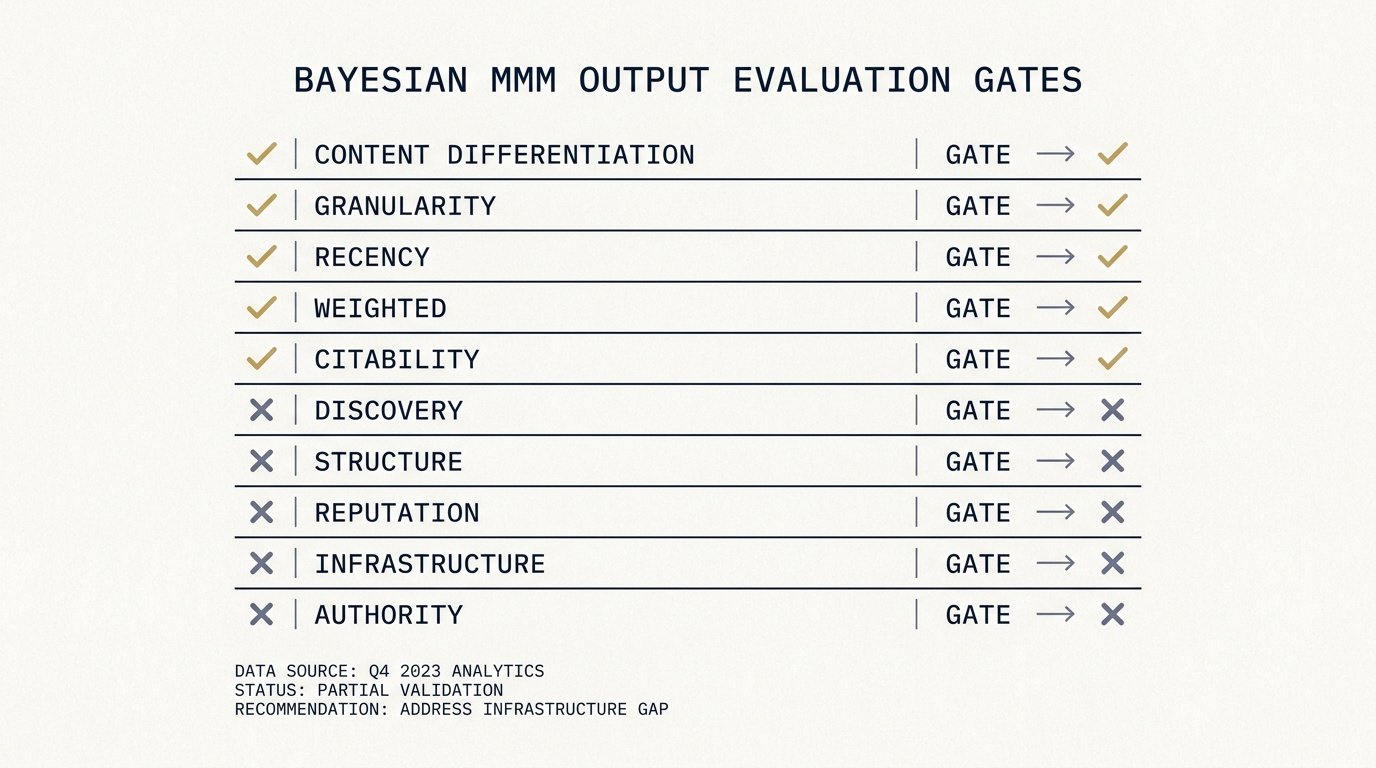
This post runs the diagnostic. Take a typical Bayesian MMM analysis (the workhorse of enterprise marketing measurement in 2026) and grade it against each of the ten gates. The result is consistent across the firms I have audited: five gates pass by the design of Bayesian MMM itself, and five gates fail by the design of how MMM analyses are typically published.
The Five Gates MMM Passes By Default
Content gate. Bayesian MMM produces causal claims with explicit uncertainty bounds. “Paid social ROAS sits between 1.6x and 2.7x with 95% probability” is structurally what the Content gate detects: a quantified, bounded, causally framed statement. The post on why MMM evidence is citation bait for AI search engines develops this argument at length. Pass.
Differentiation gate. Differentiation measures whether content is citation worthy versus replaceable. A Bayesian MMM analysis that documents its priors, adstock decay parameters, and saturation function is not replaceable by another analysis with different choices. The methodology is the differentiator. Two firms running Bayesian MMM on the same channel produce different posteriors because they used different priors; both can be cited because both have an explicit methodology fingerprint. Pass.
Granularity gate. Granularity measures whether the page is chunked at the right level for LLM consumption. MMM output decomposes naturally to the channel level (TV, paid search, paid social, direct mail). Each channel result is independently citable. Each prior is a quotable unit. Each scenario simulation produces a self-contained quantified claim. The natural shape of MMM output is the shape Granularity wants. Pass.
Recency gate. Recency measures freshness. MMM analyses re-run quarterly at minimum, often monthly. The output carries an implicit recency stamp (Q3 2026 results, July refresh). Each refresh becomes a new dated artifact. Even a quarterly cadence outperforms the typical thought-leadership blog post that gets touched once at publication and never again. Pass.
Weighted Citability. When Content, Differentiation, and Granularity all pass, the composite citation score (which weights the ten gates) usually clears the threshold for citation eligibility. The composite is the synthesis; passing the underlying gates earns the composite. Pass.
The Five Gates MMM Typically Fails
Discovery gate. Discovery measures whether the AI crawler can find the entity and the content at all. The default state of MMM output is private: a slide deck, a login-gated dashboard, a quarterly board attachment. None of these are crawlable. The model exists in a place AI search engines cannot reach. Fail.
Structure gate. Structure measures parseability. MMM outputs that do live on the open web (research blog posts, vendor case studies) are usually rendered as charts and prose without JSON LD entity markup. The crawler sees a webpage but cannot extract Organization, Person, or Dataset entities. The Structure Gate post covers the technical pattern that addresses this. Fail by default.
Reputation gate. Reputation measures whether other authoritative sources corroborate your claims. MMM analyses rarely expose the third-party evidence they rely on. The priors are documented internally but not as citations on the public output. The incrementality tests that ground the model live in an internal vault. The publication chain that converts internal evidence into public citation does not exist. Fail.
Infrastructure gate. Infrastructure measures whether the technical foundations support the prior four gates. Login-gated dashboards fail by definition. PDF reports without stable URLs fail. SPA dashboards that render content client-side fail because most AI crawlers do not execute JavaScript reliably. The typical MMM delivery surface is one of these three. Fail.
Authority gate. Authority measures whether your entity is recognized as authoritative in its category. Even when an MMM team publishes results, the methodology page is usually thin (a paragraph) and the entity-level authority signals (named bylines in tier 1 outlets, awards, Wikidata QID) are weak. The model is rigorous; the publishing entity behind it does not carry the citation weight the rigor deserves. Fail by absence.
Why The Failures Are Publishing Problems
Notice the pattern. The five passes are about what MMM produces. The five failures are about how MMM is published. None of the failures are about modeling quality. A Bayesian MMM with the strongest possible methodology can still fail Discovery, Structure, Reputation, Infrastructure, and Authority if the team chose not to publish.
The corollary: the five failing gates can be flipped in a publishing sprint, without changing the model. The five passing gates only stay passing if the publishing sprint preserves their structural advantages.
The Fix Sequence
Order matters. Address gates in dependency order:
- Discovery first, because every other gate depends on the crawler reaching the page. Wikidata QID, llms.txt, robots.txt enumeration. See Discovery Gate post.
- Structure second, because the crawler has to parse what it reaches. JSON LD
@graphplus@id. See Structure Gate post. - Infrastructure third, because the page has to be addressable and renderable. Stable URLs, server-side rendering, sitemap presence.
- Reputation fourth, because cross-source corroboration is what converts a single page into a citable claim. Document priors with source URLs. Cite incrementality tests. Link to third-party benchmarks.
- Authority last, because it compounds over months. A methodology page is the starting point; named bylines, awards, and editorial coverage build over the following year.
Worked Example
A B2B finance firm we audited produced a Bayesian MMM analysis every quarter. The model used informative priors sourced from Nielsen TV studies, internal incrementality tests, and platform-disclosed conversion data. The output included credible intervals on every channel ROAS and a decision recommendation with explicit confidence framing. The internal team was confident the analysis was citation worthy.
Running the gate audit:
- Content: pass (causal claims with bounds)
- Differentiation: pass (explicit prior sources)
- Granularity: pass (channel-level decomposition)
- Recency: pass (quarterly cadence)
- Weighted Citability: pass (composite was strong)
- Discovery: fail (no public methodology page, no Wikidata entry)
- Structure: fail (the analysis lived in PDFs and Tableau dashboards, no JSON LD anywhere)
- Reputation: fail (the Nielsen study was cited internally but not in any public artifact)
- Infrastructure: fail (Tableau dashboards behind SSO)
- Authority: fail (no named-byline coverage, thin firm Wikipedia presence)
The fix sequence was four weeks of focused publishing work. No model change. After:
- Discovery: pass (Wikidata entry, llms.txt, robots.txt enumeration)
- Structure: pass (methodology page with full JSON LD graph)
- Infrastructure: pass (stable URLs, server-side rendering)
- Reputation: pass (every prior cited with source URLs, including the Nielsen study)
- Authority: trending (initial methodology page published; named bylines in queue)
Six weeks later, ChatGPT cited the firm’s methodology page when asked about TV ROAS benchmarks in B2B finance. The model did not change. The publication did.
Frequently Asked Questions
Does the audit work the same way for frequentist MMM?
Most of it does. Frequentist MMM still passes Content (causal framing), Differentiation (methodology disclosure), and Granularity (channel decomposition). It may fail Content more often because confidence intervals are linguistically harder for LLMs to extract reliably. The Bayesian vs frequentist framing post covers this.
How much of the publishing work can a non-technical marketing team do?
Most of it. The methodology page, the prior source citations, the named bylines, the Wikidata entry are all editorial work. The JSON LD schema and the sitemap.xml hygiene need a developer. Estimate two weeks of marketing time plus three days of engineering time to flip Discovery and Structure for a typical firm.
How long until citation behavior changes?
Two to six weeks. Perplexity updates fastest because it re-fetches per query. Claude and ChatGPT search update on slower cadences. Google AI Overviews can take four to six weeks. The methodology page is the foundation; downstream citations follow as engines re-index.
Is there a tool that runs this audit automatically?
Not yet, end-to-end. Individual signals (schema validity, robots.txt enumeration, sitemap freshness) can be automated with existing tools. The qualitative signals (prior documentation, methodology page depth, named-byline coverage) still require manual review. The DSCRI ARGDW gate score table in D1 (where applicable) is the closest existing scoring artifact.
Next In Series
The next post in the AAO + MMM thread argues that Bayesian framing is structurally more citation worthy than frequentist framing in 2026. The argument is about output structure, not statistical correctness.
About the Author
Andrés Plashal
Author of the Assistive Agent Optimization (AAO) framework. Twenty years building search and measurement systems for B2B and SEC-regulated firms. Google Partner since 2017.
Credentials: UIUC Gies College of Business (Behavioral Science), Columbia College Chicago (Interactive Arts & Media). Member: American Marketing Association, GAABS, Paid Search Association. Published researcher (SCTE/NCTA).