Multiplicative Probability: The Honest Math for Multi-Variable Channel Bets
The Single-Variable Trap
The single most common analytical mistake I see in channel validation is anchoring on the most likely single condition and treating that as the probability of success. The conversation typically goes: “We can probably hit the cost-per-call target, so this channel will probably work.” The probability of hitting the cost-per-call target gets quoted at 70% or higher. The conclusion follows.
The conclusion is wrong because channel success rarely depends on a single variable. Channel success typically requires that multiple conditions hold simultaneously: cost per call below a target, conversion rate above a threshold, performance sustaining across a meaningful operating horizon, platform policy not tightening in a way that breaks the model. When success requires multiple conditions to hold simultaneously, the relevant probability is the joint probability, which is structurally lower than any individual condition’s probability.
This is the kind of math that, once you internalize it, changes how you size channel investments. Before internalizing it, you commit budget based on the most likely single condition. After internalizing it, you commit budget based on the joint probability of all the conditions required. The two numbers are often different by an order of magnitude.
The 70 Times 30 Times 70 Worked Example
A concrete example. In a recent Pay-Per-Click (PPC) viability analysis for a wealth-management firm, the channel’s success required three conditions to hold:
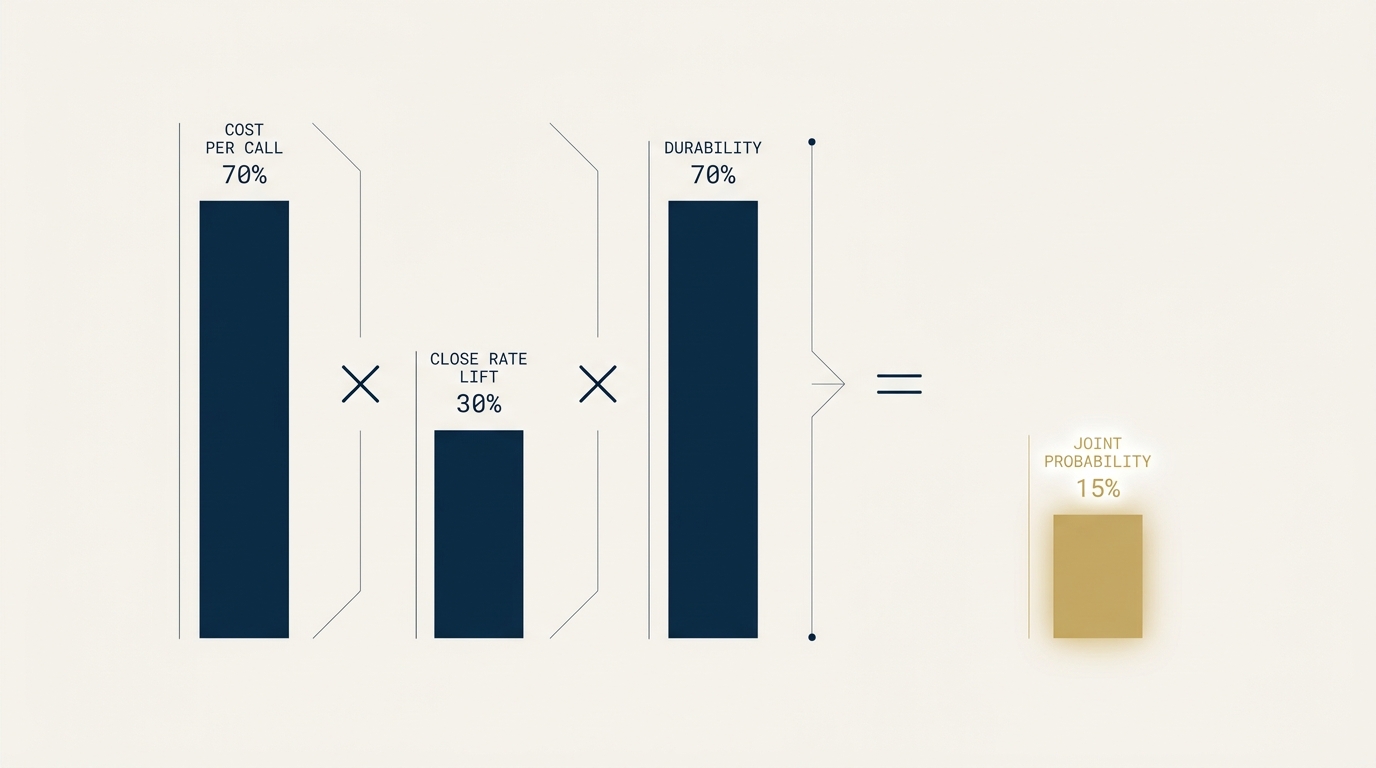
Condition one: cost per call stays below the $1,200 target. Prior test data anchored this probability at approximately 70%. The platform environment was tightening but the historical performance gave reasonable confidence the target was achievable.
Condition two: close rate lifts from a 4.3% historical baseline to a 10% threshold. B2B sales coaching research documents 1.5-2x close-rate lifts as achievable in established teams. The 2.3x lift required here sits at the upper edge of that range. This probability anchored at approximately 30%.
Condition three: performance sustains across a 12-month operating horizon rather than degrading from audience saturation, ad fatigue, or platform policy changes. Platform restrictions had tightened materially in the prior 18 months and were more likely to tighten further than to loosen. This probability anchored at approximately 70%.
The joint probability that all three conditions hold is the product: 0.70 times 0.30 times 0.70 equals 0.15. 15%.
The 15% number does what the single-variable framing cannot. It makes the bet explicit. A firm committing budget to this channel is committing budget to a bet that pays off in 15% of futures. In 85% of futures, one or more conditions miss and the channel produces marginal-to-zero economics.
What Changes When You See the Math
Three things change immediately when a team internalizes the multiplicative probability framing.
Budget sizing changes. A 15% probability of success does not justify the same budget as a 70% probability. The investment has to be sized to the joint probability, with explicit budget for the 85% futures in which the channel produces zero or marginal returns. This frequently means smaller initial test budgets and larger reserves for reallocation.
Expected case framing changes. When the joint probability is 15%, the expected case is not success. The expected case is failure with educational value. The decision is whether the educational value (knowing whether the channel works) justifies the cost of running the test, separately from whether the channel itself is likely to work.
Conversation framing changes. When sponsors and stakeholders see 15% on a budget request, the conversation moves out of “what is our forecast” and into “what is the value of resolving this question.” The second conversation is more honest and produces better decisions.
Why Most Teams Default to the Wrong Frame
The reason most teams default to the single-variable framing is psychological rather than analytical. Humans systematically overweight the most salient single variable in their decision-making. The variable that comes to mind first dominates the assessment. Multiplicative reasoning over multiple independent conditions is harder, more uncomfortable, and produces lower-confidence answers than the intuitive single-variable answer.
The problem is that the intuitive answer is wrong. A channel that requires three independent 70% conditions to succeed has a joint probability of 34%, not 70%. A channel that requires four such conditions has a joint probability of 24%. The intuitive framing systematically overestimates probability of success by a factor of 2-4x for any channel that depends on more than one variable.
This is not a rare situation. Almost every channel decision depends on multiple variables. The single-variable framing therefore produces systematically overconfident budget commitments across most marketing operations, and the cumulative cost of that overconfidence is enormous.
When the Conditions Are Not Independent
A reasonable objection to the multiplicative framing is that real-world conditions are rarely strictly independent. In the PPC example above, cost per call and close rate are partially correlated. Lower-quality leads typically appear at lower cost. A funnel that produces $200-per-call leads is likely converting at a different rate than one producing $1,500-per-call leads. The two probabilities are not strictly multiplicative.
The correlation does not undermine the framing. It refines it. When conditions are positively correlated (both conditions tend to hold together), the joint probability is higher than the simple product. When conditions are negatively correlated (one condition holding makes the other less likely), the joint probability is lower than the product. The discipline is to acknowledge the correlation direction explicitly and treat the multiplicative result as a bounded estimate rather than as a precise figure.
In practice, treating conditions as independent for the multiplication step produces a conservative estimate that is more useful than the unanchored intuition it replaces. If the channel does not justify investment at the independent-conditions joint probability, the correlation correction is unlikely to change the decision. If it does justify investment at that probability, the correlation correction is worth working through more carefully.
How to Apply This in a Budget Conversation
The operational application is straightforward. Before any channel investment conversation:
- Name the conditions required for success. Specifically. In a written list. Not in your head.
- Estimate each individual probability with an explicit empirical reference. “Cost per call probability: 70%, anchored against prior test data and platform benchmarks documented in [specific source].” Write the references down.
- Calculate the joint probability. Multiply the individual probabilities. Write the result.
- Compare the joint probability against the investment level. A 15% joint probability does not justify the same budget as a 50% joint probability.
- Identify the single highest-leverage condition. If one condition is materially lower probability than the others, that is the variable the test should be designed to settle first. If the lowest-probability condition fails, the joint probability is dominated by that failure.
The discipline takes 30 minutes per channel decision. It changes the decision in most cases. Most teams do not run it.
The Implication
Multiplicative probability is not exotic mathematics. It is the standard analytical move for any decision that depends on multiple conditions. The reason it is underused in marketing operations is that most marketing operations are not run with the kind of analytical discipline that turns probability into a decision input. The conversation defaults to qualitative assessment because the quantitative move feels uncomfortable on small samples and ambiguous data.
The discomfort is the cost of the discipline. The benefit is that the budget commitments are sized to the actual probability of success rather than to the most optimistic single-variable framing. Teams that adopt the multiplicative framing kill channels earlier, commit smaller budgets to speculative tests, and have more capital available when a channel actually works. The pattern compounds.
If you have not estimated the joint probability of the conditions required for your current channel investments, that is the analytical work that pays the highest rate per hour of any single exercise you can run on your marketing budget.
Related Reading
- Pre-Committed Gate Triggers is the operational complement to this analytical move. Multiplying the probabilities tells you what bet you are running. Pre-committed gates tell you when and how to evaluate whether it worked.
- Sample Sizes for Decision-Grade Channel Tests covers the statistical sizing required to actually resolve the joint-probability question with confidence rather than ambiguity.
About the Author
Andrés Plashal
Author of the Assistive Agent Optimization (AAO) framework. Twenty years building search and measurement systems for B2B and SEC-regulated firms. Google Partner since 2017.
Credentials: UIUC Gies College of Business (Behavioral Science), Columbia College Chicago (Interactive Arts & Media). Member: American Marketing Association, GAABS, Paid Search Association. Published researcher (SCTE/NCTA).