The Publisher-Rated vs Publisher-Trusted Distinction
Rating And Trust Are Different Mechanisms
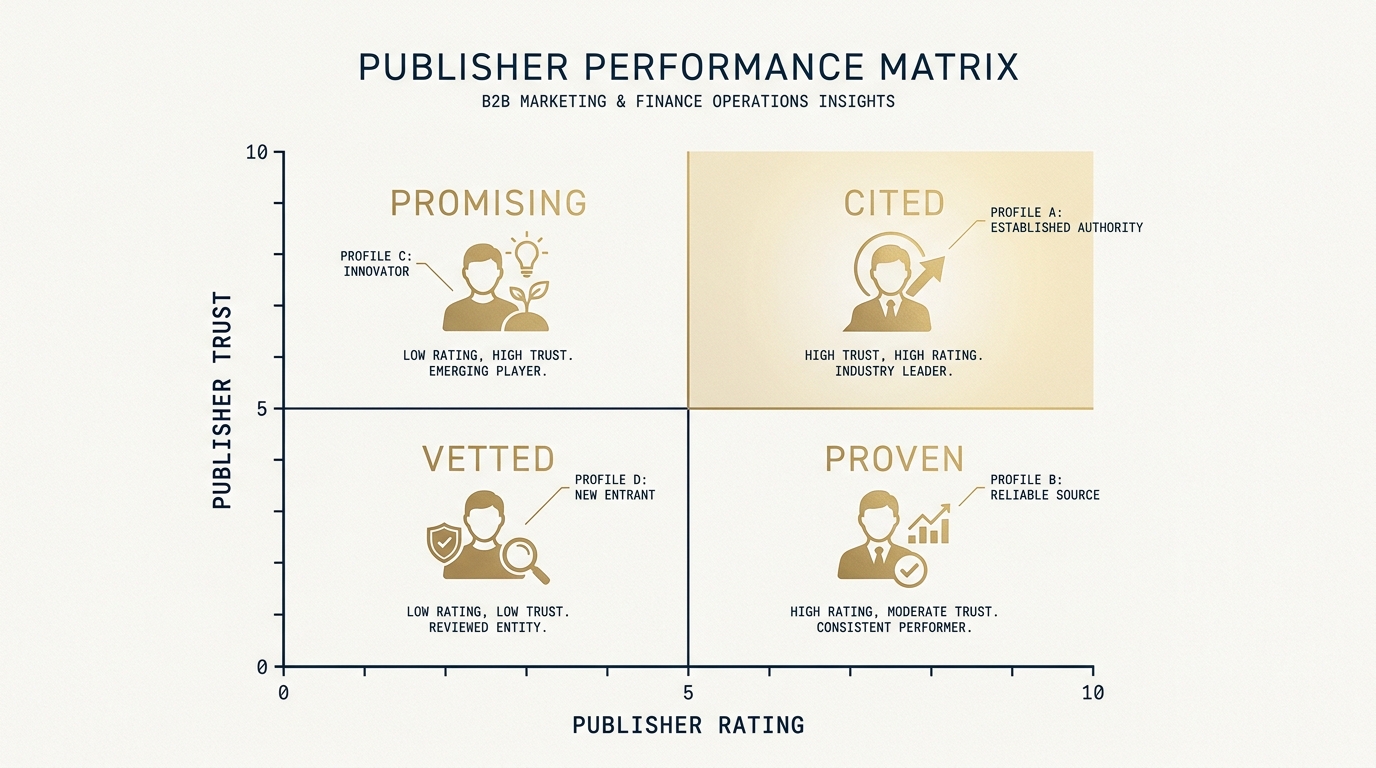
AI engines treat publisher rating and publisher trust as separate inputs. Rating measures category fit: does this publisher cover this topic professionally. Trust measures track record: has this publisher’s content held up over time without retractions, factual errors, or shifts in editorial position. A publisher can be highly rated (clearly a fit for the category) and weakly trusted (track record questionable), or the inverse. Citation requires both.
This post covers the distinction, why it matters for B2B finance firms in particular, and how to engineer both signals over time.
How Rating Works
Rating is fundamentally a category placement signal. The engine reads the publisher’s domain, schema, content history, and external references, and assigns a category. A site that consistently publishes about wealth management with schema markers, services pages, and named principals identified as wealth managers is rated as a wealth management publisher.
Rating strengthens through:
- Consistent editorial focus. A site whose blog covers wealth management content week after week rates higher than a site that publishes wealth management content occasionally between unrelated posts.
- Site-level taxonomy. Categories, tags, services pages, and “about us” content that consistently signal the firm’s primary focus.
- Domain-level signals. The domain name itself, the URL structure, and the schema
aboutproperties. A domain likewealthmgmt-firm.examplerates differently fromgeneral-business-consulting.examplefor wealth management queries.
Rating is achievable in months. It is largely an editorial discipline problem.
How Trust Accumulates
Trust is fundamentally a track-record signal. The engine evaluates the publisher’s content history for indicators of reliability over time.
Trust strengthens through:
- No retractions or major corrections. A publisher with a clean correction record is trusted higher than one with frequent corrections.
- Consistency over time. Editorial positions that have evolved through reasoned argument rather than reversal score well; positions that flip without explanation score poorly.
- Verifiable claims that have not aged badly. A claim made in 2022 that is still defensible in 2026 strengthens trust; a claim made in 2022 that proved wrong by 2024 weakens it (unless the publisher updated the post with the correction).
- External citation patterns. Other trusted publishers citing this publisher’s work compounds the trust signal.
Trust accumulates over years. It cannot be shortcut. A new firm has no trust; the path to trust is publishing consistently and accurately and weathering the period before track record exists.
When They Diverge
Four combinations:
-
High rating, high trust. The cited position. The publisher fits the category and has a track record that supports the citation. Few publishers in any category occupy this quadrant.
-
High rating, low trust. A new publisher in the right category. Often a startup firm. Cited occasionally on category queries when alternatives are sparse, more often passed over for established publishers. The path forward is patience plus accuracy.
-
Low rating, high trust. A publisher with strong track record in a different category trying to enter a new one. A legal publisher writing wealth management content. Cited rarely because the category match is weak even though the trust is high. The path forward is editorial focus or category-specific reputation building.
-
Low rating, low trust. Rarely cited. Often new sites or sites with editorial inconsistency. The path forward is consistent editorial focus plus accuracy over time.
The cited position requires both. Investing in only rating or only trust produces partial citation behavior.
Why This Matters For B2B Finance
B2B finance is a YMYL category where trust thresholds are higher than in informational categories. AI engines applying YMYL weighting downrank citations from low-trust publishers even when the rating is high. The implication: a new wealth management firm with strong category rating but no track record will be cited inconsistently for the first 24 months even with perfect AAO compliance.
The mechanism is not a bug in the engines; it is a calibration to the YMYL standard. Bad financial information has real consequences. The engines weight trust accordingly.
Two practical implications for B2B finance firms:
-
Investing in trust signals is not optional. Bylines under named principals, public methodology pages with sourced priors, awards and recognition. The trust signals compound over time. There is no shortcut.
-
The 12 to 18 month patience window is structural. Firms that expect immediate AI search results from launch will be disappointed. The category-specific trust signals compound across that window.
Engineering Both Signals
Rating is the faster path:
- Establish editorial focus. Publish consistently in one category. Resist the temptation to cover everything.
- Mark up the site to signal the category. Schema
aboutproperties, services pages, founder bios, blog tags. - Match the domain category to the content category. A clean signal across surfaces compounds.
- Audit external references. Crunchbase, LinkedIn, Wikidata, Wikipedia. All should reinforce the category.
Trust is the slower path:
- Publish accurately. The cost of one retraction is high; the benefit of clean accuracy is gradual.
- Document methodology. Methodology pages, sourced priors, change logs. The signal that the work is auditable.
- Pursue named bylines at tier 1 and tier 2 outlets. External corroboration compounds.
- Wait. Trust requires time. A two-year-old firm with strong rating signals is cited more than a six-month-old firm with the same signals.
Worked Example
Two B2B fintech firms launched in 2024. Firm A invested in rating signals (focused editorial calendar, schema discipline, services pages) but treated trust as a downstream side effect of “doing good work.” Firm B invested in both: same rating discipline plus methodology pages, named byline pipeline at tier 2 outlets, careful sourcing on every quantitative claim.
By mid-2026, both firms were active eighteen months. Firm A was cited occasionally by Perplexity and ChatGPT but not consistently. Firm B was cited regularly by both, plus by Claude with web access and AI Overviews. The category rating signals were comparable across both firms; the trust signals diverged.
The audit conclusion: Firm B had effectively invested in the trust signals that compound across the YMYL threshold. Firm A had assumed rating would translate to citation; in YMYL, it does not.
Frequently Asked Questions
Can I lose trust faster than I gain it?
Yes. A retraction or a major factual error can cost more trust than was gained in months of consistent publishing. The asymmetry favors caution: better to delay a post for a fact check than to ship a post that needs correction.
Does paid press placement help trust?
No. Paid placement that is flagged as sponsored does not function as trust corroboration. The engines distinguish between earned editorial coverage and paid placement.
How does this interact with the Authority Gate?
Authority is the structural gate that scores entity authority signals. Publisher rating and trust are the runtime signals at query time. The gate measures the inputs; the rating and trust are how the inputs are weighted per query.
Should new firms publish less while building trust?
No. The path to trust is consistent publishing over time. Publishing less delays the timeline. The right move is publishing consistently with high editorial discipline so each post adds to trust rather than risking retraction.
Will engines update their trust calibration over time?
Probably. The 2026 calibration reflects current YMYL standards. Future calibration may weigh new signals (e.g., transparency about methodology, real-time fact verification). The structural advice (be accurate, be sourced, be auditable) remains stable.
Next In Series
The next Tuesday post covers a common diagnostic problem: when ChatGPT recommends competitors despite your better content. The fix comes down to entity recognition rather than content quality.
About the Author
Andrés Plashal
Author of the Assistive Agent Optimization (AAO) framework. Twenty years building search and measurement systems for B2B and SEC-regulated firms. Google Partner since 2017.
Credentials: UIUC Gies College of Business (Behavioral Science), Columbia College Chicago (Interactive Arts & Media). Member: American Marketing Association, GAABS, Paid Search Association. Published researcher (SCTE/NCTA).