When ChatGPT Recommends Competitors Despite Your Better Content: The Entity Recognition Diagnostic
Content Quality Is Necessary, Not Sufficient
You wrote the better post. The argument is sharper, the data is denser, the framing is more useful. Your competitor’s post is generic, thin, and recycled. ChatGPT cites the competitor anyway when asked about the topic. The intuition that AI search rewards better content is correct in the broad case and wrong in this one. The mechanism that drove the citation is not content quality. It is entity recognition.
This post is the diagnostic that surfaces in this scenario most often, and the three-step fix. The same diagnostic applies when Perplexity, Claude, or AI Overviews pass over your content for a competitor’s; the mechanism is consistent across engines.
Five Reasons This Happens
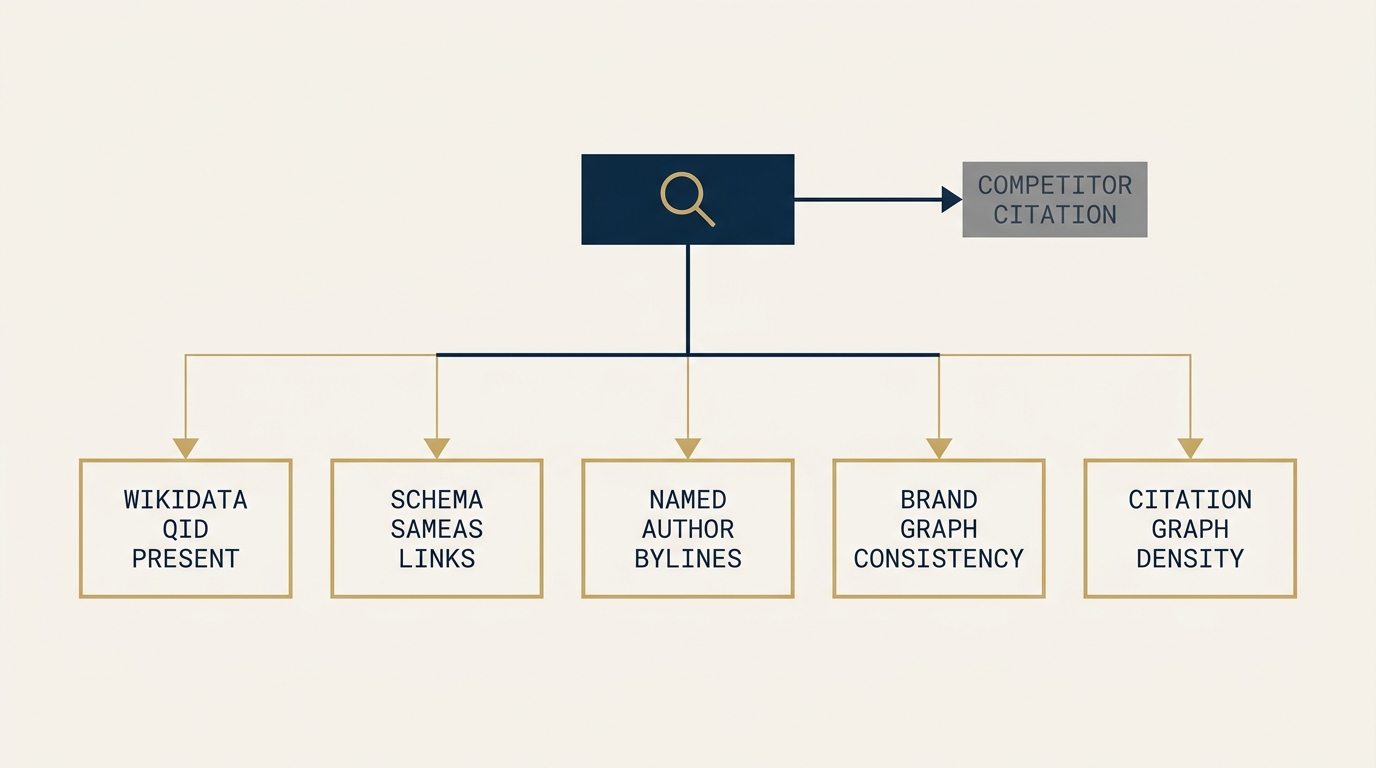
The five most common explanations, in order of frequency:
-
The competitor has stronger entity recognition. Their Wikidata QID, schema cross-references, named bylines, or Wikipedia presence give the engine a more confident handle on the entity than yours.
-
The competitor’s content is better aligned to the query decomposition. Their title and headers map to the query fan-out better than yours, even if your content is deeper.
-
The competitor’s category match is cleaner. Their site is more consistently about the query category; yours covers more topics, diluting the category signal.
-
The competitor’s content is fresher. Their
dateModifiedis recent; yours is months or years older. The Recency Gate post covered why this matters more than expected. -
The competitor benefits from citation graph density. Other authoritative publishers cite them; few cite you. The graph density tilts the ranking.
Most cases involve two or three of the five simultaneously. The diagnostic untangles which.
The Entity Recognition Diagnostic
Run the five checks in order. The first failure is the load-bearing one to fix.
Check one: Wikidata QID. Search wikidata.org for your firm and for the competitor. If the competitor has a QID and you do not, this is likely the primary issue. The Wikidata QID post covered the path to fixing this.
Check two: schema sameAs references. View source on both homepages and inspect the Organization schema. Look for the sameAs array. The competitor’s might include Wikidata, LinkedIn, Crunchbase, Bloomberg; yours might be empty or contain only social media. Inconsistency here means the engine cannot connect your entity to the broader authority graph.
Check three: named author bylines. Search the competitor’s principal name plus “Forbes” or “Bloomberg” or a relevant tier 1 outlet. If they have published bylines and your principal has not, the citation graph density gap explains a lot.
Check four: brand graph consistency. Compare claims across the competitor’s homepage, About page, and external profiles (Crunchbase, LinkedIn). Compare the same for your firm. The brand-attribute claim graph post covered why inconsistency damages entity grounding.
Check five: citation graph density. Search for the competitor’s domain on Ahrefs, Semrush, or any backlink tool. Look at the composition of inbound links: tier 1 editorial coverage, named author cross-references, awards mentions. Compare to your inbound profile. A gap here is the slowest to close but compounds over months.
The Three-Step Fix
The fix sequence follows the diagnostic:
Step one: Address the foundational gap. If Wikidata is missing, fix it first. If schema sameAs is empty, populate it. Both are 90-minute jobs with substantial payoff. The Discovery Gate post covers the technical specifics.
Step two: Build the byline pipeline. Pitch tier 2 outlets to start. One published byline per quarter at a tier 2 outlet produces real citation graph density improvement over a year. The Authority Gate post covered the engineering pattern.
Step three: Wait and re-measure. The first two steps take a few weeks for the engines to incorporate. Re-run the original query four to six weeks later. If your citation rate has not shifted, the issue is more than entity recognition; investigate the deeper gates (Content, Differentiation, Granularity).
Worked Example
A B2B fintech firm noticed that ChatGPT consistently recommended a smaller competitor on category queries. The firm’s content was substantively better: more research, more original data, named principals with deeper expertise. The citation pattern was inverted from what the team expected.
Diagnostic findings:
- Wikidata QID: competitor had one. Firm did not.
- Schema sameAs: competitor referenced Wikidata, LinkedIn, Crunchbase. Firm’s referenced only Twitter and LinkedIn.
- Named bylines: competitor’s founder had three Forbes columns over 18 months. Firm’s founder had none.
- Brand graph: both firms had inconsistencies. Roughly tied here.
- Citation graph density: competitor had been cited in two industry trade publications and one academic paper. Firm had been cited in one trade publication.
Three of the five diagnostics flagged. The root cause was clear: the firm had under-invested in entity recognition while the competitor had built up the structural anchors over 18 months. Content quality was real but invisible because the engine could not anchor the firm to the broader authority graph.
Fix sequence took six months. Wikidata submission and approval. Schema sameAs expanded to include four external references. Founder pitched and published two Forbes columns and one Wealthtender column. By month seven, ChatGPT was citing the firm on the same queries that had previously surfaced the competitor.
The firm’s content had not changed in the six months. The entity-graph anchors had. The citation behavior followed the anchors.
Frequently Asked Questions
How long should I wait before declaring the diagnostic fix successful?
Six weeks for early indicators; three to six months for steady-state. Engines update their indices on different cadences. If you see no change after six months, the issue is structurally different from entity recognition and requires a deeper audit.
Can I shortcut the byline pipeline?
No reliable shortcut. PR firms can place tier 2 articles in your name within 90 to 180 days at meaningful cost. Tier 1 placement requires substance the principal contributes. Paid placement does not function as citation graph density (engines discount sponsored content).
What if my competitor is much larger and I cannot match their entity-graph anchors?
You may not need to match. Citation is per-query, and many queries are niche enough that medium-sized entity anchors are sufficient. Identify the queries that matter for your firm specifically and audit those rather than trying to compete on broad category queries.
Does this work for new firms?
Yes, with a longer timeline. New firms have no track record (see the publisher rated versus trusted post). The fix is the same; the wait is longer.
How does this interact with citation worthiness signals?
The five signals are the runtime ranking inputs. This diagnostic identifies which signal is the weakest for your firm specifically. The two posts compose: the prior post covers what the engine measures; this post identifies which measurement you are losing.
Next In Series
The next Thursday post is a complete worked example: AAO methodology applied gate by gate to a single landing page, with the before-after audit results and the citation outcome four weeks after the fixes.
About the Author
Andrés Plashal
Author of the Assistive Agent Optimization (AAO) framework. Twenty years building search and measurement systems for B2B and SEC-regulated firms. Google Partner since 2017.
Credentials: UIUC Gies College of Business (Behavioral Science), Columbia College Chicago (Interactive Arts & Media). Member: American Marketing Association, GAABS, Paid Search Association. Published researcher (SCTE/NCTA).