The Authority Gate: Domain Rating vs Entity Authority in YMYL
Volume Is Not Authority
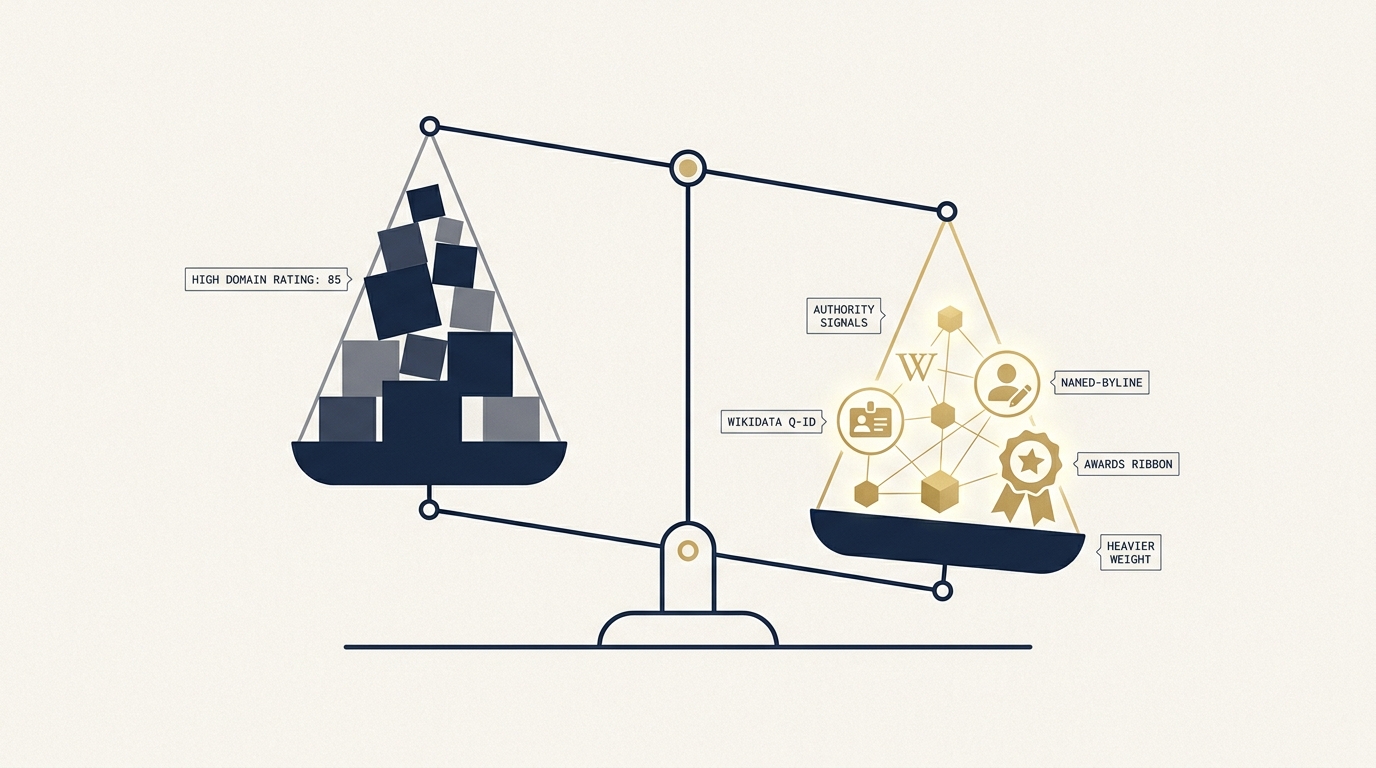
Domain Rating is a useful aggregate metric. It correlates with the volume of inbound links weighted by source authority. It is not what the DSCRI ARGDW framework Authority gate measures, and it is not what AI search engines weigh on YMYL queries.
Authority, as the sixth gate, is about entity identity. The question the gate answers: does the AI engine recognize this entity as authoritative in its category? The answer depends on whether the entity is anchored in the structured authority sources LLMs trained on (Wikipedia, Wikidata, Crunchbase, Bloomberg terminal data, NerdWallet, Investopedia for finance specifically) and whether named bylines from the entity appear in tier 1 outlets the engine treats as authoritative.
A 30 DR site that has cleared these signals can outrank a 70 DR site that has not. The mechanism is not a bug; it is how YMYL citation should work.
What Entity Authority Means
Entity authority is a property of the entity, not the website. The website is one expression of the entity. The entity also lives in Wikipedia (if it qualifies), Wikidata (where it can claim a QID), the firm’s principals’ LinkedIn profiles, named bylines, awards lists, podcast appearances, conference speaker listings, regulatory filings, and the long tail of cross-referenced public records.
An AI engine asked “who is authoritative on B2B finance marketing in 2026” does not read a single site and assess it. The engine reads its own representation of the relevant entities and surfaces the ones that appear in multiple authority sources. The website is the entity’s anchor; the cross-references are the entity’s authority.
The Wikipedia, Wikidata, Crunchbase Ecosystem
Three load-bearing entity sources for B2B finance in 2026:
-
Wikipedia. A neutrally-edited article on the firm or its principal is the strongest single Authority signal. Wikipedia notability standards are real; most firms below a certain size cannot earn a page. Above the size threshold, Wikipedia presence is a category-shaping advantage.
-
Wikidata. Lower bar than Wikipedia. Most firms can claim a Wikidata QID by demonstrating verifiable existence through third-party sources. The Discovery Gate post covered why the QID matters for entity resolution; for Authority, the QID also serves as the anchor that connects the firm to its broader claim graph.
-
Crunchbase, LinkedIn, Bloomberg. Professional databases with claim-backed entries. Crunchbase profile completeness signals firm legitimacy. LinkedIn presence for named principals signals the citation graph extends to identifiable people. Bloomberg terminal data is the gold standard for finance-specific authority.
A firm with all three signals plus tier 1 named bylines passes Authority comfortably. A firm with raw DR and none of these fails.
Why Named Bylines Compound
A backlink from a tier 1 outlet is a Reputation signal. A named byline at the same outlet is a stronger signal because the byline binds an individual entity (the author) to the article. The author entity is linkable to the firm entity. The article becomes a citation event in the author’s graph, the firm’s graph, and the outlet’s graph simultaneously.
Compounding mechanics:
- One article per quarter at a tier 1 outlet over 12 months produces 4 named-byline citation events.
- Each event is searchable on the open web indefinitely.
- LLMs trained after the publication date treat the byline as evidence that the author is authoritative on the article’s topic.
- Subsequent queries about the topic surface the author’s articles.
- The author’s affiliation (the firm) inherits a portion of the authority via the linked entity graph.
The effect is not linear. Twelve published columns over three years produces a citation graph stronger than what 100 generic backlinks could buy.
The 50 DR vs 30 DR YMYL Flip
A specific dynamic in YMYL categories in 2026: aggressive SEO-driven DR can lose to surgical entity-authority development. Three reasons:
- AI engines downweight YMYL pages without authority signals. A high-DR page on financial planning that cannot be tied back to a named expert or an authoritative firm is downweighted on citation queries.
- Authority signals are harder to fake than backlinks. A Wikipedia article requires neutral notability. A Crunchbase profile requires verifiable funding events. A named byline at WSJ requires an editor’s approval. The signals are constrained in ways that backlink counts are not.
- Authority signals compose into entity graphs. A firm whose principal has a Wikipedia article that cites her firm’s research that lives at a stable URL is an entity with a complete graph. An engine asked about the topic surfaces the graph as a unit.
The 30 DR firm that has cleared these signals wins on YMYL queries because the queries are routed through the entity graph rather than the link graph.
Engineering Authority
Authority cannot be assembled overnight. A workable 12 to 18 month plan:
- Months 1-2: Wikidata QID. Lowest cost, highest impact. Document the firm via three to five cited references. Submit. Wait for community review.
- Months 1-6: named-byline pipeline. Tier 2 outlets first. Build a portfolio of three to six published columns under the firm’s named principal at tier 2 outlets (Wealthtender, Kitces, Citywire, Wealth Management Today).
- Months 6-12: tier 1 entry. With the tier 2 trail as proof, pitch tier 1 outlets directly. One published article per quarter is realistic.
- Months 6-18: awards submissions. Barron’s, Forbes, Wealth Management. Most have annual cycles; the wait is structural.
- Months 12-18: Wikipedia eligibility. Only after the firm has accumulated independent secondary source coverage (the bylines and award listings) does Wikipedia notability become defensible. Submit through neutral channels; do not self-edit.
- Continuous: Crunchbase, LinkedIn, Bloomberg. Maintain factual presence. Update profiles on funding, hiring, product, and recognition events.
None of this is a backlink-building tactic. All of it is publishing and entity-management work.
Worked Example
Two B2B fintech firms with similar product offerings, similar revenue, similar customer mix. Firm A: 70 DR, no Wikipedia, no Wikidata QID, no named bylines, no awards. Firm B: 30 DR, Wikidata QID, three Wikipedia entries (firm, founder, second founder), eight published articles by founders at tier 1 outlets over 24 months, two industry awards.
Query to ChatGPT and Perplexity: “What are the leading B2B fintech firms for [specific use case]?”
Result: both engines named Firm B in their top three responses. Firm A did not appear in either response, despite ranking #1 on the equivalent Google query. The link-graph signal that produced the Google ranking did not translate to the entity-graph signal that drove the LLM response.
The diagnostic: the LLMs had built their representations from the Wikipedia articles, Wikidata claims, and tier 1 outlet content. Firm A had none of these anchors in the LLM’s training distribution. Firm B had all of them.
Frequently Asked Questions
How long until Authority work shows up in citation behavior?
Wikidata QID: 2 to 8 weeks. Named bylines: 4 to 12 weeks per published piece. Wikipedia: 12 to 24 months minimum, often longer. Awards: 6 to 18 months depending on annual cycles. Authority is a long-term engineering effort, not a sprint.
Can I outsource the authority engineering work?
The byline pitch and editorial relationship work yes, partially. PR firms with editorial relationships can place contributed articles in tier 2 outlets. Tier 1 placement usually requires the principal to be the author of substance. Wikidata and Wikipedia work cannot be outsourced because the credibility of the entries depends on neutral, verifiable sources rather than paid placement.
Should the named bylines be by the founder or by a team?
Founder first. A founder byline is a stronger signal because it is fully attributable. Team bylines (or ghost-written content under a founder’s name) carry less weight because LLMs treat the founder-entity as the citation anchor and the topical signal blurs when the same byline writes about everything.
Do podcast appearances count?
Yes, when the podcast publishes transcripts and the appearances are searchable on the open web. Podcast appearances without published transcripts are weak signals because the AI crawler cannot extract the content.
How does this gate relate to Differentiation?
Authority is about whether the entity is recognized. Differentiation is about whether the entity’s content is replaceable. Both matter; they are sequenced. The Differentiation Gate post in three weeks covers what makes content unreplaceable.
Next Gate
The next Tuesday post covers the Recency Gate: why AI training cutoffs and content cutoffs interact, how dateModified compounds, and the change-log discipline that keeps content citable across engine refresh cycles.
About the Author
Andrés Plashal
Author of the Assistive Agent Optimization (AAO) framework. Twenty years building search and measurement systems for B2B and SEC-regulated firms. Google Partner since 2017.
Credentials: UIUC Gies College of Business (Behavioral Science), Columbia College Chicago (Interactive Arts & Media). Member: American Marketing Association, GAABS, Paid Search Association. Published researcher (SCTE/NCTA).