The Recency Gate: Freshness Signals for AI vs Google
Two Cutoffs, Two Cadences
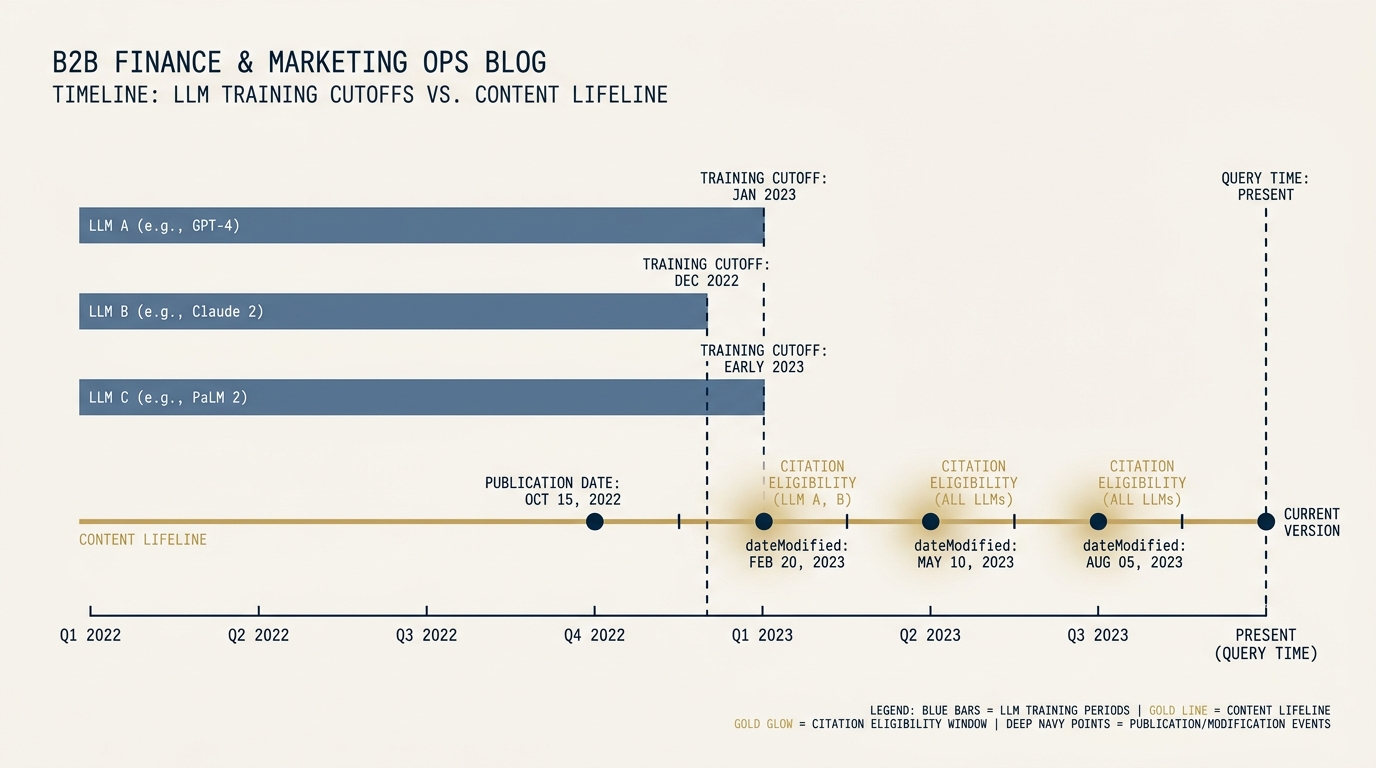
AI engines have training cutoffs. Your content has a publication cutoff. The DSCRI ARGDW framework Recency gate scores the relationship between the two. A post published before the engine’s training cutoff is in the engine’s offline index; a post published after the cutoff is reachable only via live retrieval. A post updated since the engine’s last index refresh signals that the content represents the author’s current position. A post that has not been touched in two years signals the opposite, even if the underlying argument has not changed.
Recency is not the same as freshness in the Google sense. Google’s freshness signal is one of many ranking factors and applies primarily to news and trending queries. The AI Recency gate applies to every query and weighs heavier on YMYL categories where stale information has direct consequences.
What dateModified Actually Does
The dateModified property in BlogPosting schema is the primary signal AI engines use to assess content recency. Three properties of the signal:
- The crawler trusts the schema. When
dateModifiedsays 2026-08-11 and the visible byline says 2024-03-15, the crawler defers to the schema. This is structural: schema is the machine-readable surface; visible bylines are human-readable convention. - The signal compounds with content changes. A
dateModifiedupdate without underlying content changes is detected by retrieval engines that compare content hashes against their index. UpdatingdateModifiedwhile leaving the body unchanged is, in 2026, treated as a weak signal by most engines and a deceptive signal by some. - The signal is checked at retrieval time. When Perplexity or Claude with web access fetches a page in response to a query, the
dateModifiedis read live. Update timing matters for queries received after the update.
Practical rule: update dateModified when meaningful content changes. Do not run a script that bumps every post’s dateModified to today on a schedule; engines detect the pattern and discount the signal.
Change Log Discipline
A change log section at the bottom of high-value posts converts updates from “trust the schema” to “verify the change.” The pattern:
**Updated 2026-08-11.** Added two sources for the saturation prior;
clarified the worked example with 2026 Q2 data.

**Updated 2026-05-22.** Added FAQ section based on reader questions.

**Originally published 2025-12-15.**
Three to five entries are enough. The change log lives at the bottom of the post (not the top; the front of the post is reserved for the lede). AI engines extract the change log as a citation signal: the post has been maintained, the maintenance is documented, the most recent change is recent.
For long-running posts (cornerstone content, methodology pages, framework hubs), the change log is what converts a single publication date into an ongoing publication relationship. The methodology page pattern from the MMM methodology page post carries this discipline forward.
AI Training Cutoffs In 2026
A simplified picture of major engines’ training cutoffs as of August 2026:
- Claude (Anthropic): Knowledge cutoff approximately January 2026 for the most current model, with web access enabling live retrieval for newer content.
- ChatGPT (OpenAI): Mixed; varies by model. Live web search for newer content.
- Perplexity: Real-time fetch per query, minimal reliance on training cutoff.
- Gemini (Google): Training cutoff in early 2026; AI Overviews use a separate retrieval pipeline.
- AI Overviews: Updated index, frequency varies by query category.
The practical implication: content published before each engine’s training cutoff is in the offline index and is cited from training data. Content published after is reachable only via live retrieval. The Recency gate scores both surfaces; an authoritative post benefits when it lives in both the training distribution and the live index.
Why Updated In 2026 Matters Even When The Argument Has Not Changed
A post about technical SEO foundations published in 2023 may have the same core argument as the same post updated for 2026. From a content perspective, an update could be unnecessary. From a Recency perspective, the 2026 update is meaningful for three reasons:
- The dateModified moves the post into more engines’ active index. A post last touched in 2023 is treated as historical by Perplexity, which weighs freshness heavily.
- The byline conveys that the author still endorses the argument. A 2023 post that has not been touched looks abandoned; the implicit author endorsement weakens over time.
- The cluster topology depends on it. Internal links from 2026 posts to a 2023 post that has not been updated suggest the cluster itself is aging. Updates compound across the cluster.
The work to update a post for Recency is real but bounded. A two-hour pass per high-value post per six months keeps the cluster live.
A 2024 Post Outranked By A Thinner 2026 Post
A finance firm I audited had a strong 2024 post on technical SEO for B2B finance. The post was substantive (2,200 words), well-structured, and ranked top three on Google for the target query. It was never cited by ChatGPT or Perplexity.
A competing firm published a thinner 2026 post on the same topic (1,400 words, less depth) and started getting cited within four weeks.
Diagnostic: the 2024 post’s dateModified was 2024-03-15. The 2026 post’s was 2026-04-02. Both engines were preferentially citing the 2026 post because the freshness signal swamped the depth signal. The Google ranker, which weighs depth more, still favored the 2024 post.
Fix: the 2024 post was updated. The author reviewed the body, added two sections covering 2026 developments, updated the worked example, added a change log entry, and pushed the dateModified to the actual update date. Within five weeks, both engines started citing the updated post in parallel with the competitor’s. The Google rank position stayed unchanged.
Frequently Asked Questions
How often should I refresh high-value posts?
Every six months for pillar content; every twelve months for second-tier posts. Set a calendar reminder per post if necessary. The work per refresh is bounded; the cumulative effect on Recency gate scores compounds.
Is there a downside to too-frequent updates?
Yes. Updates without content changes are detected and discounted by most engines as of mid-2026. Updates that touch every section but change nothing substantive read as gaming. Update when the content actually changes; document the change.
How does this interact with the Content gate?
The two compose. High-Content posts that are stale lose citation to slightly weaker posts that are fresh on time-sensitive queries. High-Content posts that stay fresh win on both gates simultaneously.
What is the right format for the change log?
Bottom-of-post section titled “Change Log.” Three to five entries, newest first, with date and brief description of changes. Keep entries terse; the change log is for the engine and the careful reader, not for prose elegance.
Should I use lastmod in sitemap.xml the same way?
Yes. Sitemap lastmod should match the post’s dateModified. Inconsistencies between sitemap and schema signal confusion to the crawler. The Astro Foundation’s sitemap configuration aligns the two automatically.
Next Gate
The next Tuesday post covers the Granularity Gate: why h2 hierarchy, FAQPage schema, and chunk-aligned writing are what makes a page extractable at the right grain for LLM consumption.
About the Author
Andrés Plashal
Author of the Assistive Agent Optimization (AAO) framework. Twenty years building search and measurement systems for B2B and SEC-regulated firms. Google Partner since 2017.
Credentials: UIUC Gies College of Business (Behavioral Science), Columbia College Chicago (Interactive Arts & Media). Member: American Marketing Association, GAABS, Paid Search Association. Published researcher (SCTE/NCTA).