The Trademark Click Loss: When Your Own Brand Term Falls During a Content Ramp
The Symptom
In a recent engagement, the single most diagnostic finding across a year-long content investment audit was what happened to the firm’s own registered trademark during the content ramp. The trademarked term had been producing a steady stream of branded organic clicks before the ramp began. During the year of high-volume content production, click volume on that exact term collapsed by approximately 90%. A direct competitor with a lower Domain Rating, no schema investment, and no content velocity outranked the firm on its own trademark.
This is not a rare pattern. It is one of the more common side effects of large-scale content production, particularly when the content production is operating at a velocity that exceeds the editorial and authority infrastructure supporting it. The trademark click loss is the visible signature of a deeper structural issue that surfaces first on the branded term because the branded term is the lowest-friction surface to lose.
The Four Candidate Causes
When you observe this pattern, the cause is one of four mechanisms, each with a different remediation path:
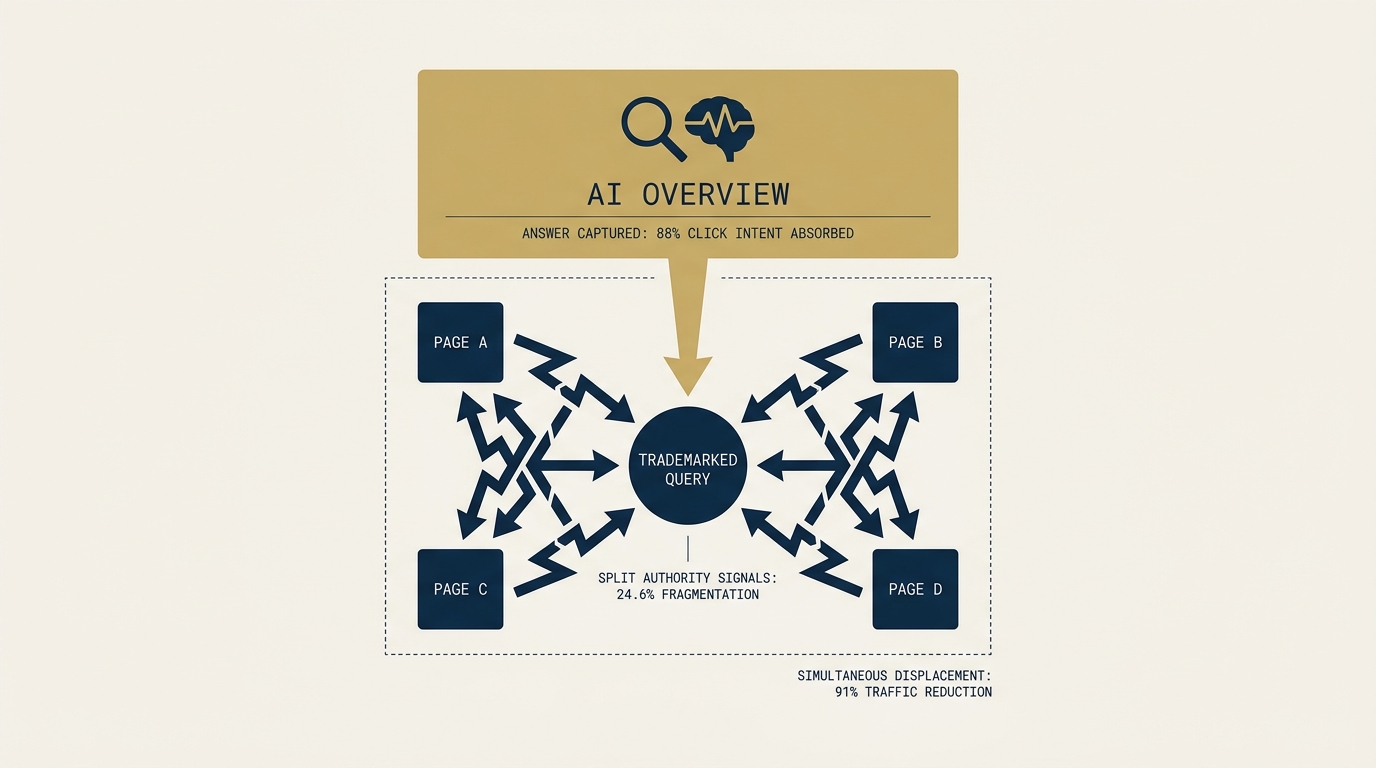
Cause one: keyword cannibalization. Multiple pages on the same domain are competing for the same query and splitting the authority signal. Google does not know which page to rank, so it ranks the wrong one or ranks an underpowered version of the right one. This is the most common cause when the content ramp produced posts that incidentally targeted the trademarked term as a secondary keyword, often without the content strategist intending it.
Cause two: thin content dilution. The expanded corpus shifted Google’s understanding of what the domain is “about” in a direction that weakened the authority of the original brand page. The brand homepage was previously the strongest signal on the trademarked term. The expansion produced enough adjacent content that the domain-level entity description blurred. The original brand page lost relative weight.
Cause three: AI Overview answer capture. Google began answering the trademarked query directly inside the AI Overview, pulling the answer from one or more pages on the firm’s site or from competitor sites that have entity-level authority on the term. The organic click that previously survived the SERP feature gauntlet now does not, because the AI Overview is consuming it. I covered this mechanism in detail in the companion post on YMYL zero-click rankings.
Cause four: competitor displacement. A competitor (often one with stronger authority signals despite weaker technical infrastructure) earned enough new editorial coverage or backlink strength during the period to outrank the firm on the trademarked term. This is the cleanest single diagnostic for an authority gap that the firm has been ignoring.
The Diagnostic Procedure
The diagnostic to settle which cause is operative takes a competent Search Engine Optimization (SEO) analyst roughly two hours of focused work.
Step one: pull all URLs ranking for the trademarked term from Google Search Console. Sort by impressions. Identify how many pages from your domain are showing for that query. If the answer is more than one or two, cannibalization is in play.
Step two: compare current ranking environment to the baseline period. What pages were ranking for the term before the content ramp? What pages are ranking now? If the dominant ranking URL has shifted from the brand homepage to a blog post or sub-pillar, dilution and cannibalization are both candidates.
Step three: run a manual SERP check on the current query. Look at what Google is actually returning. Is there an AI Overview consuming the answer? Is there a knowledge panel for a competitor entity? Is the SERP feature stack different from what it was 12 months ago? This is the AI Overview answer capture diagnostic.
Step four: pull the competitor’s backlink profile and editorial coverage for the measurement period. Did the competitor earn new tier 1 or tier 2 placements that coincide with the displacement? This is the competitor displacement diagnostic.
The four candidate causes are not mutually exclusive. In the engagement I opened with, the diagnosis surfaced two simultaneous causes: cannibalization between the brand homepage and a blog post targeting the same term as a secondary keyword, and authority-gap competitor displacement. The remediation had to address both.
The Remediation Paths
The remediation depends on which cause or combination of causes is operative.
For cannibalization: consolidate the competing URLs. The brand homepage should own the trademarked term. Blog posts and sub-pillars that incidentally rank for it need either a canonical redirect to the homepage, removal of the term from H1 and title tag positions, or rewriting to target a clearly different long-tail variant. The cannibalization remediation is typically a 1-2 hour analyst task per identified competing URL.
For dilution: the remediation is more substantive. The expanded corpus needs editorial review for content that has muddied the domain-level entity description, and a portion of it likely needs to be retired or rewritten. The dilution remediation is the most operationally expensive of the four because it implicates the underlying content production strategy.
For AI Overview answer capture: the on-page remediation is limited. The actual remediation is authority work that moves the firm into the citation set the AI Overview pulls from. PR placements, named-byline authorship, awards, and editorial coverage are the levers. The on-page work is supplementary.
For competitor displacement: the remediation is the same authority work, sized to close the specific gap the competitor has opened. If the competitor earned three tier 2 placements during the measurement window, the question is what your parallel authority engine produced in the same window. If the answer is “nothing,” that gap has to close before the trademark click stream returns.
Why the Trademark Term Is the Leading Indicator
The reason the trademarked term is the first surface to lose during a content ramp is that it is the lowest-friction signal in your Search Console data. Branded queries are the queries Google has the most confidence about. A click loss on your own brand term is therefore a louder signal than a click loss on a non-branded query, because the structural noise that drives non-branded click variance is largely absent on branded queries.
If your branded term is losing clicks during a content ramp, the ramp is producing one or more of the four pathologies above. The fact that the loss is showing up on the branded query means it is also likely happening, less visibly, on non-branded queries. The branded query is the canary.
The Strategic Implication
A trademark click loss is the operational equivalent of a smoke alarm. It tells you that something in the production system is producing exhaust the rest of the system was not designed to handle. The right response is not to silence the alarm (republish the brand page, add more keywords to the homepage, ask Google to recrawl). The right response is to investigate what is producing the exhaust.
In most engagements I have audited, the underlying cause is a content production model running at a velocity that exceeds the editorial review, internal linking discipline, and authority signal compounding the model assumed it would have. The fix is to bring the velocity into alignment with the support infrastructure, not to chase the alarm.
If your branded search is losing volume and you have been running a content investment, treat the loss as the highest-priority diagnostic available to you. The four-step procedure above will surface the cause within an afternoon. The remediation will tell you what your content strategy needs to change about how it operates, not just what it produces.
Related Reading
- Schema Is Necessary, Not Sufficient covers the broader pattern where technical SEO execution is peer-leading and the commercial outcome still falls because authority signals are the binding constraint.
- Crawled, Currently Not Indexed is the upstream diagnostic for the dilution mode of trademark click loss. A corpus with substantial non-indexed pages is the operating environment in which cannibalization compounds fastest.
About the Author
Andrés Plashal
Author of the Assistive Agent Optimization (AAO) framework. Twenty years building search and measurement systems for B2B and SEC-regulated firms. Google Partner since 2017.
Credentials: UIUC Gies College of Business (Behavioral Science), Columbia College Chicago (Interactive Arts & Media). Member: American Marketing Association, GAABS, Paid Search Association. Published researcher (SCTE/NCTA).