Why #1 Organic Rankings Now Produce Zero Clicks in YMYL
The Pattern That Is Now Routine
In a recent audit of a mid-sized firm’s organic search performance, the most striking finding was not the keywords the firm was ranking for. It was the click data on the keywords where the firm was ranking at position 1. On a portfolio of more than a dozen high-intent commercial queries (terms like “fee-only financial advisors near me,” “investment management” with a city qualifier, “financial planners” with a metro qualifier), the firm held position 1 organic placement. Across the six-month measurement window, those rankings produced zero clicks. Not low click-through rate. Zero. Across thousands of cumulative impressions.
This is not an outlier. It is the new structural feature of YMYL (Your Money or Your Life) search in 2026.
The Mechanism
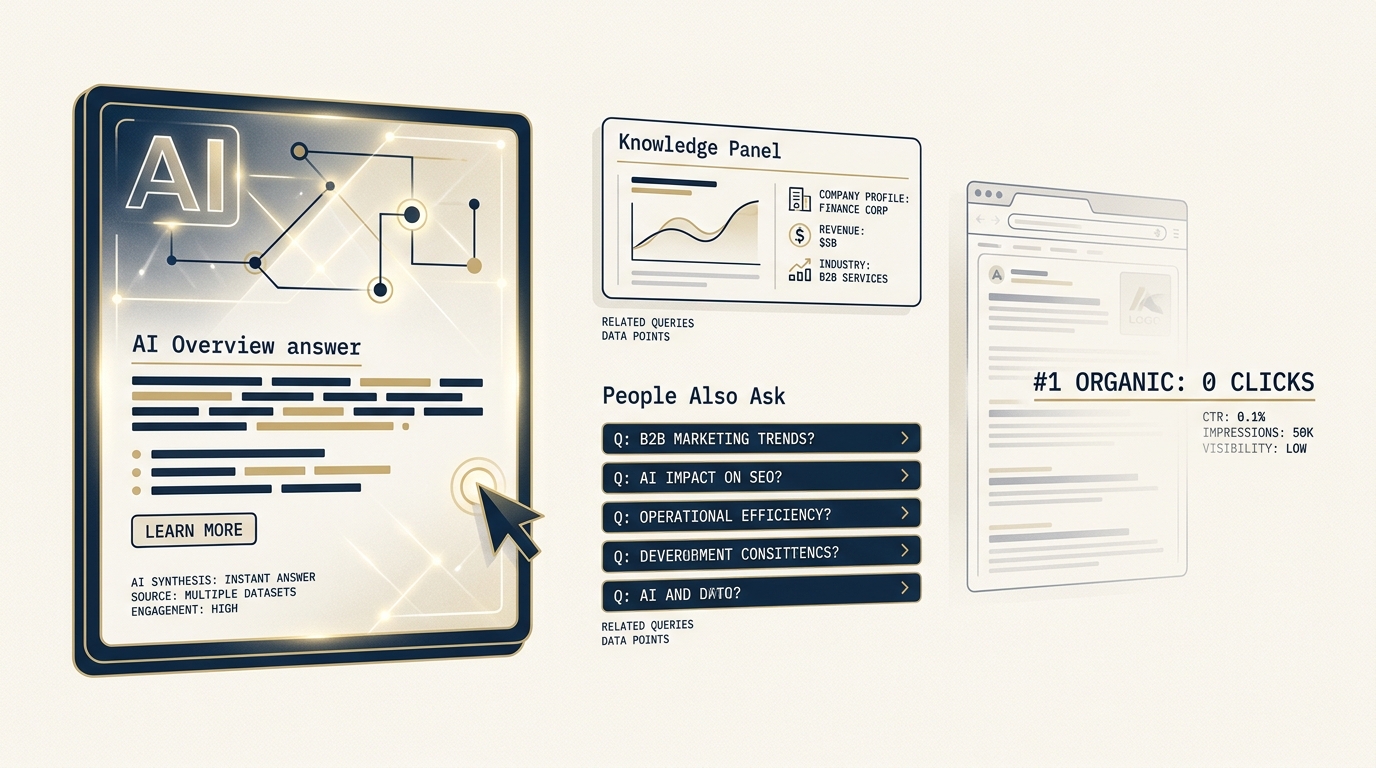
The cause is the Search Engine Results Page (SERP) environment doing what its current design now requires it to do. A user searching a commercial-intent query in finance encounters a sequence of answer surfaces that consume their attention before they reach the organic result.
In a typical YMYL SERP today the user sees, in order:
- An AI Overview panel at the top that summarizes the answer directly with inline citations to a small set of sources.
- A knowledge panel for the dominant entity (often an incumbent media brand or established firm with deep schema).
- A “People Also Ask” block answering common follow-up questions.
- A Map Pack for local-intent queries.
- A featured snippet pulled from one of the indexed pages.
- Then, beneath all of that, the position 1 organic result.
By the time the user reaches the position 1 organic result, the question has been answered, the leading entity has been recommended, and the related questions have been addressed. The position 1 ranking shows up as an impression. It does not show up as a click, because the user’s information need was met above the fold.
The Empirical Anchor
BrightEdge’s One-Year Mark Report from September 2025 reports a finding that quantifies the gap precisely. Finance has the lowest AI Overview to top-10-organic overlap of any vertical at approximately 11%. Translated: a finance site ranking #1 organically is the least likely of any vertical to be cited inside the AI Overview that sits above it on the page. The AI Overview is pulling its citations from a different set of sources than the organic ranking system is rewarding.
Conductor’s 2026 AEO/GEO Benchmarks Report (Answer Engine Optimization and Generative Engine Optimization), based on more than 20 million Google searches across thousands of domains, found that AI Overviews now appear on approximately a quarter of finance queries. Within finance, the AI Overview presence is bifurcated by query type. Educational queries (“what is an IRA”) see AI Overview presence above 90%. Rates and planning queries see it above 65%. Tax queries above 55%. Retirement planning above 60%. Stock tickers, navigational queries, and “near me” queries see it under 10%.
The structural feature of these distributions is that the queries with the highest AI Overview presence are the same queries that, classically, produced the most traffic for content-marketing investment. Educational and planning content was the bread and butter of advisory content strategy from 2018 through 2023. The traffic for that content is now consumed by the AI Overview.
The Honest Read on the Authority Question
The position 1 organic result that produces zero clicks could be there for two distinct reasons. Each has a different remediation path.
Reason one: the organic ranking is correct, but the AI Overview is winning the click. In this case, the page is doing the right job in Google’s classical ranking system, and the click is being consumed by a separate system that ranks sources for AI surface citation. The remediation path is authority signals (PR, editorial placement, named-byline authorship) that move the page into the citation set the AI Overview is pulling from.
Reason two: the organic ranking is high but the snippet is unappealing or the user’s intent is met without clicking. In this case, the title, description, or excerpt is failing to motivate the click even before the AI Overview is considered. The remediation path is copy work on the indexed snippet, schema work that controls the rich result presentation, and intent-matching on the underlying page.
The diagnostic procedure is straightforward. Look at the snippet Google is actually showing for the position 1 ranking. Click through to the page and ask whether the page is the right destination for the underlying query. If the snippet is reasonable and the page is intent-matched, the cause is the AI Overview cannibalization (reason one). If the snippet is weak or the page is misaligned, the cause is in your control (reason two).
In the engagement I opened with, the cause was reason one. The pages were well-structured, the snippets were reasonable, and the user’s question was being answered above the fold by an AI Overview pulling from incumbent media brands the firm could not displace through schema work alone.
What This Implies for Investment
The strategic implication is that traditional organic ranking optimization no longer produces the click outcomes it did even three years ago, particularly in YMYL verticals. Sites investing in ranking improvements without parallel authority investment are buying impressions that do not translate to traffic.
For YMYL categories specifically, the right investment mix has shifted. The technical SEO and content quality work that produces high organic rankings is still necessary (the ranking is the precondition for any visibility), but it is no longer sufficient. The parallel investment in authority signals (PR retainers, named-feature pursuit in tier 1 outlets, awards and recognition submissions, podcast guesting, conference circuit work) is what moves a page from “ranking but not cited” into “ranking and cited by the AI Overview.” The citation, not the rank, is what now produces the click.
I covered the schema implications of this shift in detail in a companion post on technical SEO as a floor rather than a ceiling. The principle is the same here. Rankings are necessary infrastructure. Authority signals are what allow the infrastructure to convert into commercial outcome.
The Discipline
The discipline this asks for is to stop measuring SEO success by ranking position and to start measuring it by citation share. A site ranking #1 on a portfolio of YMYL commercial queries and capturing zero clicks is producing the visible signature of an authority gap, not of a content optimization opportunity. The remediation work happens off-site (in the authority engine) more than on-site (in the content engine).
Most SEO consultants and most marketing teams have not made this shift. They are still optimizing for the metric (ranking position) that no longer correlates cleanly with the outcome (revenue). The teams that produce the strongest outcomes in YMYL today are the teams that have internalized the citation-share frame and have built parallel authority investment alongside their content investment. The clicks follow the citations, not the ranks.
Related Reading
- Crawled, Currently Not Indexed covers the upstream diagnostic when the issue is not click capture but index inclusion itself. A page that is not indexed cannot rank, regardless of how the SERP environment treats #1 organic.
- AI Content at Scale Is Now a YMYL Liability shows the empirical failure pattern when sites respond to zero-click conditions by scaling up content velocity instead of authority investment.
About the Author
Andrés Plashal
Author of the Assistive Agent Optimization (AAO) framework. Twenty years building search and measurement systems for B2B and SEC-regulated firms. Google Partner since 2017.
Credentials: UIUC Gies College of Business (Behavioral Science), Columbia College Chicago (Interactive Arts & Media). Member: American Marketing Association, GAABS, Paid Search Association. Published researcher (SCTE/NCTA).