Why Your Entity Needs a Wikidata QID for AI Search (and the 90 Minute Path)
The Cheapest Authority Signal You Can Earn
Wikipedia is hard to earn. Wikidata is not. Both anchor your entity in the structured authority graph that AI engines use for disambiguation, but the bar for a Wikidata QID is substantially lower: verifiable existence through three independent sources, neutral phrasing, and a focused submission. Most B2B finance firms above $10M in revenue can clear it. Most do not, because they assume the bar is the same as Wikipedia. It is not.
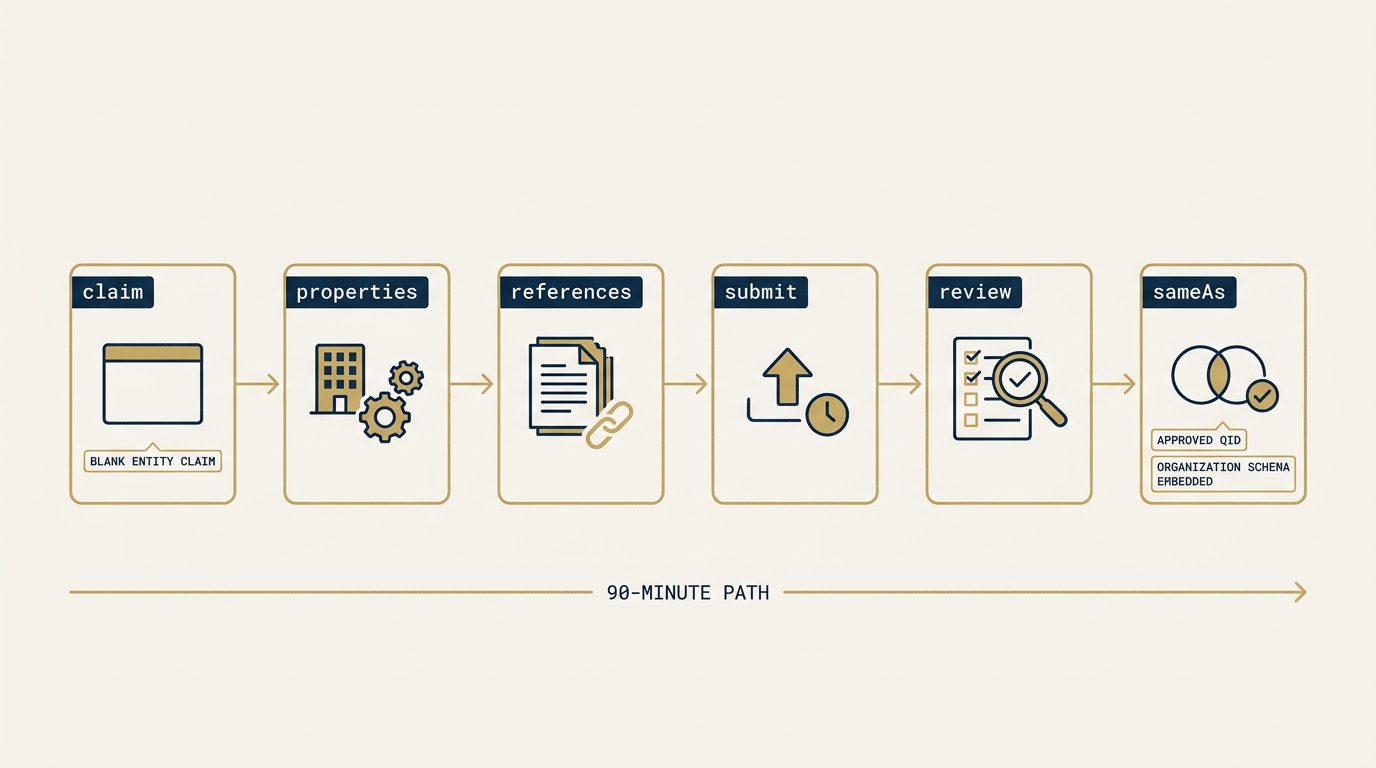
This post walks the 90-minute path from “we have no Wikidata presence” to “we have a QID referenced from our homepage Organization schema.” The mechanics are documented elsewhere; the value is in the sequence and the rejection-avoiding patterns. See the Discovery Gate post for why the QID matters structurally.
What A QID Does
A QID is a unique identifier in the Wikidata graph. The format is Q followed by a number (Q123456789). Once assigned, the QID becomes the canonical reference for your entity across systems that consume Wikidata: Google’s Knowledge Graph, Apple’s Knowledge Graph, OpenAI’s training distribution, Anthropic’s reference data, and the long tail of AI search engines that train on or query Wikidata directly.
The practical effect: when Perplexity is asked about your firm by name, it has a single canonical entity to reference rather than disambiguating between similarly-named alternatives. When ChatGPT is asked about your firm’s services, it links the firm to the broader claim graph anchored by the QID. The disambiguation is structural, not editorial.
Notability Requirements B2B Firms Can Meet
Wikidata’s notability bar is lower than Wikipedia’s but not zero. The working test: verifiable existence through three independent sources. For a B2B finance firm, independent sources typically include:
- A registered business filing (SEC ADV for RIAs, state corporate filings for others).
- Two news mentions in editorial publications (not press releases, not paid placements).
- A professional database entry (Crunchbase, Bloomberg, LinkedIn company page).
Three sources is the floor; five to seven is the comfortable range. The sources do not need to be tier 1. A Crunchbase entry plus two Investment News articles plus a Wealthtender mention plus an SEC ADV is a defensible source set.
The Six-Step Path
The submission process, with realistic time budgets:
-
Confirm no existing entry (5 minutes). Search Wikidata for the firm name and any close variants. If an entry exists, your work is to update it rather than create one. Many firms have stub entries created by Wikidata’s automated import bots that need to be expanded.
-
Draft the entity claim with core properties (20 minutes). The minimum useful set:
instance of(typically Q4830453 for business or Q891723 for public company),country(Q30 for USA),legal form,headquarters location,founded, andfoundersif applicable. Each property gets a value; the value can be a literal string or a reference to another QID. -
Add cited external references (20 minutes). Each property should be supported by a reference. Use the “add reference” function to attach a URL to each claim. Three to five total references across the entity is the comfortable range.
-
Submit and wait for community review (variable). Submission is immediate. Community review usually completes within 2 to 7 days. During review, an editor may add or modify properties, request additional sources, or merge with an existing entry.
-
Add
sameAsreferences in your Organization schema (10 minutes). Once the QID is assigned, edit your site’s Organization schema to include"sameAs": ["https://www.wikidata.org/entity/QXXXXXXXXX"]. This is the link from your site to the Wikidata graph that AI crawlers follow. -
Verify the link in production (5 minutes). Inspect the rendered Organization schema with Google’s Rich Results Test or by viewing source. Confirm the
sameAsarray contains the Wikidata URL. The link is what triggers the entity recognition downstream.
Active work: roughly 60 minutes. Calendar time: typically a week including review.
Common Rejection Reasons
Three patterns that cause review delays or rejections:
-
Promotional language. “Leading provider of innovative wealth management solutions” reads as marketing copy and fails neutrality. Replace with descriptive language: “Registered investment adviser headquartered in [city].”
-
Insufficient sources. A submission with only the firm’s own website as a reference is rejected. Independent sources are required.
-
Conflict of interest disclosure. If you are the firm’s principal or employee, declare the conflict in your edit summary. Wikidata’s policies allow conflicted edits with disclosure but penalize undisclosed ones.
Worked Example
A mid-sized RIA we worked with attempted Wikidata submission three times before succeeding. First two attempts were rejected for promotional language. Third attempt followed the path above with neutral phrasing and four independent sources (SEC ADV, two Wealthtender articles, a Crunchbase entry). Review completed in four days. QID was added to the firm’s Organization schema within an hour of approval.
Six weeks later, Perplexity asked about the firm by name returned the firm’s accurate description rather than a competitor profile that had been the prior response. The improvement came from one schema attribute (sameAs to the QID) added in one deploy.
Frequently Asked Questions
Can I claim a QID for myself as an individual?
Yes, with notability evidence. For an individual practitioner, notability evidence typically means published bylines in tier 1 or tier 2 outlets, awards or recognition, conference appearances, and professional database entries (LinkedIn alone is not enough). A founder with two Forbes columns and a Barron’s Top 100 listing meets the bar comfortably.
Will Wikidata stay current after I submit?
Mostly. The community maintains entries against vandalism but does not actively update factual changes. Set a calendar reminder to review your entry annually and submit updates as material facts change (acquisitions, founders, headquarters moves).
What if my submission is rejected and I cannot find the reason?
Check the edit history of your submission for editor comments. If the comments are unclear, post a question on the Wikidata project chat. The community is generally helpful to good-faith submitters who are responding to feedback.
Does this work for early-stage startups?
The notability bar requires independent sources, which early-stage firms often lack. A firm at the seed stage with no editorial press coverage will struggle. Once the firm has three independent press mentions, the path opens.
How does this interact with the Authority Gate?
The QID is the Wikidata anchor in the entity authority graph. It is one of several authority signals; named bylines, Wikipedia (when available), and Crunchbase complete the picture. The Authority Gate post covers the full ecosystem.
Next In Series
The next post covers query fan-out: how LLMs decompose ambiguous queries into multiple sub-queries before retrieval, and what that means for how you write title tags and header hierarchy.
About the Author
Andrés Plashal
Author of the Assistive Agent Optimization (AAO) framework. Twenty years building search and measurement systems for B2B and SEC-regulated firms. Google Partner since 2017.
Credentials: UIUC Gies College of Business (Behavioral Science), Columbia College Chicago (Interactive Arts & Media). Member: American Marketing Association, GAABS, Paid Search Association. Published researcher (SCTE/NCTA).