AI-Generated Content and YMYL Compliance: Where the SEC Went in 2026
The Firm’s Responsibility Did Not Change
When ChatGPT, Claude, or another generative tool produces marketing content for a firm, the firm’s regulatory responsibility for the content is unchanged. The 2026 SEC posture made this explicit through risk alerts and enforcement actions: AI-tool authorship does not shift liability. The firm that publishes AI-generated content is treated as the author for compliance purposes.
This post covers the 2026 reframing and the supervisory workflow that operationalizes it. The frame is conservative: the safest assumption is that AI-generated content carries the same obligations as any other marketing content, and the operational fix is the supervisory workflow.
The framing is operational; refer to counsel for jurisdiction-specific application.
What Changed In 2026
Three movements in 2026 that crystallized the SEC posture:
-
Risk alerts on AI use. The SEC’s Division of Examinations issued risk alerts in early 2026 calling out specific failure modes seen in AI-generated marketing: fabricated statistics, unsupported performance claims, hallucinated regulatory framings, and inconsistent disclosure language.
-
Enforcement actions on RIA AI use. Several RIA firms faced enforcement actions in 2025 and 2026 for misleading marketing that involved AI-generated content. The enforcement framing did not distinguish AI-generated from human-written; the standard applied was the same.
-
Industry guidance from FINRA on AI tools. FINRA published guidance for broker-dealers on AI-tool use in marketing. The core point: existing rules apply, and supervisory frameworks must extend to AI-tool workflows.
The cumulative effect: by mid-2026, the regulatory posture on AI-generated content was clear. The firm’s responsibility is the same regardless of authorship.
Common Failure Modes
Five patterns where AI-generated content creates compliance gaps:
-
Fabricated statistics. AI tools sometimes generate confident-sounding statistics that are wrong or have no source. “Our research shows that 72% of B2B finance buyers…” with no underlying research is fabrication. The firm publishing the statistic is liable.
-
Unsupported performance claims. AI tools rephrase performance claims in ways that can lose disclosure or methodology detail. A prompt that asks for “engaging copy about our 8% returns” may produce a paragraph that loses the net-of-fees treatment.
-
Hallucinated regulatory framings. AI tools sometimes describe regulatory frameworks inaccurately, particularly when asked to summarize compliance posture. A blog post that mischaracterizes the SEC Marketing Rule creates a compliance and credibility risk.
-
Inconsistent disclosure language. AI-generated content may include disclosure language that differs from the firm’s approved language. The variance can be material; the firm should publish only approved disclosure.
-
Personalization that crosses into recommendation. AI personalization engines can produce content that, depending on context, functions as personalized investment advice. This category triggers strict regulatory treatment.
The Supervisory Workflow
A workable workflow for firms using AI tools in marketing:
-
Define approved use cases. Identify the AI tasks the firm permits (e.g., drafting blog post outlines, generating headline variations) and the tasks the firm restricts (e.g., generating performance claims, drafting testimonial language).
-
Approve specific tools and configurations. Not all AI tools are equal. Some have hallucination rates that make them unsuitable for finance marketing; some have configuration options (temperature, system prompts) that affect output reliability.
-
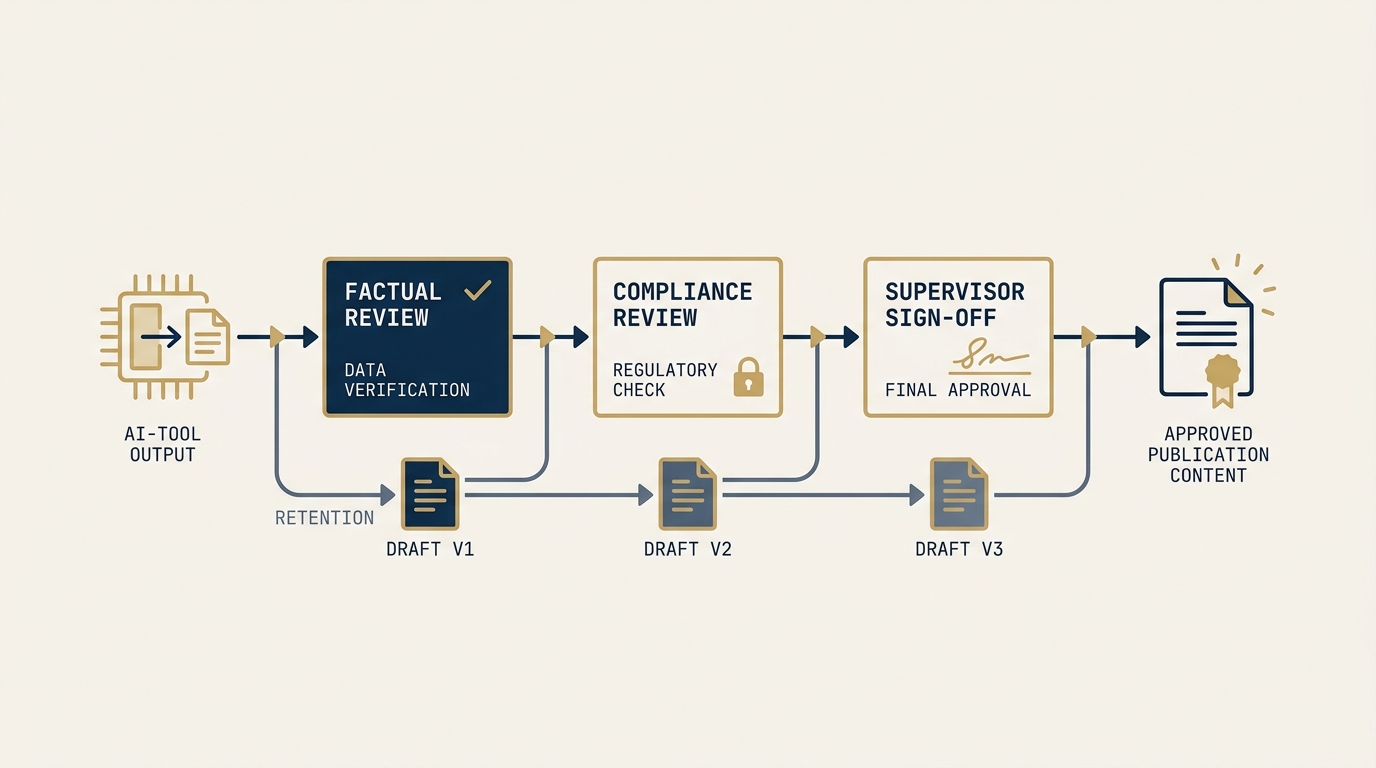
Require human review before publication. Every AI-generated artifact intended for publication goes through human compliance review. The review is not optional and not abbreviated for AI output.
-
Document the review. The compliance review of AI-generated content should be documented per the firm’s record-retention policy. Both the AI tool’s output and the human-edited final version are retained.
-
Train the team. Marketing team members using AI tools should understand the compliance framework. Training reduces error rates more than process alone.
-
Audit periodically. Quarterly review of AI-tool use in marketing. Are the approved use cases still appropriate? Are new tools being used that need approval?
Disclosure Of AI Authorship
A separate question: does AI-generated content need to be disclosed as AI-generated?
The 2026 SEC posture does not require disclosure of AI authorship per se. The firm is the author for compliance purposes regardless. Some firms choose voluntary disclosure for transparency; others do not. Disclosure is generally permitted but not required.
The FTC Endorsement Guide overlay may apply for sponsored content that AI tools have generated; the standard for material connections applies to AI-generated promotional content the same as human-generated.
Retention Of AI Workflow Artifacts
Modern AI workflow tools generate multiple intermediate artifacts: prompts, drafts, edits, alternative variations. Record retention under the SEC Marketing Rule and FINRA Rule 2210 applies to the final published content, but firms should consider whether to retain intermediates.
The conservative position: retain prompts, key drafts, and the final version. The retention surface increases; the audit trail is more complete.
The minimal position: retain only the final published version. The retention surface matches non-AI content; the audit trail is less complete.
Counsel should advise on the appropriate position for the firm’s risk posture.
Worked Example
A wealth management firm we audited had introduced AI tooling for blog content drafting in 2025. The marketing team had been using ChatGPT to draft 30% of blog posts and editing for tone. The compliance review was skipped for AI-drafted posts because “the AI checked it.”
Audit findings: two of the eighteen AI-drafted posts contained statistics that could not be sourced; three contained regulatory framings that were partially inaccurate; one contained a performance claim that lost the net-of-fees treatment in the AI drafting process.
Remediation: the firm extended the compliance review queue to cover all AI-generated content. The two unsourced statistics were retracted; the regulatory framings were rewritten; the performance claim was corrected. The remediation took four weeks. The team’s process was updated to require compliance review of all AI-generated content before publication.
Frequently Asked Questions
Should our compliance team prohibit AI tool use entirely?
Most firms find prohibition unworkable; the productivity gains from AI tools are substantial. The right answer is supervised use rather than prohibition.
Are there AI tools designed specifically for finance compliance?
Several tools market themselves for compliance-aware finance content. Vendor claims should be evaluated against the firm’s actual workflow needs. Some tools provide useful pre-screening; none substitute for human compliance review.
How does this interact with the SEC Marketing Rule post?
The SEC Marketing Rule applies to AI-generated content the same as to human-generated content. The supervisory workflow described here is the operational fix that maintains compliance under the rule regardless of authorship.
What if a client uses AI to generate a testimonial?
Client-generated AI testimonials are still subject to the testimonial framework from the testimonial advertising post. The compensation, conflicts, and representative-nature disclosures apply. The fact that a client used AI to compose their testimonial does not change the firm’s obligations.
How often should AI-tool approval be reviewed?
Quarterly at minimum. AI tools evolve rapidly; a tool approved in Q1 may have new features or behavioral changes by Q3 that affect compliance posture. Quarterly review keeps the approved-tool list current.
This is operational guidance for marketing teams, not legal advice. Consult firm counsel for jurisdiction-specific application of rules to AI-generated marketing content.
Next In Series
The next post covers state-by-state RIA advertising rules: a working checklist. State law overlays complicate the federal compliance posture in predictable ways; the checklist surfaces the gaps most firms underweight.
About the Author
Andrés Plashal
Author of the Assistive Agent Optimization (AAO) framework. Twenty years building search and measurement systems for B2B and SEC-regulated firms. Google Partner since 2017.
Credentials: UIUC Gies College of Business (Behavioral Science), Columbia College Chicago (Interactive Arts & Media). Member: American Marketing Association, GAABS, Paid Search Association. Published researcher (SCTE/NCTA).