Performance Claims: A Defensible Structure for 'We Generated $X' Statements
Quantitative Claims Carry Strict Requirements
“We generated $48 million in new AUM” is a performance claim. So is “our process produced a 22% client acquisition rate.” So is “advisors using our platform saw revenue grow by 34%.” Each carries disclosure obligations under the SEC Marketing Rule, FINRA Rule 2210, or both. The obligations are not satisfied by adding a generic disclaimer at the bottom of the page. They require a specific methodology disclosure structure that survives audit review.
This post covers the four-element template that produces defensible performance claims. The framing is operational; refer to counsel for jurisdiction-specific application.
The Four-Element Template
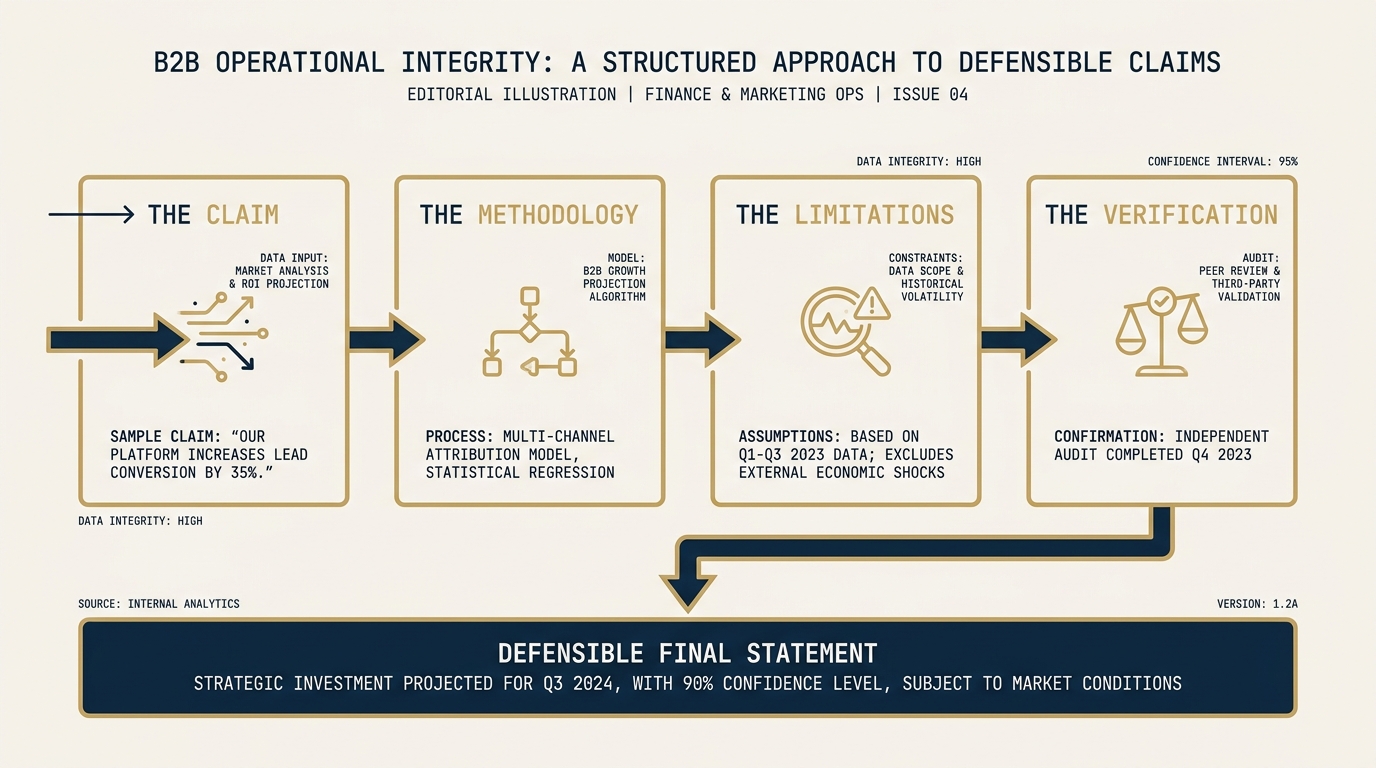
A defensible quantitative claim has four elements:
-
The claim itself. The headline quantitative statement. Specific and bounded (“$48 million in new AUM across 18 client engagements”) rather than vague (“substantial growth”).
-
The methodology. How the metric was calculated. Source of the data, timeframe, scope, inclusion and exclusion criteria. The reader can recompute the claim from the methodology.
-
The limitations. What the claim does not assert. Survivorship bias, selection effects, time period dependence, market conditions, non-applicability to future periods.
-
The verification path. How the claim can be independently verified. Link to a longer methodology page, link to a regulatory filing if applicable, or a contact for inquiry.
Each element is necessary. Skipping any one produces a gap an auditor identifies. The four elements compose into a 100 to 200 word disclosure block that accompanies the claim wherever the claim appears.
Applied To Three Common Claim Types
Type one: Aggregate commercial outcomes. “We generated $X in new AUM across Y client engagements.”
Disclosure structure: “This figure represents new AUM contracted through the firm’s client engagements between [start date] and [end date]. The methodology counts AUM at the point of engagement initiation; AUM growth subsequent to engagement is not included. Selection criteria: all client engagements meeting [criteria]; engagements that did not produce AUM growth are included in the denominator. Past results do not predict future results; market conditions during this period [briefly characterized] may not persist. Full methodology at [linked page].”
Type two: Conversion or efficiency metrics. “Our process produced a 22% client acquisition rate from qualified leads.”
Disclosure structure: “This rate measures qualified leads (defined as [criteria]) that converted to engaged clients within 90 days of initial contact, across the sample period [date range]. Qualified-lead definition is consistent across the sample. The rate does not include leads that converted after 90 days or leads that engaged the firm and then disengaged. Industry comparisons are challenging because qualified-lead definitions vary across firms. Full methodology at [linked page].”
Type three: Investment performance. “The portfolio returned 8.4% net of fees over 36 months ending Q4 2025.”
Disclosure structure: “Return is net of management fees and trading costs; gross returns were [%]. The 36-month period reflects [conditions]. Benchmark comparison: [Russell 2000 or applicable] returned [%] over the same period. Past performance does not guarantee future results. Specific risk factors and full performance methodology at [linked page].”
Each structure includes the four elements explicitly. The structures vary by claim type but the framework is consistent.
Hypothetical Performance Has Stricter Requirements
The SEC Marketing Rule treats hypothetical performance more strictly than actual performance. Hypothetical scenarios in marketing materials require:
- Explicit identification as hypothetical. The word “hypothetical” or equivalent appears at the start of the claim, not buried.
- Assumptions disclosed completely. Every assumption underlying the scenario is identified. Reasonable readers should be able to evaluate whether the assumptions are realistic.
- Limitations of hypothetical analysis disclosed. The fact that hypothetical scenarios do not reflect actual trading and may not be achievable.
- Conditions under which the scenario would not hold. What market or operational conditions would invalidate the projection.
A common compliance failure: presenting a hypothetical as if it were actual (“Our process produced…” when the underlying data is a simulation rather than realized outcomes). This pattern triggers enforcement risk and should be avoided structurally rather than disclaimed.
The Methodology Page Anchor
Performance claims should link to a longer methodology page that hosts the full disclosure detail. The page serves three functions:
- Compliance audit trail. The page documents how every claim was calculated, with version history.
- AI search citation surface. A public methodology page passes AAO gates and becomes the citation anchor for downstream marketing content. The Methodology Page post covered this from the MMM angle; the same pattern applies to commercial performance.
- Reader credibility. Readers who care about methodology can verify; readers who do not care still benefit from the implicit signal that methodology is documented.
The page is typically 1,500 to 3,000 words, lives at a stable URL, includes structured data markup, and is updated when methodologies change.
Common Failures
Five patterns that produce audit findings:
- Numbers without methodology. “$48M in new AUM” with no explanation of how the figure was calculated.
- Methodology that is not actually disclosed. “Methodology available upon request” is generally insufficient for retail communications.
- Survivorship bias not addressed. A claim that includes only successful engagements while omitting unsuccessful ones is misleading without explicit disclosure.
- Time period cherry-picking. Selecting a favorable 36-month window without identifying alternative windows the reader might consider.
- Hypothetical presented as actual. The most expensive failure category.
Worked Example
A B2B finance firm we audited had a homepage claim of “180% organic traffic growth” referenced in five paid ads, two blog posts, and one case study. The methodology behind the claim was not documented.
Audit findings: the 180% figure was technically accurate over a specific 18-month window with a particular baseline definition, but the figure had been used in marketing 12 months after the underlying conditions had changed materially. The current state of the metric was substantially different from the published claim.
Remediation: the team retired the 180% claim across all marketing surfaces. Replacement claims were written with the four-element structure: smaller, current, and fully documented. The methodology page was rebuilt to support the replacement claims. The remediation took two weeks; the lesson on aging quantitative claims was retained.
Frequently Asked Questions
What about claims about results from “average” clients?
“Average client” claims trigger the same methodology disclosure requirements as aggregate claims. The methodology must specify how “average” is defined (mean, median, mode) and across what sample.
Can I use specific dollar figures from a single client?
Yes, with full case study treatment per the lead-gen post. Single-client claims are testimonial-adjacent and require both testimonial-style and performance-style disclosures.
How often should the methodology page be updated?
Whenever the underlying methodology changes or whenever new claims are added. The dateModified discipline applies; aged methodology pages create gaps between current claims and documented methodology.
Does this apply to client-success teams’ anecdotes shared in sales conversations?
Sales conversations are not “communications” in the regulatory sense unless they are documented and distributed. The same content used in marketing materials carries the obligations.
What about peer-firm benchmarks like “we outperform the industry average”?
Comparative claims trigger comparison-specific disclosure requirements. The peer set must be defined, the benchmark methodology must be disclosed, and the time period must be explicit.
This is operational guidance for marketing teams, not legal advice. Consult firm counsel for jurisdiction-specific application of performance claim disclosure rules.
Next In Series
The next post covers AI-generated content and YMYL compliance: where the SEC went in 2026 on AI-generated marketing content, the operational implications, and the supervisory workflow that addresses them.
About the Author
Andrés Plashal
Author of the Assistive Agent Optimization (AAO) framework. Twenty years building search and measurement systems for B2B and SEC-regulated firms. Google Partner since 2017.
Credentials: UIUC Gies College of Business (Behavioral Science), Columbia College Chicago (Interactive Arts & Media). Member: American Marketing Association, GAABS, Paid Search Association. Published researcher (SCTE/NCTA).