Pre-Engagement vs Engaged Client Communications: The Disclosure Boundary
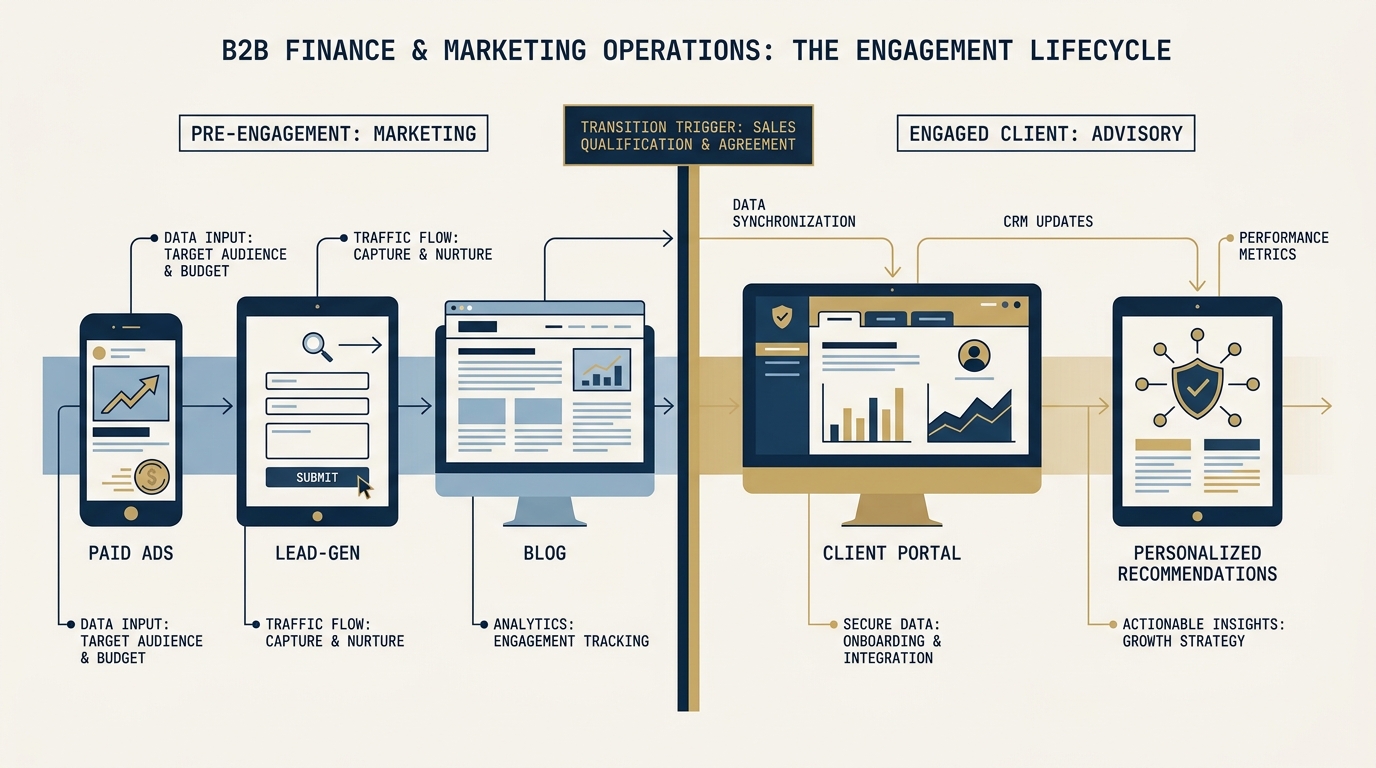
Two Regimes, One Funnel
The funnel from prospect to engaged client crosses a compliance boundary that most marketing operations teams underweight. On one side, marketing-to-prospect communications fall under the SEC Marketing Rule, FINRA Rule 2210, and state advertising rules. On the other side, advisory-to-client communications fall under different rules: the advisory contract, fiduciary obligations, Form ADV Part 2 brochure delivery, and ongoing supervisory frameworks for personalized advice.
The boundary is operational. The moment a prospect crosses from “audience” to “engaged client” is the moment the regime changes. Operations teams that treat the funnel as a continuous marketing process miss the transition. The fix is workflow-level: identify the boundary, assign the regime, route the content accordingly.
This post covers the boundary, the common failure patterns, and the operational fix. The framing is operational; refer to counsel for jurisdiction-specific application.
What The Boundary Is
The boundary is the point at which the firm and the individual enter an advisory relationship. In practice:
- Pre-engagement. The individual is a prospect, a lead, a website visitor, a subscriber. Communications are marketing.
- Engaged client. The individual has an advisory agreement with the firm. Communications are advisory and may be personalized.
Three transition triggers most commonly mark the boundary:
- Advisory agreement signature. The advisory contract is signed. The individual is a client.
- First fee event. Some firms treat the first paid invoice as the boundary, particularly for project-based engagements.
- First substantive advice exchange. Some firms treat the first personalized advice exchange as the boundary, particularly for firms with extended pre-engagement consultations.
The firm’s compliance framework should specify which trigger applies. The trigger should be consistent across the firm’s operations.
The Pre-Engagement Regime
Pre-engagement communications are marketing. The applicable rules:
- SEC Marketing Rule for RIA marketing (see the SEC Marketing Rule post).
- FINRA Rule 2210 for broker-dealer marketing (see the FINRA Rule 2210 post).
- State advertising rules.
- FTC Endorsement Guide as overlay.
- Privacy law overlays (CCPA, CPRA, etc.).
Pre-engagement content can be general but cannot be personalized advice. A prospect asking “should I rebalance my 401k” should receive marketing-appropriate response (general information, encouragement to engage advisory services) rather than personalized advice.
The Engaged Client Regime
Engaged client communications fall under different rules:
- Advisory contract terms.
- Fiduciary obligations.
- Form ADV Part 2 brochure delivery and annual updates.
- Custody Rule requirements (where applicable).
- Privacy and confidentiality obligations under Regulation S-P.
- Ongoing supervisory frameworks for the firm’s advisory operations.
Engaged-client communications can be personalized. Personalized advice that reflects the client’s specific circumstances is the core advisory product. The communications are within the advisory relationship.
Five Common Failure Patterns
Five patterns where the boundary is mismanaged:
-
Pre-engagement nurture sequences that drift toward personalized advice. A drip email campaign that, over weeks, escalates from general content to specific recommendations crosses the boundary without crossing the relationship.
-
Sales calls that provide personalized advice without contract signature. A discovery call that gives the prospect specific recommendations is functioning as advisory without the relationship being established.
-
Client portal content available to prospects. A client portal that prospects can access (often via guest accounts or trial periods) blurs the boundary. Advisory content available without the advisory relationship.
-
Marketing automation that personalizes by inferred client status. A marketing automation platform that adapts content based on inferred lifecycle stage may include personalized advice content for prospects.
-
Re-engagement campaigns to former clients that include unsolicited advice. A campaign targeting former clients may revive the advisory relationship informally, with unclear regime application.
Each pattern has operational fixes. The unifying fix is workflow discipline at the transition.
The Operational Fix
A workable workflow for managing the boundary:
-
Define the transition trigger. Pick one of the three triggers above; document it; apply it consistently.
-
Build separate communication tracks. Pre-engagement track uses marketing-compliant content. Engaged-client track uses advisory-compliant content. The tracks have separate templates, separate review processes, and separate record retention.
-
Tag individuals by lifecycle stage in the CRM. Lifecycle stage drives which track applies. Automation rules use the tag to route content.
-
Audit the boundary regularly. Surface cases where content crosses without lifecycle progression, or where lifecycle has progressed without content track switch.
-
Train sales and marketing teams. The boundary is operational; the teams executing the work need to understand it.
The fix is process discipline more than tooling. Modern CRMs (HubSpot, Salesforce, Mailchimp) support the workflow; the firm’s discipline is the differentiator.
Worked Example
A wealth management firm we audited had three relevant gaps:
- The lead-nurture sequence escalated from general blog content to a “personalized recommendation” email that recommended specific portfolio adjustments based on inferred prospect interests.
- The discovery call script included a step where the advisor would offer a “quick recommendation” for the prospect’s situation before any advisory contract was discussed.
- The newsletter for “subscribers” mixed prospects and former clients without differentiation.
The remediation: the lead-nurture email was rewritten to recommend a consultation rather than a specific adjustment. The discovery call script removed the recommendation step and replaced it with a “we can develop a recommendation as part of an engagement” framing. The newsletter was split into two: a prospect-facing version and a former-client-facing version with different content discipline.
The remediation took five weeks. The firm’s compliance posture improved without measurable impact on conversion rates; the conversion impact of the discovery-call recommendation had been smaller than expected.
Frequently Asked Questions
What about “free consultation” offers? Where does that sit?
Free consultations are typically pre-engagement. The consultation itself is a marketing offer that surfaces the firm’s value and produces a conversion event to engaged-client status. Free consultations should be structured to avoid drifting into personalized advice during the consultation itself.
Can engaged clients receive marketing communications?
Yes, with appropriate framing. A “you might also be interested in [new service]” communication to an engaged client is marketing within an existing relationship. The communication still passes through marketing compliance review.
How does this interact with the Marketing Rule’s testimonial framework?
Testimonials from engaged clients have their own treatment under the Marketing Rule. The pre-engagement / engaged distinction does not exempt testimonials from disclosure requirements; both categories require the same disclosure structure.
What about prospects who never become clients?
Prospects who do not convert remain in the pre-engagement track. They may exit the firm’s communication pipeline through opt-out, attrition, or explicit “not a fit” disposition. The communications during their pipeline period are governed by the marketing regime.
How does this affect retargeting?
Retargeting audiences typically include pre-engagement prospects. Engaged-client audiences should be excluded from retargeting because the relationship has different communication patterns. CRM-based audience exclusion is the standard pattern.
This is operational guidance for marketing and operations teams, not legal advice. Consult firm counsel for jurisdiction-specific application of compliance frameworks at the marketing-to-advisory transition.
Closing Batch 4
This is the last post of Batch 4 (Compliance for Performance Marketing). Ten posts covering the regulatory frameworks that overlay paid acquisition in regulated industries, with operational fixes for the patterns most consistently underweighted. The next batch begins Tue Nov 17 with the Industry Vertical Playbooks, starting with wealth management and RIAs.
About the Author
Andrés Plashal
Author of the Assistive Agent Optimization (AAO) framework. Twenty years building search and measurement systems for B2B and SEC-regulated firms. Google Partner since 2017.
Credentials: UIUC Gies College of Business (Behavioral Science), Columbia College Chicago (Interactive Arts & Media). Member: American Marketing Association, GAABS, Paid Search Association. Published researcher (SCTE/NCTA).