The Differentiation Gate: The Citation Worthiness Threshold
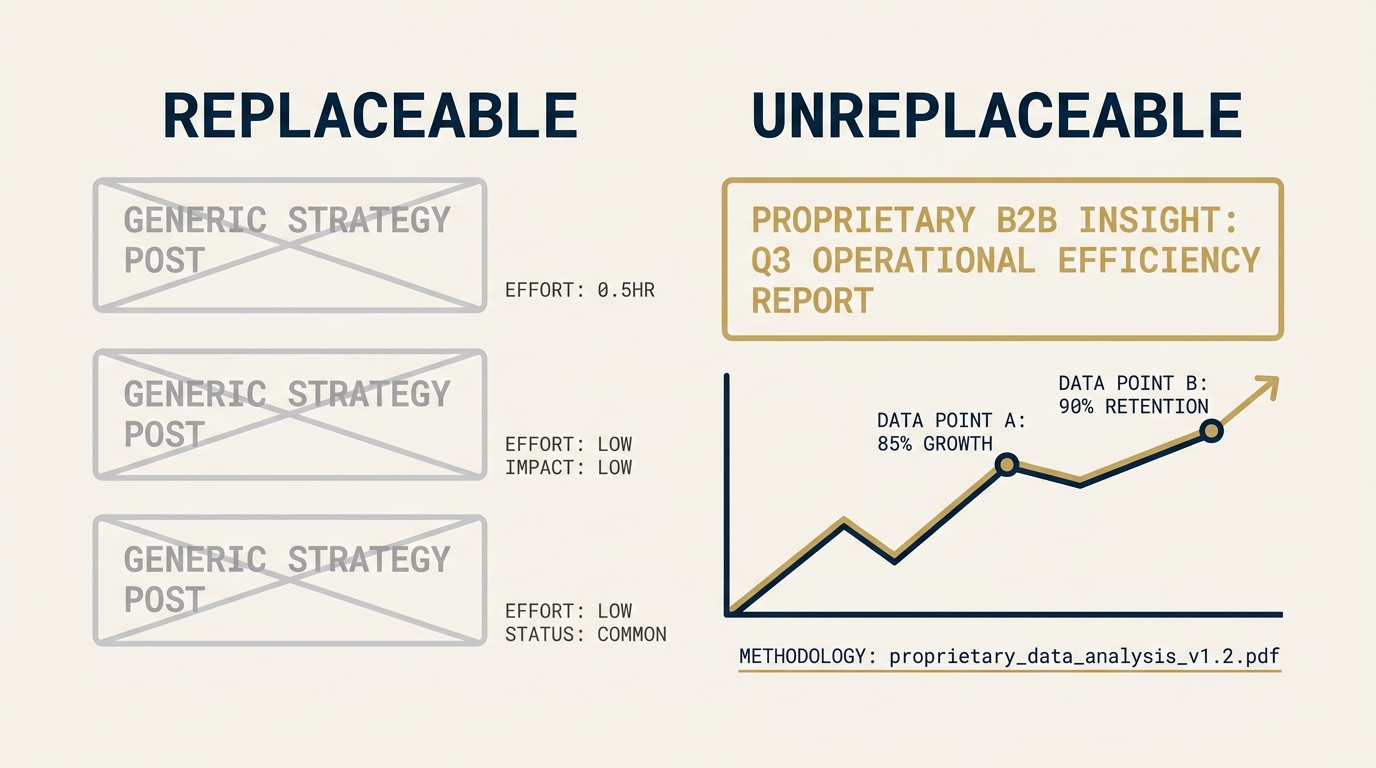
Replaceable Content Is Invisible Content
The DSCRI ARGDW framework Differentiation gate measures whether your content is citation worthy versus replaceable. A page that says the same thing as a thousand other pages is, from an AI engine’s citation perspective, one of a thousand interchangeable sources. The engine cites the source with the strongest other signals (Authority, Reputation, Recency) and ignores the rest. Differentiation is the gate that decides whether your page can compete for citation at all.
The threshold is not about quality in a generic sense. A well-written, accurate, expertly-edited page can still fail Differentiation if its argument is the consensus argument and its evidence is the consensus evidence. The gate scores structural originality, not editorial polish.
This post covers three sources of structural Differentiation: defensible perspective, original data, and methodology disclosure. Each is a publishable artifact. None is achievable through better writing alone.
Defensible Perspective
A defensible perspective is opinion plus evidence. Not opinion alone (commentary) and not evidence alone (description). The structural form: the author takes a position that a reasonable peer might disagree with, supports it with specific evidence, and acknowledges the counterposition.
Three patterns that score well on perspective:
-
Methodology preference. “Bayesian MMM is structurally more citation worthy than frequentist MMM in 2026.” A take. Supported by argument from output structure rather than statistical correctness. Acknowledges the counter (regulatory contexts where frequentist is preferred). Lives at a specific URL.
-
Practice critique. “Most MMM vendor methodology pages fail AAO gates in predictable ways.” A take. Supported by specific failure patterns. Acknowledges the counter (vendor pages are written for sales rather than reviewers).
-
Category boundary. “Schema is necessary but not sufficient for AI search citation in YMYL.” A take. Supported by a specific case study. Acknowledges the counter (schema is necessary; the argument is not against schema).
Posts without a defensible perspective tend to read as inventory: lists, summaries, descriptions. These are useful for some readers and uncitable to AI engines because the engine has no perspective to attribute to the author.
Original Data
Original data is structurally the strongest Differentiation signal because the data itself is non-substitutable. Three sources of original data accessible to most B2B finance firms:
-
Audits and benchmarks. A firm that audits 50 B2B finance sites and publishes the aggregate findings (anonymized) produces a dataset no other firm has. The methodology is the differentiator; the findings are the artifact.
-
Internal experiment results. Incrementality tests, A/B test results, channel-specific lift studies. Sanitized publication preserves competitive sensitivity while satisfying the AAO chain. The incrementality testing post covered the publication pattern.
-
Survey and primary research. Commissioning a survey of 200 wealth management CMOs about their measurement maturity produces data no aggregator publishes. The cost is real but the AAO payoff is durable.
Original data published under a stable URL with Dataset schema becomes the citation surface for category queries. Engines asked about the category cite the dataset. The publisher inherits authority.
Methodology Disclosure
Methodology disclosure is the Differentiation signal that does not require original data. A firm that applies a standard methodology to a specific use case can differentiate by documenting how the methodology was applied. Three patterns:
-
Parameter choice documentation. The adstock and saturation post walked through the parameter decision table pattern. The table is the Differentiation artifact.
-
Validation approach documentation. A holdout strategy, a sensitivity analysis, a cross-validation result. The validation is the audit trail.
-
Decision framework documentation. A published rubric for how decisions are made, including the inputs and the weights. The DSCRI ARGDW framework itself is an example: a worked argument about which signals determine AI citation, expressed as a rubric.
Methodology disclosure converts standard methodology into a differentiator by making the application transparent. The methodology is the same; the application is the differentiator.
Why Ten Tips Lists Never Win
A 2,000-word “10 tips for B2B SEO” post is, from the Differentiation gate’s perspective, a stack of ten replaceable claims. Each tip is a generic statement that ranks against thousands of identical statements on other sites. The retriever has no signal to prefer your version over the alternatives.
Three reasons the format never wins on AAO:
- No defensible perspective. “Tip 1: use schema markup.” Not a position; a recitation. The author could be substituted with any other author and the post would read identically.
- No original data. “Schema markup increases citation by 30%.” If the number is not from a published source, it is opinion. If it is from a published source, the published source is the citation anchor, not your post.
- No methodology to disclose. “Choose your keywords carefully” is methodology adjacent but never specific enough to differentiate.
The format is not without value. It can serve as introductory content for newer readers. It will not pass Differentiation; it will not be cited by AI engines on category queries.
The DSCRI ARGDW Framework As Worked Example
The framework this Tuesday thread documents is itself a Differentiation worked example. The structural elements:
- Defensible perspective. The argument that AI search citation requires a specific set of structural signals, not generic content quality, is a position that disagreed with the 2024 consensus.
- Original data. The framework was developed from auditing dozens of B2B finance sites; the gate definitions and the failure patterns are grounded in primary research.
- Methodology disclosure. The framework is published as a worked rubric. The gate names, definitions, and scoring criteria are explicit. The composite scoring approach is documented.
The framework’s Differentiation gate score is high because all three sources of differentiation are stacked. The framework cites primary audits, declares a perspective that disagrees with consensus, and publishes the methodology as a usable rubric.
A Worked Example
A wealth management firm published two posts on the same week, both about marketing measurement.
Post A: “10 Marketing Metrics Every RIA Should Track.” Generic list. Each metric described in 100 words. No data, no perspective, no methodology. Well-written; high editorial polish.
Post B: “Why Last-Click Attribution Fails Wealth Management.” Specific argument. Cited a 2025 audit of 22 wealth firms (anonymized aggregate findings published as a Dataset). Documented the alternative methodology. Acknowledged the counter (last-click is operationally convenient).
Three weeks after publication: Post A ranked top 5 on Google for “marketing metrics RIA” but was not cited by Perplexity, ChatGPT, or Claude. Post B ranked top 20 on Google (less broad search demand) but was cited by all three engines on category queries about attribution methodology. The Differentiation gate scored Post B higher; the cited authority graph routed citation queries to it.
Frequently Asked Questions
Is being controversial a Differentiation signal?
No. Controversial-for-the-sake-of-it reads as marketing. Defensible perspective is opinion plus evidence; controversial without evidence is the opposite of what the gate measures.
Can I differentiate through better writing?
Better writing helps the Content gate. It does not help Differentiation. Two well-written posts about the same generic argument both fail Differentiation.
How do I generate original data without a research budget?
Audit your own work. Publish anonymized aggregate findings from client engagements (with permission and proper aggregation). Publish your own experiment results. Conduct light surveys of your peer network. None of these require a research budget; all of them produce data that is yours.
Does the framework itself need to be public to differentiate my application of it?
Yes, when feasible. A proprietary framework that no one outside the firm can read produces some Differentiation, but a public framework that the firm applies in documented ways produces more. The frameworks that win citation tend to be publishable.
How does this gate interact with Authority?
Differentiation makes a single post unreplaceable. Authority makes the publishing entity recognized. They compound: an unreplaceable post from an authoritative entity wins citation on YMYL queries. An unreplaceable post from an unknown entity wins citation on niche queries. An authoritative entity publishing replaceable content wins on broad queries via Authority alone but is not cited specifically on category queries.
Next Gate
The next Tuesday post is the synthesis: Weighted Citability, which integrates the ten gates into a composite framework. It is the pillar for the entire Tuesday thread and the natural conclusion of the DSCRI ARGDW deep dive series.
About the Author
Andrés Plashal
Author of the Assistive Agent Optimization (AAO) framework. Twenty years building search and measurement systems for B2B and SEC-regulated firms. Google Partner since 2017.
Credentials: UIUC Gies College of Business (Behavioral Science), Columbia College Chicago (Interactive Arts & Media). Member: American Marketing Association, GAABS, Paid Search Association. Published researcher (SCTE/NCTA).