Weighted Citability: A Composite Framework for AI Search Readiness
The Composite Is The Synthesis
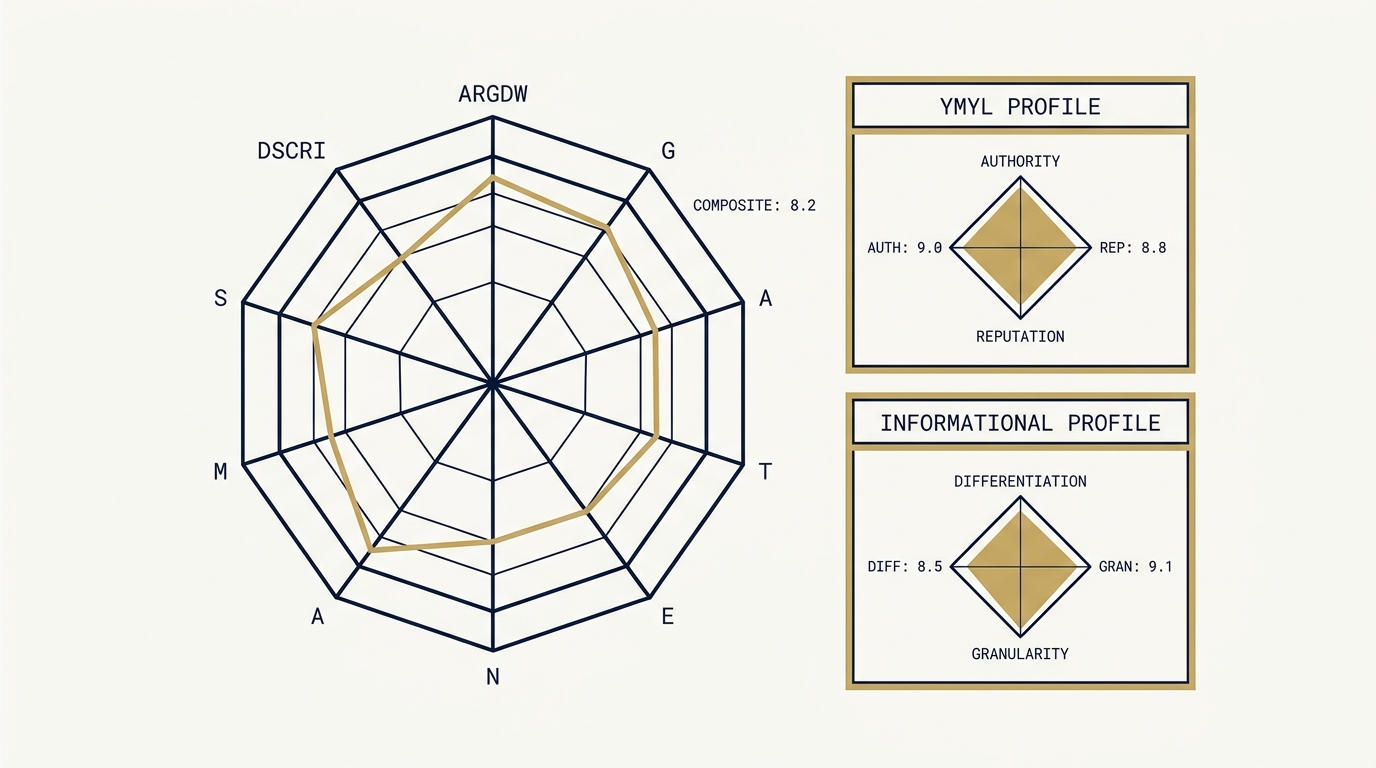
The ten gates of the DSCRI ARGDW framework (Discovery, Structure, Content, Reputation, Infrastructure, Authority, Recency, Granularity, Differentiation, and Weighted Citability) are each necessary and none is sufficient. A page that passes nine and fails one is, in most cases, uncitable. The tenth gate is the synthesis: how the other nine combine into a composite that AI engines actually score against.
This post is the pillar for the Tuesday thread. It covers how the composite is constructed, how the weighting shifts across categories (YMYL weights differently than informational), how the gate-score table works in practice, and where the framework will evolve in 2027 as AI search continues to mature.
Why One Gate Is Not Enough
A page that nails Discovery, Structure, Content, and Authority but fails Reputation gets cited inconsistently. The engines that weight Reputation heavily (Perplexity and Claude for YMYL queries especially) downrank the page. The engines that weight it less (OpenAI on informational queries) cite it. The composite picture: inconsistent citation behavior across engines and categories, even though four of the five major gates pass.
The framework’s working assumption is that AI engines apply a composite scoring function across the ten dimensions. The function is not public. The weights are not constant across queries. What is consistent across engines and queries is that all ten dimensions matter; the variation is in how much each matters.
Two implications for the practitioner:
- Triage gate failures by current category. A YMYL site failing Reputation should fix Reputation before Differentiation. An informational site failing Granularity should fix Granularity before Authority.
- Aim for a balanced profile. Stacking all the wins on three gates while neglecting seven produces a brittle citation profile. A balanced profile across all ten is more resilient.
Weighting By Category
The composite weighting shifts across content categories. The pattern I have observed across audits:
YMYL categories (finance, health, legal, insurance): Authority and Reputation weight heaviest. Citation worthiness is gated by whether the entity is recognized as authoritative. Content and Differentiation weight medium. Discovery and Structure weight as gates (you have to pass them, but exceeding the threshold does not earn extra credit).
Informational categories (technical tutorials, how-to content): Content, Differentiation, and Granularity weight heaviest. Citation worthiness depends on whether the content answers the question better than alternatives. Authority and Reputation weight less; a small site with strong content can win.
Product and category queries: Reputation and Authority weight heavily, similar to YMYL, but with more weight on Recency. Buyers care about current information.
Niche expertise queries: Differentiation weights heavily. A unique perspective from an under-known source can win when the consensus content is generic.
The implication: audit your content’s primary category before triaging gate failures. The right fix sequence is category-dependent.
The Gate Score Table
In the Astro Foundation pattern, the page_gate_scores table in D1 tracks per-page scores across all ten gates. Schema for the table:
CREATE TABLE page_gate_scores (
  page_url TEXT PRIMARY KEY,
  content_hash TEXT NOT NULL,
  scored_at INTEGER NOT NULL,
  discovery_score REAL,
  structure_score REAL,
  content_score REAL,
  reputation_score REAL,
  infrastructure_score REAL,
  authority_score REAL,
  recency_score REAL,
  granularity_score REAL,
  differentiation_score REAL,
  composite_score REAL,
  category TEXT,
  notes TEXT
);
Each score is a 0 to 100 value. The composite is computed via a category-aware weighting function. The gate-checks.yml GitHub Action populates this table weekly and on every deploy. Over time, the table becomes the audit trail for the site’s AAO health.
For sites without the foundation pattern, simpler scoring (a spreadsheet with the ten columns, updated quarterly) works at lower fidelity.
From Gate Score To Action
A passing composite score is not the goal in itself. The goal is citation behavior on the queries that matter for the firm’s positioning. Three patterns for translating gate scores into action:
-
The lagging gate. A site with nine gates at 80+ and one at 30 should fix the laggard before optimizing the rest. The composite is gated by the weakest link.
-
The category mismatch. A site scoring well on Content and Differentiation but poorly on Authority is well-suited for niche expertise queries but unsuited for YMYL category dominance. Either invest in Authority engineering or shift the target query set.
-
The Recency drift. A site that scored 85 composite a year ago and 65 today has likely drifted on Recency without losing other gates. The fix is editorial refresh, not strategic rework.
The gate-score table makes drift visible. Quarterly reviews of the table surface lagging gates before they affect citation behavior.
Where The Framework Evolves In 2027
Three directions the framework will extend in 2027 as AI search continues to mature:
-
Entity grounding as a separate dimension. Wikidata QID, schema graph integrity, and cross-source entity reference may break out as a dedicated eleventh gate. Currently distributed across Discovery, Structure, and Authority; the separation would clarify the entity-versus-content distinction.
-
Brand graph claims. The set of factual claims the brand makes (about itself, its products, its outcomes) modeled as a knowledge graph that AI engines validate against. Currently distributed across Content and Reputation; would benefit from a dedicated dimension as brand graph tooling matures.
-
Multimodal extraction. AI engines increasingly extract from images, video transcripts, audio, and tables in addition to prose. The current gates focus on text; multimodal sources will need their own framework extension. Methodology: the same gates apply, but the extraction surface is broader.
The framework’s stability through 2026 reflects the relative stability of AI search behavior. The 2027 extensions reflect changes already visible in mid-2026 telemetry.
Worked Example
A B2B finance firm we audited had been investing in AI search optimization for 18 months without consistent results. Citation behavior was unpredictable: sometimes ChatGPT cited the firm prominently; sometimes it returned generic responses. Perplexity cited the firm rarely. Google AI Overviews cited the firm on some queries and ignored it on others.
We ran the gate score table for the firm’s 20 most important pages:
- Discovery: 92 avg (Wikidata QID present, llms.txt current, robots.txt enumerated)
- Structure: 88 avg (full JSON LD graph emitted via Astro Foundation)
- Content: 76 avg (good passages but some pages with wandering ledes)
- Reputation: 41 avg (low cross-source corroboration; few sourced priors on methodology pages)
- Infrastructure: 85 avg (Cloudflare Pages, SSR, fast)
- Authority: 47 avg (no Wikipedia, thin Crunchbase, two named bylines per year)
- Recency: 72 avg (most pages dateModified within 12 months; three flagship pages stale)
- Granularity: 78 avg (good h2 hierarchy, FAQ schema on some posts)
- Differentiation: 81 avg (defensible perspectives on most pages)
- Composite: 71 avg
The diagnosis: two laggards (Reputation 41, Authority 47) were dragging the composite. The firm had been investing in technical AAO (Discovery, Structure, Infrastructure all 85+) and content quality (Content 76, Differentiation 81) without comparable investment in authority engineering (Reputation, Authority). For YMYL queries, where Reputation and Authority weight heaviest, the gap was decisive.
The fix sequence was 12 months of Reputation and Authority engineering: byline pipeline at tier 1 outlets, Wikidata QID claims for the founders, methodology page rebuilds with sourced priors, awards submissions. The other gates were maintained but not aggressively optimized. The composite stayed flat for the first six months, then began rising. By month 12, composite was 84 average and citation behavior on YMYL queries was consistent across engines.
Frequently Asked Questions
Can I compute my own composite score without the foundation pattern?
Yes. The ten-column spreadsheet works at lower fidelity. Score each page subjectively on a 0 to 100 scale per gate; compute a category-weighted composite. Update quarterly. The fidelity loss is real but the rigor of forcing per-gate scoring catches most lagging gates.
How often should the gate scores be refreshed?
Per-deploy for sites with the foundation pattern. Quarterly for sites without it. Some gates (Discovery, Structure, Infrastructure) are stable across deploys; others (Recency, Reputation, Authority) drift continuously and benefit from regular review.
Should I optimize for one engine or all engines?
All. The composite is robust across engines because the gate set is roughly the union of what every major engine considers. Optimizing for one engine produces a profile that fails on others; optimizing the composite produces a profile that works across the engine landscape.
Is the framework specific to B2B finance?
The gates apply to any category. The category-specific weighting shifts the priorities. The framework was developed in B2B finance because of audit volume in the category, but the gates have been applied to consumer wealth, fintech, B2B SaaS, and professional services with consistent results.
Where can I read more about each individual gate?
The Tuesday thread that this post concludes has covered each gate in depth: Discovery, Structure, Content, Reputation, Infrastructure, Authority, Recency, Granularity, and Differentiation. The Thursday thread covers the AAO + MMM application of the framework; the synthesis post for that thread publishes Sep 3 and integrates both threads.
What Comes Next
This is the pillar post for the Tuesday DSCRI ARGDW thread. The companion Thursday thread on AAO + MMM concludes Sep 3 with its own synthesis. Beyond Batch 2, the editorial calendar continues with AI Search Optimization Tactics (Sep 8 to Oct 8), Compliance for Performance Marketing (Oct 13 to Nov 12), and Industry Vertical Playbooks (Nov 17 to Dec 22). Each batch extends the framework’s application surface; the framework itself remains the structural anchor.
About the Author
Andrés Plashal
Author of the Assistive Agent Optimization (AAO) framework. Twenty years building search and measurement systems for B2B and SEC-regulated firms. Google Partner since 2017.
Credentials: UIUC Gies College of Business (Behavioral Science), Columbia College Chicago (Interactive Arts & Media). Member: American Marketing Association, GAABS, Paid Search Association. Published researcher (SCTE/NCTA).