Why Your MMM Vendor's Methodology Page Kills Your Citation Worthiness
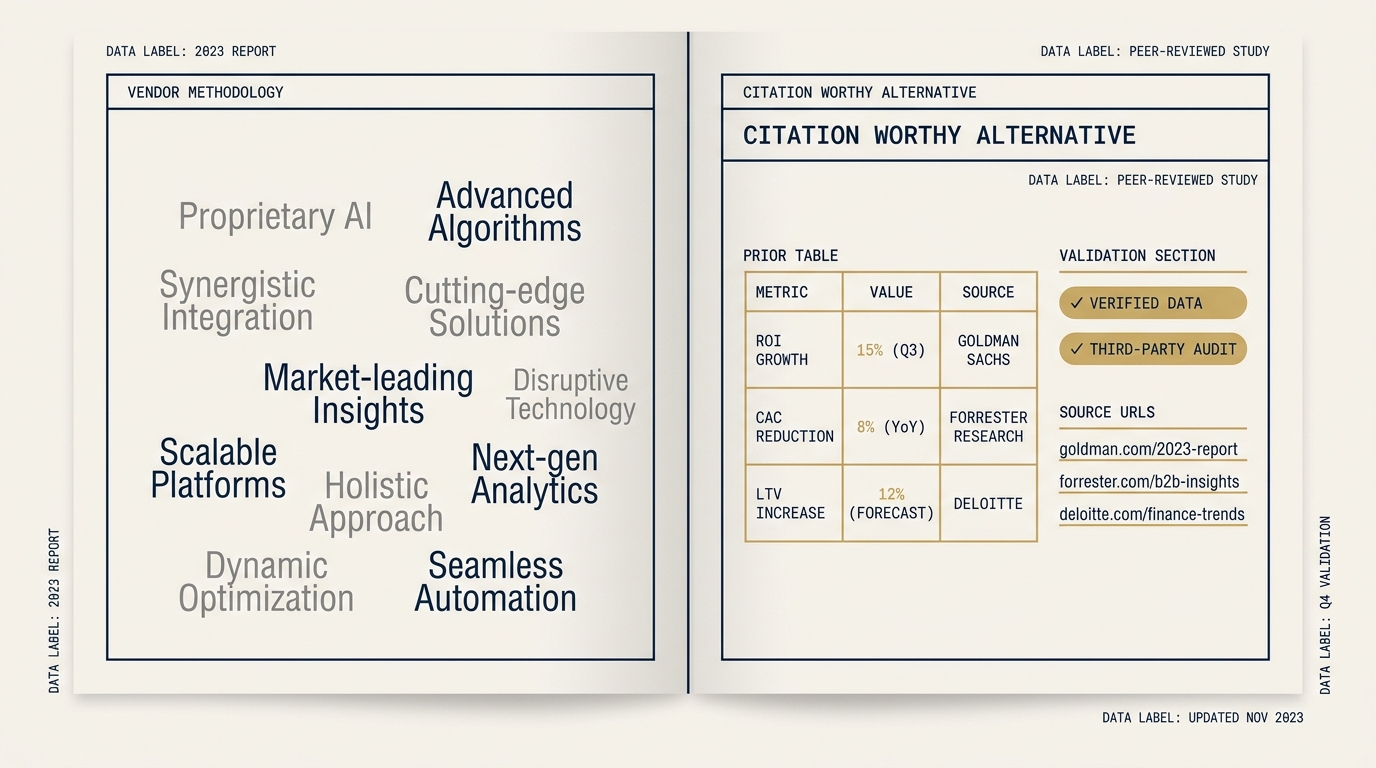
Inherited Citation Worthiness
When your firm’s content cites your MMM vendor’s methodology to substantiate a claim, you inherit your vendor’s citation worthiness. If the vendor’s methodology page is citation-worthy, your content’s citation chain is intact. If the vendor’s methodology page reads as marketing copy, your citation chain breaks at the first hop. AI engines that crawl the citation chain stop at the broken link.
Most enterprise MMM vendor methodology pages, audited against the AAO framework, fail. The patterns are predictable: no JSON-LD schema, no source citations for prior values, no version history, no validation methodology disclosure, language tuned for procurement rather than peer review. The pages exist as sales artifacts, not as citable evidence.
This post critiques the pattern, explains the structural failures, and offers two fixes that work: pressure the vendor to publish a citation-worthy methodology page, or publish your own (with attribution) that documents how you use the vendor’s tooling.
The Vendor Methodology Page Anti-pattern
Five characteristics of the typical 2026 enterprise MMM vendor methodology page:
-
Marketing language above technical detail. “Our proprietary AI-powered platform leverages advanced econometric modeling techniques.” Tells the Content gate nothing extractable. The crawler sees adjectives without claims.
-
No JSON-LD schema. The page renders as a paragraph in a content management system without TechArticle or ScholarlyArticle schema. The Structure gate fails by absence.
-
No source citations for prior values. The vendor claims “industry-leading priors based on extensive research” without naming the research. The Reputation gate cannot evaluate cross-source corroboration that does not exist.
-
No version history. The page is undated, or dated once at publication. AI engines treat undated methodology as stale. The Recency gate fails.
-
No validation methodology disclosure. The page describes “rigorous validation” without explaining what was validated, against what holdout, or what failure modes were tested. The Differentiation gate fails because the validation is generic.
Each failure compounds. A vendor methodology page that fails one gate may still serve sales. A page that fails all five is structurally invisible to AI engines.
Five Common Failure Patterns In Detail
The “proprietary algorithm” page. Says the algorithm is proprietary; offers no methodology detail. Justifies the opacity with competitive concerns. The AAO problem: an opaque methodology cannot be cited because nothing about it is extractable. Engines treat the page as marketing.
The white paper as PDF. The vendor links to a PDF instead of a web page. PDFs are crawlable but rank lower for citation because schema markup is harder to express. Most AI engines downweight PDF sources unless no web equivalent exists.
The methodology hidden behind a download form. Lead-gen form gates the methodology page. AI crawlers cannot fill the form. The methodology is invisible to citation extraction. The page exists for marketing analytics, not for evidence.
The methodology distributed across the marketing site. No single methodology page; instead, scattered claims across the homepage, the product page, the case studies, and the press releases. The crawler cannot reconstruct the methodology from the fragments. No coherent citation surface exists.
The methodology that contradicts itself across pages. The product page says one thing about validation; the white paper says another; the case study uses a third metric. Inconsistencies signal weakness to AI engines, which downrank inconsistent sources for citation reliability.
When You Cite The Vendor, You Inherit Their Gates
Your firm’s quarterly MMM digest reads: “Our analysis uses [Vendor Name]‘s Bayesian MMM methodology, with priors informed by their proprietary research.” You have just cited the vendor as your methodology authority. The AI engine reading your digest follows the citation. If the vendor’s methodology page passes AAO gates, your digest inherits the strength of the chain. If the vendor’s page fails, your digest’s chain breaks at the vendor.
A practical test: copy your vendor’s methodology page URL into Perplexity and ask Perplexity to characterize the vendor’s methodology. If Perplexity returns specific methodology details with quoted sources, the vendor page is citation-worthy. If Perplexity returns generic marketing summary or refuses to characterize, the page is not. Your downstream citations inherit the same constraint.
Two Fixes That Work
Fix one: pressure the vendor. Vendors care about citation visibility too. A request from a paying customer for a citation-worthy methodology page (with specific requirements: JSON-LD schema, prior source URLs, validation disclosure, version history) tends to get traction. The vendor improves their page; your downstream chain inherits the improvement. Specific request template that works:
“We are publishing quarterly MMM analyses on the open web and citing your methodology. To maintain citation chain integrity, we need your methodology page to (1) emit TechArticle JSON-LD schema, (2) list prior values with source URLs, (3) document validation approach and sensitivity, (4) maintain a version history. Is this on your near-term roadmap?”
The request frames the work as helping the vendor’s marketing rather than as a customer complaint. Most vendors will engage.
Fix two: publish your own methodology page (with attribution). Document how your firm uses the vendor’s tooling. The page is your firm’s, not the vendor’s, but it credits the vendor for the underlying methodology. Pattern:
“We use [Vendor Name]‘s Bayesian MMM platform for the model implementation. The priors used in our analysis are documented below; we selected the priors from public sources rather than relying on the vendor’s defaults. Validation follows our internal protocol described in [linked appendix].”
The page lives on your domain. Your firm gets credit for the documented application. The vendor relationship is preserved. The citation chain anchors on your page rather than the vendor’s, which is structurally better because you control the page’s AAO compliance directly.
Worked Example
A wealth management firm used a major MMM vendor (treated as anonymous here) for its quarterly analyses. The firm cited the vendor’s methodology in every quarterly digest. AI engines, asked about the firm’s measurement approach, returned vague summaries that mentioned the vendor but did not name the firm.
Diagnostic: the vendor’s methodology page was a marketing-language page hidden behind a lead-gen form. AI engines could not extract methodology details. The vendor was the named source in the firm’s digest, but the engines could not follow the citation chain to anything specific. The result: the vendor got visibility (sometimes); the firm got nothing.
Fix: the firm published a /methodology/mmm/ page on its own domain. The page documented its application of the vendor’s platform: the priors used (from public sources), the validation protocol, the model versioning. The page attributed the platform to the vendor but anchored the methodology to the firm. The firm’s quarterly digest started citing its own methodology page rather than the vendor’s.
Within five weeks, ChatGPT and Perplexity began citing the firm’s methodology page when asked about Bayesian MMM in wealth management. The vendor’s name appeared in some citations as the platform; the firm’s name appeared in all of them as the methodology authority. The shift was structural: ownership of the citation chain moved from the vendor to the firm.
Frequently Asked Questions
Should I name the vendor publicly in my methodology documentation?
Yes, when contractually permissible. Naming the vendor is fair, gives them appropriate credit, and lets the AI engine link the platform to the broader software category. The naming is not the problem; the dependent citation chain is.
What if my vendor refuses to improve their methodology page?
Pursue fix two. Publish your own methodology page that anchors the citation chain on your domain. The vendor’s reluctance is a constraint on the citation surface they control; it is not a constraint on the one you control.
Are there MMM vendors whose methodology pages already pass AAO gates?
A few, and the list shifts year to year. Audit the candidates against the five criteria above before selecting. The decision should weigh methodology page citation worthiness alongside the standard procurement criteria.
How does this argument apply to consultancies that build custom MMMs?
Same argument with different actors. A consultancy that builds a custom MMM and hands the firm a result deck without publishing methodology is the same anti-pattern as a SaaS vendor with marketing-copy methodology. The fix is the same: publish your own methodology page on your domain, attribute the consultancy, anchor the chain.
How does this relate to the Reputation gate?
Vendor methodology page citations are one type of cross-source corroboration. The Reputation gate scores composition. If the vendor citation is the only external source on your methodology page, the composition is weak. The methodology page should cite multiple sources, of which vendor methodology is one.
Next In Series
The next Thursday post is the synthesis: the AAO + MMM framework that integrates everything in the Thursday thread. It is the four-stage publication framework for measurement-grounded AI search authority and the natural conclusion of the AAO + MMM deep dive.
About the Author
Andrés Plashal
Author of the Assistive Agent Optimization (AAO) framework. Twenty years building search and measurement systems for B2B and SEC-regulated firms. Google Partner since 2017.
Credentials: UIUC Gies College of Business (Behavioral Science), Columbia College Chicago (Interactive Arts & Media). Member: American Marketing Association, GAABS, Paid Search Association. Published researcher (SCTE/NCTA).