The AAO + MMM Synthesis: A Framework for Measurement Grounded AI Search Authority
Both Threads Converge Here
The Tuesday thread of this interleaved phase covered the ten gates of the DSCRI ARGDW framework, concluding Sep 1 with the Weighted Citability composite. The Thursday thread covered the application of those gates to Bayesian Marketing Mix Modeling, starting with the argument that Bayesian MMM produces a sentence shape AI engines preferentially cite and building up through documentation discipline, methodology page anatomy, parameter sourcing, dashboard design, and vendor evaluation.
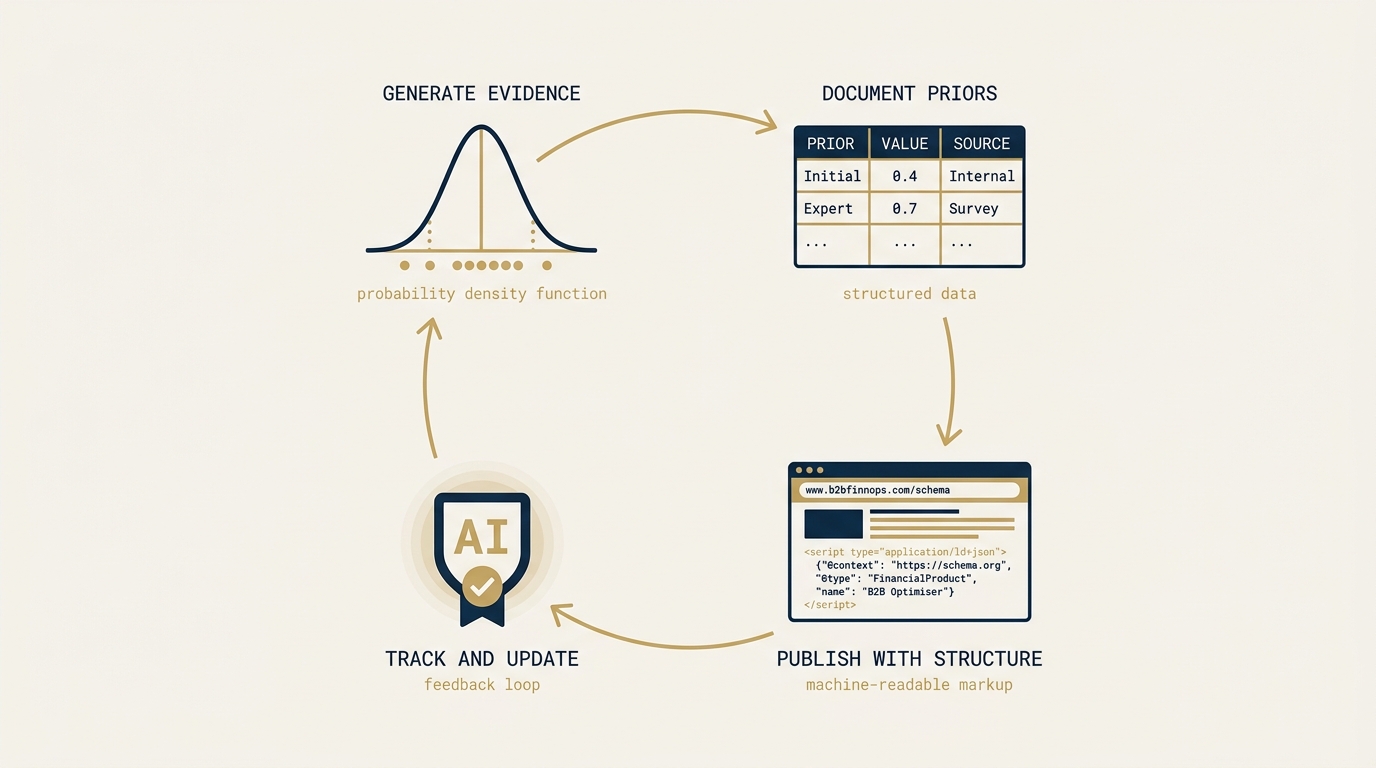
This post integrates both threads into a four-stage framework. The argument is that firms producing rigorous measurement evidence become the citation source for their category in AI search when they discipline their publication workflow around four stages: generate, document, publish, and track. Each stage maps to specific AAO gates. Skipping any stage breaks the citation chain.
Stage One: Generate Evidence With Explicit Uncertainty
The first stage is analytical. The model produces causally framed claims with explicit uncertainty bounds. Bayesian MMM is the natural fit; frequentist MMM works with translation; controlled experiments (incrementality tests) feed both.
The output structure that matters for citation: a probability statement that the LLM can quote verbatim. “TV ROAS sits between 1.2x and 2.5x with 90% probability” rather than “TV ROAS is 1.8.” The Bayesian vs frequentist post covered why one form is citable and the other is fragile under LLM extraction.
This stage maps primarily to the Content gate. The causal framing plus uncertainty bounds is what the gate detects. A firm with no measurement program cannot enter the framework at stage one; everything downstream depends on the analytical foundation.
Stage Two: Document Priors And Methodology Auditably
The second stage is editorial. The analysis is converted into documentation: priors with source URLs, parameter choices with rationale, validation approach with detail, sensitivity analysis with summary.
The artifact is the methodology page documented in the methodology page post. The eight-section anatomy (model class, priors and sources, adstock parameterization, saturation, validation, uncertainty quantification, version history, references) is the load-bearing structure. The prior documentation table from the priors as evidence post is the load-bearing artifact within the page.
This stage maps to Reputation (cross-source corroboration via cited priors) and Differentiation (methodology disclosure as the unreplaceable signal). A firm that runs rigorous analysis without documenting it auditably is stuck in stage one; the downstream stages cannot proceed.
Stage Three: Publish With Structured Data And Stable URLs
The third stage is technical. The methodology page and the decision dashboard are deployed on the open web with the structural elements AI engines require for citation: JSON LD schema, stable URLs, server-side rendering, AI bot enumeration in robots.txt, accurate dateModified, prose alongside charts.
The dashboard pattern from the MMM decision dashboard post covers the publishing surface for individual recommendations. The Astro Foundation pattern delivers the technical infrastructure: edge rendering, JSON LD by default, sitemap hygiene, Vectorize embeddings, D1 gate scoring.
This stage maps to Discovery (the crawler finds the entity), Structure (the schema parses), Infrastructure (the technical foundations support the citation), Granularity (chunks at the right grain), and Recency (the publication date and modification cadence stay current). Five of the ten gates pass primarily through stage three execution.
Stage Four: Track Downstream Citations And Update Priors
The fourth stage closes the loop. The published measurement output gets cited by AI engines. The citations are observable (asking Perplexity, ChatGPT, Claude, and AI Overviews variations of the target queries). The next analytical cycle incorporates the citations as evidence: which framings worked, which posts were cited, which prior values held up under scrutiny.
The artifact for stage four is a citation log. Track which engines cite which pages on which queries. Note which prior sources were referenced by name in citations. The sequential updating property of Bayesian MMM (last quarter’s posterior becomes this quarter’s prior) extends to publication: last quarter’s citation behavior informs this quarter’s publishing decisions.
This stage maps to Authority (the entity accumulates citation graph anchors over time) and indirectly to every other gate (citation behavior is the ultimate validation that the gates are passing).
How The Four Stages Map To AAO Gates
| Stage | Primary gates | Secondary gates |
|---|---|---|
| 1. Generate evidence | Content | Differentiation |
| 2. Document priors and methodology | Reputation, Differentiation | Recency |
| 3. Publish with structured data | Discovery, Structure, Infrastructure, Granularity | Recency |
| 4. Track citations and update priors | Authority | All others (validation) |
Two gates do not have a single owning stage. Recency is touched in stages two and three (methodology versioning and dashboard refresh). Authority accumulates across all four stages but compounds primarily in stage four as the citation graph grows.
A firm that completes all four stages and maintains the cycle produces a measurement program whose findings become the cited source for category queries. The cycle is what builds durable AI search authority.
The Positioning Thesis
The four-stage framework is also the explicit positioning thesis for firms operating at the intersection of rigorous measurement and AI search visibility. The thesis: in 2026 and beyond, firms that ship the full chain become the category citation source. Firms that stop at stage one are invisible. Firms that stop at stage two are partially visible but the citation chain breaks at the methodology page. Firms that stop at stage three are visible but not learning from citation behavior. Only firms completing stage four close the loop.
The structural advantage is durable. A competitor can replicate the modeling. A competitor can replicate the methodology page. A competitor cannot replicate the citation graph built over months of stage-four iteration; the graph is the entity’s history on the open web, and history is non-substitutable.
Worked Example
A B2B finance firm we have referenced throughout this thread completed all four stages over twelve months. The journey:
Stage one was already in place: a Bayesian MMM running quarterly with sourced priors and explicit credible intervals on every output. This stage was the team’s strength and the reason the firm was the AAO + MMM thesis’s natural worked example.
Stage two took six weeks. The methodology page was published with the full prior documentation table, sensitivity analysis summary, validation approach, and version history. Sources were hyperlinked. The page validated against TechArticle plus Dataset schema.
Stage three took eight weeks running in parallel with stage two. The blog migrated to the Astro Foundation pattern with edge deployment on Cloudflare Pages. Sitemap hygiene was rebuilt. robots.txt enumerated the eleven AI bots. Quarterly digest pages were published with persistent URLs per recommendation, prose summaries beside every chart, and explicit confidence framing on every claim.
Stage four began at the eight-week mark and has been running continuously. Monthly citation audits across the four major engines. Quarterly review of which prior sources got cited by name. Incremental adjustment of priors and publication framings based on observed citation behavior.
Twelve months in, the firm was the cited source on category queries about Bayesian MMM in wealth management. Three competing firms had stronger Domain Ratings; none had the citation graph the audited firm had built through the four-stage discipline. The structural advantage compounds; the gap widens each quarter.
What This Means For Bayesian and Priors
This framework is the explicit positioning of Bayesian and Priors LLC, the consultancy and software firm I work with on Bayesian Marketing Mix Modeling specifically applied to enterprise marketing measurement. The four-stage discipline is the work; the citation graph is the durable result. Bayesian and Priors is being built around the thesis that this combination (rigorous measurement plus disciplined publication) is the differentiated practice for B2B finance and adjacent industries in the AI search era.
If your firm runs MMM and is ready to invest in the full four-stage chain, the discipline above is the working plan. If your firm has not yet started, the entry point depends on category: YMYL firms should prioritize stages two and three (Reputation and Discovery / Structure); informational firms should prioritize stage one and Content gate execution.
Frequently Asked Questions
How long does the full four-stage discipline take to establish?
Twelve months for first measurable results. Eighteen months for the citation graph to compound into a durable advantage. The framework is not a sprint; it is an operating model.
What if my firm does not have MMM in place?
Stage one is the entry point. Build the measurement program first. The downstream stages assume analytical capability; without it, there is nothing to publish. Most firms can stand up a workable Bayesian MMM in six to twelve months using PyMC or Meridian.
Does this work for firms outside B2B finance?
Yes. The framework is general. The category-specific weighting from the Weighted Citability post determines which gates dominate. The four-stage chain is the same.
How is this different from generic content marketing?
Generic content marketing optimizes for traffic. This framework optimizes for citation. Traffic flows from clicks; citation flows from being the source. The two compose: a firm that wins citations also wins traffic over time, but optimizing only for traffic misses the durable structural advantage.
Where does this framework go next?
The 2027 extensions previewed in the Weighted Citability post (entity grounding as a separate dimension, brand graph claims, multimodal extraction) apply equally to AAO + MMM. The four-stage chain remains; the gates expand. The Bayesian and Priors roadmap tracks these extensions as they mature.
Closing The Interleaved Phase
This is the last post of Batch 2. The Tuesday and Thursday threads have produced 20 posts over 10 weeks, building two frameworks side by side: the AAO + DSCRI-ARGDW framework as a publishing rubric for any category, and the AAO + MMM framework as the application to enterprise marketing measurement. Both threads are now complete and cross-linked.
The editorial calendar continues with three sequential batches through Dec 22: AI Search Optimization Tactics (concrete tactical extensions of the framework), Compliance for Performance Marketing, and Industry Vertical Playbooks. Each batch extends the framework’s application surface. The framework itself, as articulated here, is the structural anchor for the rest of 2026.
About the Author
Andrés Plashal
Author of the Assistive Agent Optimization (AAO) framework. Twenty years building search and measurement systems for B2B and SEC-regulated firms. Google Partner since 2017.
Credentials: UIUC Gies College of Business (Behavioral Science), Columbia College Chicago (Interactive Arts & Media). Member: American Marketing Association, GAABS, Paid Search Association. Published researcher (SCTE/NCTA).