Performance Marketing for Fintech & B2B SaaS in 2026
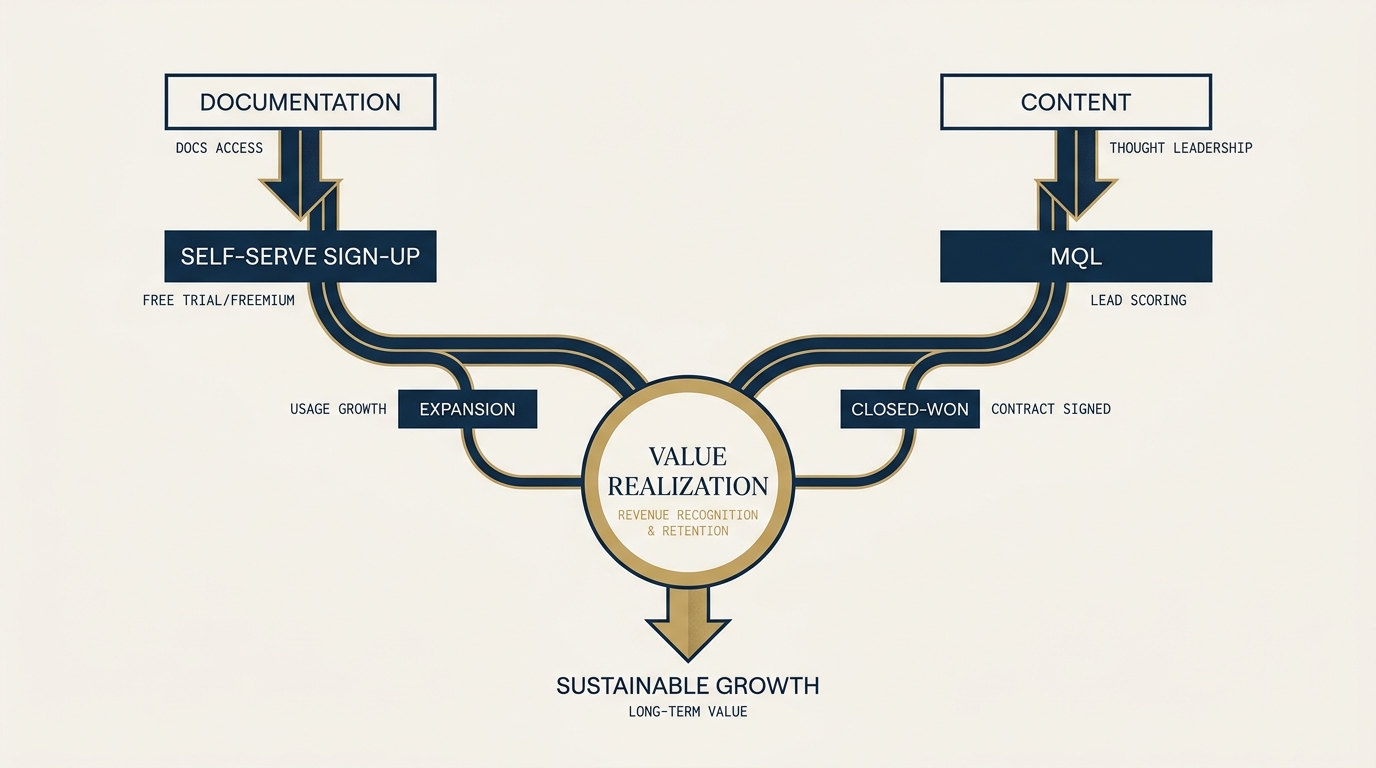
The Vertical Splits By GTM Model
Fintech and B2B SaaS firms in 2026 split by go-to-market model in ways that drive different performance marketing patterns. Product-led growth (PLG) firms acquire through self-serve sign-ups, expansion-driven revenue, and developer-facing content. Sales-led firms acquire through ABM, demand-gen content, and enterprise relationships. Many firms operate both models simultaneously, with distinct marketing functions for each.
The implication for performance marketing: the channel mix that works depends on which model the firm operates and at what stage. A pre-product-market-fit fintech with $5M ARR has a different mix than a $200M ARR enterprise-focused B2B SaaS firm.
This post covers the two GTM models, the channel mix that works for each, and the AI search dimension that increasingly matters across both.
Product-Led Growth: The Channel Mix
PLG firms drive acquisition through the product itself, with marketing’s role being to drive qualified self-serve sign-ups and support expansion within accounts.
What works:
- Developer-facing documentation as a marketing asset. API docs, integration guides, tutorials. Treated as marketing content; written with editorial discipline; AAO-optimized for search.
- Use-case content with specific tactical depth. “How to implement X with our API.” Each post is a search-targeted page that converts via in-product CTA.
- Community and forums as compounding channels. Stack Overflow presence, Reddit subreddits, dedicated community platforms. Long-tail traffic from technical questions.
- Free tier and trial conversion optimization. The product itself is the conversion funnel; performance marketing supports the funnel.
What does not work:
- Generic SaaS thought leadership without product specificity.
- Lead-gen content gated behind aggressive forms (developers do not fill them).
- Broad paid search on generic category terms.
The PLG channel mix invests heavily in compounding content channels (documentation, tutorials, community) and lightly in paid demand-gen. The expansion revenue compounds when retention is strong.
Sales-Led: The Channel Mix
Sales-led B2B SaaS firms target larger accounts with longer sales cycles and higher contract values. The channel mix shifts toward demand generation, ABM, and field marketing.
What works:
- Account-based marketing on LinkedIn. Targeted at specific accounts in ICP, with multi-touch sequences across LinkedIn, email, and direct outreach.
- Long-form thought leadership at the platform level. Frameworks, methodology, original research. AAO discipline applied so the content compounds.
- Industry events and partnerships. Conferences (SaaStr, Money 20/20 for fintech, sector-specific events) and partnerships with ecosystem players.
- Sales-enablement content. Buyer guides, ROI calculators, vendor comparison frameworks that sales teams use during the cycle.
What does not work for sales-led B2B SaaS:
- Volume-based paid search at the top of funnel (generates MQLs that do not convert at expected rates).
- Display advertising broadly targeted.
- Email blasts without specific persona targeting.
The AI Search Dimension
Both GTM models face an increasingly AI-search-mediated buyer journey. The buyer running “best [category] tools” through Perplexity or ChatGPT is increasingly common. The category-leading firms invest in AI search visibility through the AAO discipline covered in Batch 2.
Specific patterns for fintech and B2B SaaS:
- Category pages with explicit comparison. “X vs Y vs Z” content that AI engines extract as buyer-research material. The Granularity gate’s chunking pattern applies.
- Methodology and architecture pages. Documentation of how the product works, with substance the engines can cite.
- Customer outcome documentation. Case studies with the compliance-appropriate testimonial structure (covered in the testimonial post).
A fintech or B2B SaaS firm with strong AI search citation behavior receives meaningful inbound from prospects who would not have surfaced through traditional SEO.
Compliance Considerations For Fintech
Fintech firms face industry-specific compliance regimes that overlay performance marketing:
- Money transmitter and bank charter regulatory frameworks. State-by-state money transmitter rules affect marketing.
- BSA, AML, and KYC requirements. Marketing-to-onboarding workflows touch compliance frameworks.
- Consumer protection rules. CFPB and state attorney general enforcement on marketing claims for consumer-facing financial products.
The fintech compliance framework is industry-specific and overlays the standard marketing rules covered in Batch 4. Counsel review is the standard path.
Worked Example
A B2B fintech firm we worked with operated both PLG and sales-led motions. The PLG side served small-business customers through self-serve; the sales-led side served enterprise customers through field sales.
The 2024-2025 reorientation invested heavily in:
- Developer documentation as a marketing asset (PLG side). The docs became one of the firm’s top traffic sources.
- AAO-compliant thought leadership on enterprise-relevant topics (sales-led side). Long-form pieces on integration patterns, compliance frameworks, and category dynamics.
- LinkedIn ABM for top-300 enterprise accounts. Multi-touch sequences with persona-specific content.
The PLG and sales-led programs operated separately but shared editorial infrastructure (writing, design, AAO discipline). Twelve months later:
- PLG sign-ups increased measurably with stable conversion rates.
- Enterprise pipeline doubled with stable win rates.
- AI search citations on category queries produced meaningful enterprise inbound.
The firm did not change its product. The marketing function reorganized; the channel mix shifted; the AI search investment compounded.
Frequently Asked Questions
Can a single firm run both PLG and sales-led motions effectively?
Yes, with discipline. The two motions have different success metrics and different team structures. Firms that conflate them produce mediocre results in both; firms that separate them effectively produce strong results in each.
Does AAO matter as much for PLG firms?
Yes, increasingly. Developer-facing AI search behavior is real (developers ask ChatGPT for tool recommendations). The category-leading PLG firms in 2026 invest in AAO discipline; the laggards lose category position.
What about fintech firms regulated as broker-dealers?
The compliance overlay shifts to FINRA Rule 2210 (see the FINRA post). The marketing patterns are similar; the compliance posture is stricter.
How does this interact with the Industry Vertical Playbooks more broadly?
Fintech and B2B SaaS share more patterns with each other than with relationship-driven verticals like wealth management. The technology-driven sales motion produces different channel economics.
What is the right balance between paid and organic for a Series B fintech?
Most Series B fintechs underweight organic content investment because paid channels show faster initial results. The right balance over an 18-month horizon weights organic and AAO investment more heavily; the compound effect dominates.
Next In Series
The next post covers performance marketing for professional services firms (law and accounting), where partner-led origination dynamics produce different channel economics from technology-driven verticals.
About the Author
Andrés Plashal
Author of the Assistive Agent Optimization (AAO) framework. Twenty years building search and measurement systems for B2B and SEC-regulated firms. Google Partner since 2017.
Credentials: UIUC Gies College of Business (Behavioral Science), Columbia College Chicago (Interactive Arts & Media). Member: American Marketing Association, GAABS, Paid Search Association. Published researcher (SCTE/NCTA).