Performance Marketing for Wealth Management & RIAs in 2026: What Works, What Does Not, and Why
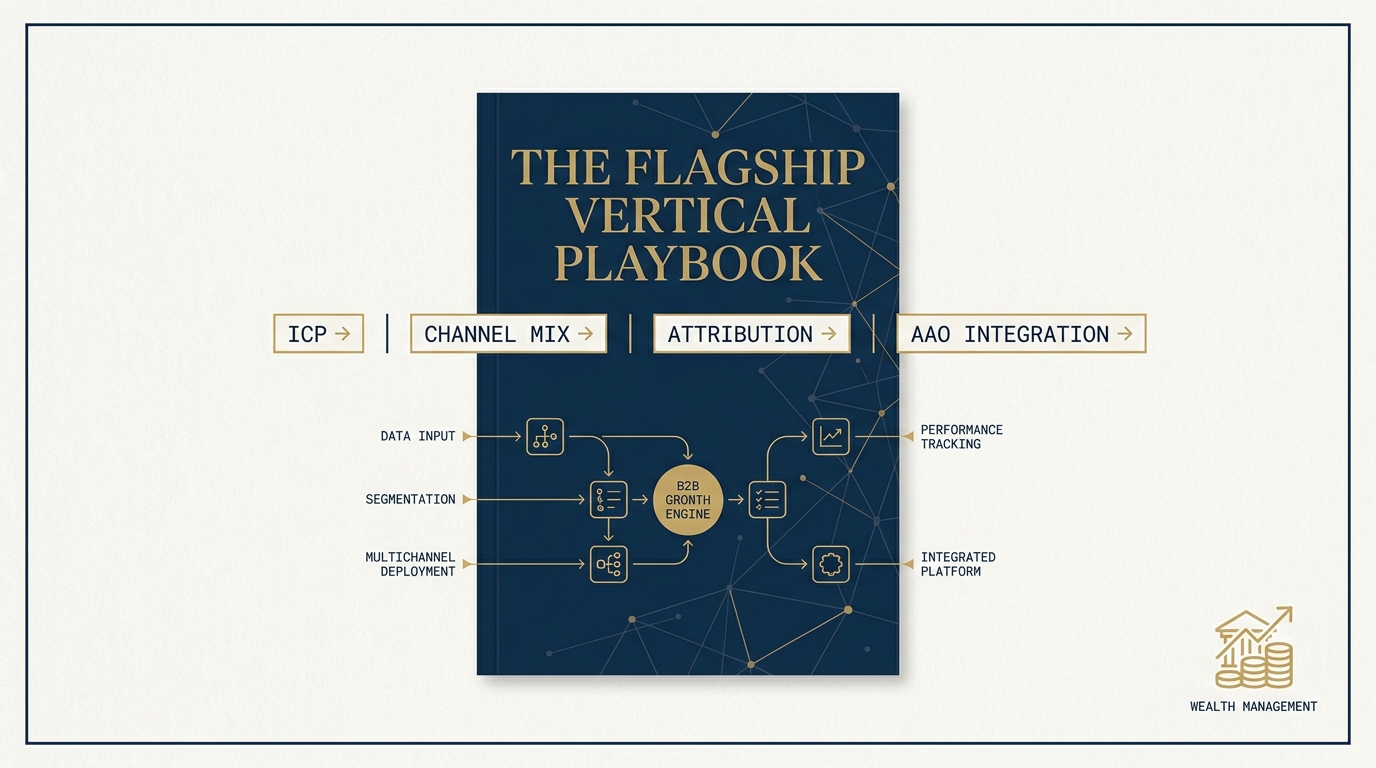
The Vertical Has Reorganized
Performance marketing for wealth management and RIAs in 2026 is not the same practice it was in 2023. Three forces reorganized the vertical between 2023 and 2026: the SEC Marketing Rule’s full implementation effect on paid channels (covered in the SEC Marketing Rule post), the rise of AI search as a discovery channel for HNW prospects, and the operational maturation of measurement (covered in the AAO + MMM thread).
This post is the first of ten vertical playbooks, each covering a specific industry’s performance marketing posture in 2026: what works, what does not, and why. The wealth management and RIA playbook leads because the vertical has been the most-studied site of these changes.
The ICP Has Sharpened
Wealth management ICP in 2026 is more specific than 2023. The category-leading firms have moved from “high net worth” (a too-broad bucket) to specific personas:
- Liquidity-event executives. Founders post-IPO or post-sale. Discrete, time-bound need. Acquisition cost is high; LTV is materially higher.
- Multi-generational family principals. Existing family wealth being repositioned across generations. Slower acquisition cycle; relationships compound over years.
- PE-backed firm operators. Executives at PE portfolio companies with concentrated equity. Sophisticated buyers who evaluate firms against specific criteria.
- Specialized professional groups. Physicians, attorneys, engineers in specific contexts. Tight peer networks; word-of-mouth still dominant.
A firm with a clear ICP within these four (or an adjacent specific persona) outperforms a firm with “wealth management for high net worth families” framing.
What Works In 2026
Five patterns I see consistently in firms producing measurable acquisition results:
-
Differentiated category positioning. A firm that takes a specific stance (“we serve PE-backed founders specifically”) outperforms a firm that serves “wealth management clients broadly.” The Differentiation gate post covered why this matters for AI search; the same dynamic applies for human prospects evaluating firms.
-
AAO-compliant thought leadership. Long-form content (1,500 to 3,000 words) on specific topics within the firm’s positioning, published with the AAO discipline covered in Batch 2 of this calendar. Citation behavior in AI search produces qualified prospects.
-
Paid social on LinkedIn for B2B-adjacent audiences. LinkedIn for PE-backed executives, professional groups, and B2B-leaning HNW segments. Programmatic LinkedIn rather than Meta or Google for these segments produces better-targeted reach.
-
Editorial relationships at tier 2 outlets. Wealthtender, Kitces, Citywire, Wealth Management Today. Named-byline pipeline at these outlets produces compounding authority (covered in the Authority Gate post).
-
Measurement discipline. Bayesian MMM with documented priors, sourced from public studies and internal incrementality tests, published with the discipline from the AAO + MMM thread. Most wealth management firms underweight measurement; the ones that do not have a structural advantage.
What Does Not Work In 2026
Five patterns that consistently underperform:
-
Generic SEO content. “Top 10 wealth management tips” content is structurally replaceable and rarely gets cited by AI search or shared by qualified prospects. The Content and Differentiation gates penalize this pattern.
-
Programmatic display advertising broadly targeted. Open-web programmatic against demographic targeting produces low-quality traffic and weak attribution. The category has not been a productive channel for wealth management firms for years.
-
Lead-gen content gated behind aggressive forms. A 30-page “wealth management guide” gated behind a 12-field form produces few leads of any quality. Modern HNW prospects do not fill the forms.
-
Aggressive paid search bidding on generic terms. “Wealth management” or “financial advisor” generic-term bidding is expensive and produces weak intent signals. Specific long-tail or branded queries perform better.
-
Webinars without specific topical depth. “Investing in 2026” generic webinar offers face low conversion. Specific topical depth (“tax planning for technology liquidity events”) performs materially better.
The Channel Mix That Works
A workable channel mix for a mid-sized RIA in 2026:
- 30 to 40% organic content + AI search optimization. Long-form thought leadership, with the AAO discipline. Produces high-quality inbound over 12 to 18 months.
- 20 to 30% paid social on LinkedIn. Targeted at specific personas, with the SEC Marketing Rule compliance discipline.
- 10 to 20% events and partnerships. Conferences, partnerships with CPAs and attorneys serving the same persona, co-marketing with non-competing firms.
- 10 to 15% referral programs. Structured client-referral programs with appropriate compensation disclosure (see the testimonial post).
- 5 to 10% direct outreach. Account-based outreach to specific firms or individuals within ICP, often by a partner-level person.
The mix varies by firm. The principle is the same: investment in compounding channels (organic content, AI search, editorial relationships) plus measured paid channels (LinkedIn, ABM) and away from broad-targeted demand-capture channels (display, generic paid search).
Worked Example
A specialist wealth management firm we worked with focused on serving PE-backed firm operators. The firm’s 2023 marketing spend was concentrated in paid search (40%), display (25%), and content marketing (35%). Acquisition cost was high; conversion rates from paid search were weak.
The 2024-2025 reorientation moved spend toward AAO-compliant content (50%), LinkedIn paid social targeted at PE-backed executives (25%), tier 2 editorial bylines (10%), and referral programs (15%). Display was eliminated; paid search was scoped to branded and PE-specific long-tail queries only.
Results over 18 months:
- Total acquisition cost down 38% per qualified client.
- AI search citations on category queries (Perplexity, ChatGPT, Claude) produced roughly 12% of inbound by mid-2026.
- LinkedIn ABM campaigns produced consistent flow of qualified meetings, with 4-6 month cycle from first touch to signed advisory agreement.
- Tier 2 editorial bylines compounded into one tier 1 opportunity (Forbes contributor approval) by year two.
The firm did not change its service or its principals. The channel mix changed; the measurement discipline changed; the AAO posture changed.
The Operational Sequence For New Firms
For a wealth management firm starting fresh in 2026:
Months 1-3: ICP definition, positioning statement, content calendar planning. Wikidata QID submission. AAO foundation work on the website (Discovery, Structure, Infrastructure gates).
Months 3-6: First batch of thought leadership content. Methodology pages for whichever services have quantifiable methodology. LinkedIn presence buildout. First paid LinkedIn test campaigns.
Months 6-12: Editorial relationships at tier 2 outlets. Continued content production. Bayesian MMM implementation if budget supports.
Months 12-24: Tier 1 byline pipeline. Industry award submissions. Continued AAO refinement. Measurement maturity (see the AAO + MMM synthesis).
The compound effect is visible by month 18 to 24. Earlier visibility is possible but inconsistent.
Frequently Asked Questions
Does this approach work for solo or boutique RIAs?
Yes, with proportional scope. A solo RIA can execute the AAO discipline and content pipeline at smaller scale; the channel mix shifts toward content and referrals because the paid-social ABM costs require more budget than a solo firm typically deploys.
What about firms primarily serving direct retail (not HNW)?
The principles apply with different channel weighting. Retail-direct firms face different ICP considerations and may use Meta and Google paid search more productively than HNW-focused firms. The compliance framework is the same.
How does this interact with the SEC Marketing Rule paid channels post?
The SEC Marketing Rule constraints apply throughout the channel mix. The post covers the specific compliance considerations for each channel. The vertical playbook here covers the strategic posture; the compliance post covers the operational rules.
What is the realistic timeline for AI search citation behavior to start producing inbound?
12 to 18 months for steady-state. Earlier signals (first AI citations) appear within 6 to 9 months for firms executing the AAO discipline well. The compound effect dominates the early signals.
How do I justify the budget shift away from paid search to leadership?
Measurement. A Bayesian MMM that decomposes channel performance, with proper attribution discipline, surfaces the underperformance of broad paid search and the compounding effect of organic and AI search investment. The measurement is the lever for the budget shift.
Next In Series
The next post covers performance marketing for private equity and venture capital firms, where the ICP and channel mix are similar in some respects to wealth management but differ in important ways around relationship-driven origination.
About the Author
Andrés Plashal
Author of the Assistive Agent Optimization (AAO) framework. Twenty years building search and measurement systems for B2B and SEC-regulated firms. Google Partner since 2017.
Credentials: UIUC Gies College of Business (Behavioral Science), Columbia College Chicago (Interactive Arts & Media). Member: American Marketing Association, GAABS, Paid Search Association. Published researcher (SCTE/NCTA).