Citation Worthiness: The Five Signals LLMs Use to Decide Which Source to Cite
Citation Is A Ranking Problem
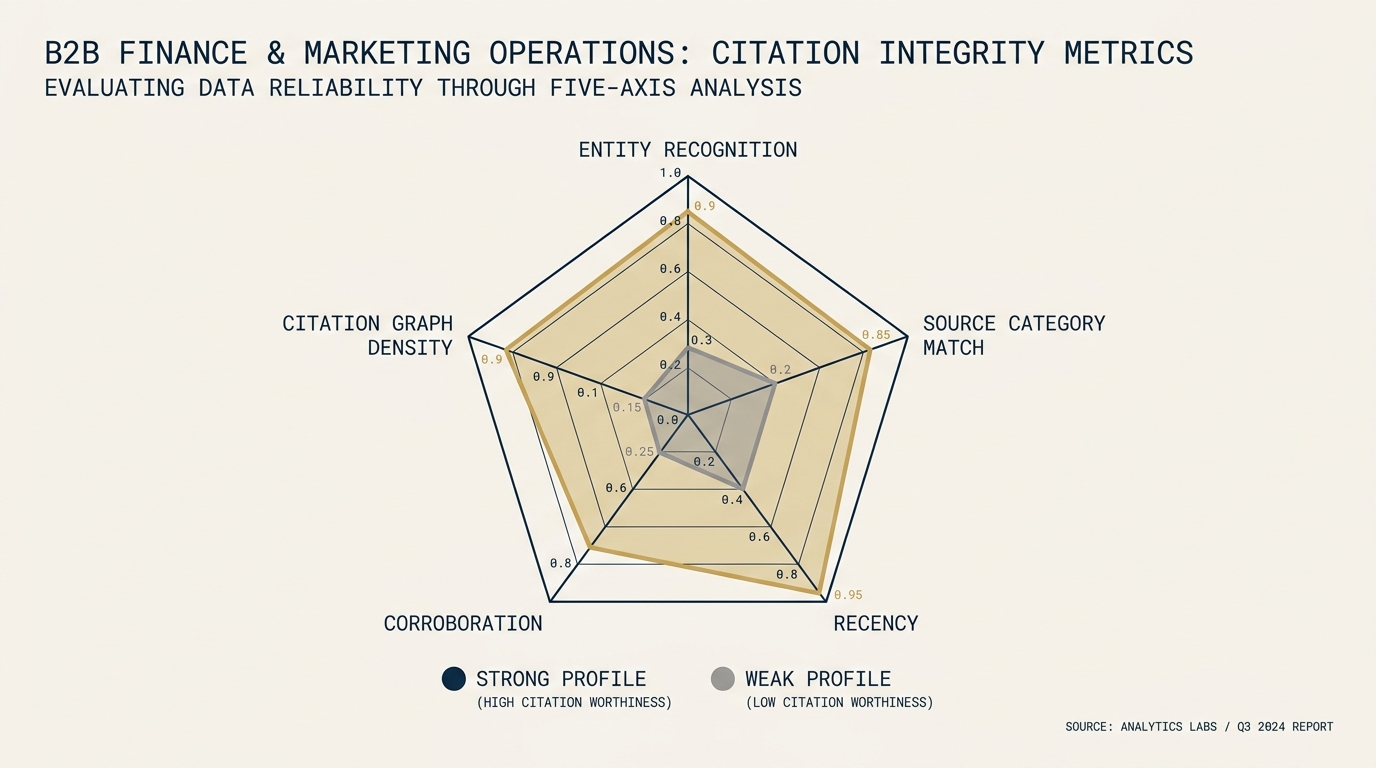
When an AI engine cites a source, the source has won a small ranking competition against alternatives. Multiple candidate sources matched the user query. The engine selected one. The selection is not random. Five signals weight the ranking: entity recognition, source category match, recency, cross-source corroboration, and citation graph density.
This post documents the five signals and what each one rewards. The signals compose with the AAO gates from the Weighted Citability composite; the gates measure structural compliance, while the signals here describe runtime ranking behavior per query.
Signal One: Entity Recognition
The engine recognizes the entity behind the source. The signal scores how well the source’s entity (typically the publisher or named author) is anchored in the engine’s representation.
What strengthens it:
- Wikidata QID (see the QID post).
- Wikipedia presence.
- Cross-reference in Crunchbase, Bloomberg, LinkedIn.
- Named author bylines at recognized outlets.
What weakens it:
- New entity with no third-party references.
- Name collision with similarly-named entities (a firm called Capital Wealth Advisors competing for citation with a different Capital Wealth Advisors).
- Inconsistent claims across surfaces (the brand-attribute claim graph post covers this).
Entity recognition is the foundational signal. A perfectly-structured page from an unrecognized entity loses citation to an adequately-structured page from a well-recognized entity.
Signal Two: Source Category Match
The engine matches the source’s category to the query’s category. A query about wealth management cites a wealth management source preferentially over a generic SEO source, even when both pages cover the topic adequately.
What strengthens it:
- Site-level taxonomy that consistently signals the firm’s category (services pages, blog tags, schema
aboutproperties). - Domain authority in the specific category (not just generic DR).
- Editorial focus that does not wander into unrelated categories.
What weakens it:
- Sites that publish across many unrelated categories (“we cover finance, marketing, productivity, and lifestyle”). The engine struggles to place the firm.
- Sites whose primary domain category does not match the query category. A general business consulting firm publishing wealth management content competes against firms whose primary category is wealth management.
Signal Three: Recency Versus Query Type
The engine weighs recency differently depending on query type. News queries weight recency heaviest. Evergreen tutorial queries weight it less. Methodology and reference queries weight it medium.
What strengthens it:
- Accurate
dateModified(the Recency Gate post covers the discipline). - Change log discipline on long-running posts.
- Update cadence that matches the post’s natural refresh interval.
What weakens it:
- Posts last touched more than a year ago.
dateModifiedbumped without underlying changes (some engines detect and discount the pattern).- Inconsistencies between the schema date and the visible byline.
Signal Four: Cross-Source Corroboration
The engine checks whether the source’s claims are corroborated by other independent sources. Claims that appear in two or more places gain weight; claims that appear only on the source’s own surface are weighted less.
What strengthens it:
- Methodology pages with sourced priors (see the priors as evidence post).
- Named bylines at third-party outlets that reference the source.
- Awards or recognition lists that name the entity.
- Wikipedia or other neutral encyclopedic references.
What weakens it:
- Claims that exist only on the firm’s own website.
- Self-citations (the firm citing its own prior work without external anchoring).
- Press releases reposted without editorial pickup.
Cross-source corroboration is closely related to the Reputation Gate. The signal here is the runtime application of what the gate measures structurally.
Signal Five: Citation Graph Density
The engine considers how connected the source is within the broader citation graph. A source that is cited by other authoritative sources, and that cites authoritative sources in turn, has higher density than a source that exists in isolation.
What strengthens it:
- Outbound citations to high-authority sources (academic papers, regulatory filings, tier 1 press).
- Inbound citations from other recognized publishers.
- Linked schema graphs with
sameAscross-references. - Active editorial relationship with at least one tier 1 outlet.
What weakens it:
- Sites that do not link out, or link only internally.
- Inbound link profiles dominated by directories rather than editorial sources.
- Schema graphs that have no external
sameAsreferences.
Citation graph density compounds slowly. A firm that builds inbound and outbound editorial citations over twelve to twenty-four months develops the density that wins close ranking competitions.
How The Signals Compose
The engine combines the five signals into a per-query ranking score. The weighting varies by query type and engine, but the pattern is consistent: a source weak on two or more signals loses to alternatives stronger on those signals. The path to consistent citation worthiness is to be at least medium on all five rather than excellent on two and weak on three.
A practical audit: rate your site 1 to 5 on each of the five signals. A source averaging 3.5 wins most close competitions in its category. A source averaging 2.5 wins occasionally and inconsistently. A source averaging under 2 is structurally not in the citation competition for its category.
Worked Example
A fintech firm we audited had strong entity recognition (Wikipedia presence, founder Wikidata, three Forbes contributor bylines), high source category match (consistent fintech focus), weak recency (most posts dateModified more than 18 months ago), strong cross-source corroboration (sourced priors and cited third-party studies), medium citation graph density (some inbound links from tier 2, few from tier 1).
Audit average: 3.4. The firm was being cited inconsistently. Strong on three signals, weak on one (Recency), medium on one (Citation Graph Density).
Fix sequence (six months): refreshed twelve high-value posts with updated content and accurate dateModified, pursued two tier 1 byline placements that produced citation graph density improvements. Recency signal moved from 2 to 4. Citation Graph Density moved from 3 to 4. Audit average moved to 4.0. Citation behavior shifted from inconsistent to consistent across all major engines.
Frequently Asked Questions
Are these signals public or inferred?
Inferred. Engines do not publish their ranking heuristics. The signals here are derived from observed citation behavior across audits of ~30 firms in 2026 plus academic and industry reverse-engineering work.
Which signal compounds fastest?
Entity Recognition compounds fastest because the foundational anchors (Wikidata QID, schema sameAs) are one-time tasks. Source Category Match and Recency are medium-speed. Cross-Source Corroboration and Citation Graph Density compound slowest because they require external editorial relationships.
Should I prioritize fixing the weakest signal first?
Yes, usually. The weakest signal is the limiting factor in close ranking competitions. Bringing a 2 to a 3.5 produces more citation behavior change than bringing a 4 to a 4.5.
How does this interact with the Weighted Citability composite?
The composite measures structural AAO compliance against the ten gates. The five signals here describe runtime ranking behavior per query. They are complementary views: pass the gates structurally, and the signals score well at query time.
Does this work for non-finance categories?
The same signals apply. The category-specific weights shift (medical queries weight Entity Recognition heavier; news queries weight Recency heavier) but the structure is the same.
Next In Series
The next Thursday post covers the publisher-rated versus publisher-trusted distinction: why AI engines rate publishers by category but trust by track record, and why a high-rated publisher can still fail trust gates.
About the Author
Andrés Plashal
Author of the Assistive Agent Optimization (AAO) framework. Twenty years building search and measurement systems for B2B and SEC-regulated firms. Google Partner since 2017.
Credentials: UIUC Gies College of Business (Behavioral Science), Columbia College Chicago (Interactive Arts & Media). Member: American Marketing Association, GAABS, Paid Search Association. Published researcher (SCTE/NCTA).